General Plant Health and Mineral Deficiencies
Pesticides and Garden Health
Pesticides can be useful tools. There. That’s the statement of the 20th Century.
However, we are in the 21st Century and we now understand that unnecessary pesticide use can affect:
- target pests
- beneficial insects
- predators
- soil organisms
- water
- wider ecosystems
The preferred approach is usually: prevention → monitoring → identification → targeted intervention (rather than spray everything.)
Integrated Pest Management
Integrated Pest Management, or IPM, considers:
- prevention
- monitoring
- identification
- biological control
- cultural control
- physical control
- chemical control where justified
Chemical control becomes one tool within a wider strategy rather than the automatic first response.

Garden Health and Mowing
Mowing is a good example of how management affects biodiversity.
A very short lawn:
- reduces flowering opportunities
- can reduce habitat
- may increase stress during drought
A less intensively managed lawn can provide:
- flowers
- insects
- seed
- shelter
However, formal lawns have legitimate uses. Therefore the answer is not, “Never mow!”
The answer is, “Mow according to purpose.”
Introduction to Observation
A healthy plant is more than a plant with green leaves.
Good plant health means that a plant is able to:
- grow normally
- produce healthy leaves and stems
- develop a strong root system
- flower or fruit appropriately
- resist or tolerate environmental stresses
- recover from minor damage
- complete its natural life cycle
A horticulturist needs to be able to recognise when something is wrong before deciding what treatment to use. Observe and record everything. The most important rule is: Diagnose before you treat.
A yellow leaf does not automatically mean that a plant needs fertiliser.
The problem could be:
- nutrient deficiency
- nutrient toxicity
- drought
- waterlogging
- poor drainage
- unsuitable pH
- root damage
- pests
- disease
- temperature
- frost
- excessive shade
- physical damage
- natural ageing
Signs of Plant Ill Health
Before feeding, inspect the whole plant.
Look for:
Leaves
- yellowing
- browning
- curling
- spots
- distortion
- premature leaf fall
Stems
- weak growth
- dieback
- lesions
- cracking
- unusual swelling
Roots
- poor rooting
- rotting
- discolouration
- lack of fine roots
Flowers
- poor flowering
- flower drop
- distorted flowers
Overall growth
- stunting
- wilting
- weak shoots
- poor vigour

Nutrient Deficiency or Something Else?
This is one of the most important skills in horticulture. A yellow leaf does not automatically mean, “The plant needs fertiliser.”
Yellowing can be caused by:
- nitrogen deficiency
- iron deficiency
- waterlogging
- drought
- root damage
- pests
- disease
- unsuitable pH
- natural ageing
The gardener must consider the whole situation.
Symptoms of Possible Nitrogen Deficiency
Possible signs include:
- general pale green colour
- yellowing of older leaves
- reduced growth
- smaller leaves
Nitrogen deficiency often affects older foliage first because nitrogen can be redistributed within the plant.
Symptoms of Possible Iron Deficiency
Iron deficiency can produce:
interveinal chlorosis
The newer leaves may become yellow while the veins remain relatively green.
This can occur where iron is unavailable because of soil conditions such as high pH.
Adding iron without correcting the underlying condition may not provide a lasting solution.
Nutrient Toxicity
More fertiliser can be harmful. Excessive fertiliser may cause:
- root damage
- leaf scorch
- poor growth
- salt accumulation
- nutrient imbalance
This is why following application rates is essential.
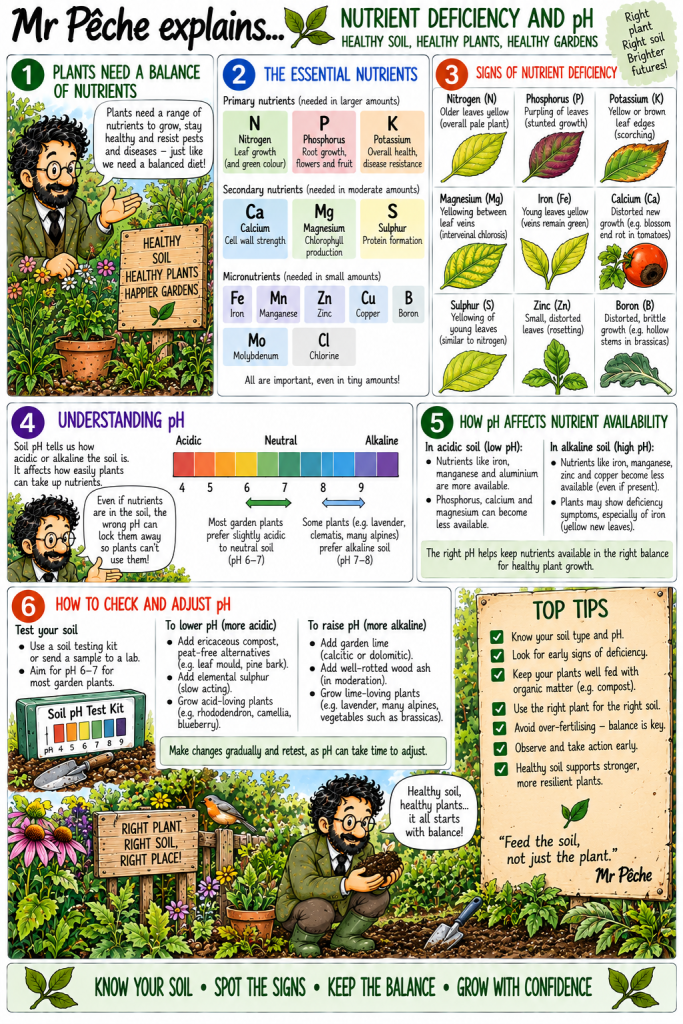
Soil pH and Nutrient Availability
Soil pH affects how available nutrients are to plants.
A nutrient may be present in the soil but unavailable to the plant.
This is called nutrient availability.
For example, high soil pH can reduce the availability of some micronutrients, including iron.
Therefore: Nutrient present ≠ nutrient available.
Feeding and Watering
Fertiliser should not be applied blindly to dry, stressed plants.
Where appropriate, ensure the growing medium has adequate moisture before applying fertiliser.
However, avoid waterlogging.
The objective is: adequate moisture + appropriate nutrients + healthy roots
Fertiliser and the Environment
Excess nutrients can leave the growing area through:
- surface runoff
- leaching
- drainage
Nutrients entering watercourses can contribute to eutrophication.
This can cause excessive algal and plant growth, followed by oxygen depletion as organic material decomposes.
Responsible horticulture therefore means:
Apply only what is required, where it is required, when it is required.

Fertiliser Application Safety (Do not mix products unless the manufacturer specifically permits it.)
Always:
- read the label
- follow application rates
- use appropriate PPE
- store fertiliser safely
- avoid contamination of water
- wash hands after use
- keep products in their original containers
- follow COSHH requirements where applicable
PPE
| Task | Potential hazard | Typical PPE / control |
| Handling granular fertiliser | Dust/contact | Gloves; avoid creating dust |
| Mixing liquid feed | Splash/contact | Gloves and eye protection where required |
| Applying fertiliser | Skin/eye contact | Gloves and suitable clothing |
| Using concentrated products | Chemical exposure | Follow label and COSHH assessment where applicable |
| Cleaning equipment | Residues | Gloves; appropriate hygiene |
| Storing fertiliser | Spills/contamination | Secure, dry and labelled storage |
PPE should be selected following the risk assessment and product instructions.
Practical Feeding Assessment
Choose a plant that appears unhealthy.
Observe
What can you see?
Leaves
Stems
Soil
Roots, if visible
Growing conditions
☐ Full sun
☐ Partial shade
☐ Shade
☐ Dry
☐ Moist
☐ Waterlogged
Possible cause
Is feeding appropriate?
YES / NO / NOT YET
Liquid Feed Practical
Plant: ______________________________
Fertiliser: ___________________________
NPK: ________________________________
Recommended dilution: ________________
Amount of water: _____________________
Amount of fertiliser: __________________
Application date: _____________________
What happened after feeding?
Was the plant healthier?
Solid Feed Practical
Plant/area: ___________________________
Fertiliser: ___________________________
Application rate: _____________________
Area treated: _________________________
Amount applied: _______________________
Application date: _____________________
Why was this fertiliser selected?
Student Questions
1. Why do plants require nutrients?
2. What does NPK stand for?
3. Give two functions of nitrogen.
4. Why might a container plant require more regular feeding than an established plant growing in the ground?
5. What is the difference between liquid and solid fertiliser?
6. Why should fertiliser not automatically be applied to a yellow plant?
7. Give three possible causes of yellow leaves that are not nutrient deficiency.
8. Why should plants not normally be fed while severely drought stressed?
9. Why can excessive fertiliser damage plants?
10. Why is soil pH important when considering plant nutrition?
11. Why is it important not to apply more fertiliser than recommended?
12. When are plants generally most likely to benefit from feeding?
The Professional Feeding Decision
Before feeding, ask:
1. Is the plant actually deficient in nutrients?
↓
2. Could something else be causing the symptoms?
↓
3. Is the plant actively growing?
↓
4. Is the soil adequately moist but not waterlogged?
↓
5. Is the soil pH suitable?
↓
6. Is feeding appropriate for this species?
↓
7. Which fertiliser is appropriate?
↓
8. Liquid or solid?
↓
9. What is the correct application rate?
↓
10. How will I monitor the result?
Remember
Fertiliser is plant food only in a very simplified sense. Plants manufacture their own food through photosynthesis. Fertilisers provide mineral nutrients required for healthy growth. The professional gardener therefore does not think:
“The plant looks ill – give it fertiliser.”
Instead, think:
“The plant looks ill – why?”
Only after identifying the likely cause should feeding be considered. Good plant nutrition is about balance. Too little can cause deficiency. Too much can cause toxicity and the wrong fertiliser, applied at the wrong time, can do more harm than good. The best horticulturist is therefore not the person who feeds the most. It is the person who knows, when to feed, what to feed, how much to feed, how to apply it, and when not to feed at all.
Key references
- Royal Horticultural Society (RHS), guidance on feeding plants, fertilisers, plant nutrition and soil management.
- Royal Horticultural Society (RHS), guidance on understanding soil pH and nutrient availability.
- Health and Safety Executive (HSE), guidance on Control of Substances Hazardous to Health (COSHH).
- Control of Substances Hazardous to Health Regulations 2002.
- Fertiliser Regulations 1991, as amended.
- Agriculture Act 1970, relevant provisions concerning fertilisers and agricultural products.
- Taiz, L. et al., Plant Physiology and Development.
Quick Mineral Deficiency Guide
| Nutrient | Possible symptoms | Where symptoms often appear |
| Nitrogen | General yellowing, weak growth | Older leaves |
| Phosphorus | Poor growth, dark/green-purple foliage in some plants | Older growth |
| Potassium | Marginal yellowing/scorching | Older leaves |
| Magnesium | Interveinal chlorosis | Older leaves |
| Sulphur | General chlorosis, poor growth | Younger growth |
| Calcium | Distorted young growth, tip damage | Young leaves/growing points |
| Iron | Interveinal chlorosis | Young leaves |
| Manganese | Interveinal chlorosis, spotting | Often younger leaves |
| Zinc | Small leaves, shortened internodes | Young growth |
| Copper | Tip dieback, distortion | Young growth |
| Boron | Distorted growing points, poor roots | Young growth |
| Molybdenum | Chlorosis, poor growth | Variable |
This table is a diagnostic aid, not a substitute for testing.
Mobile vs Immobile Nutrients
A useful Level 2 concept is:
Mobile nutrients
The plant can move them from older tissues to younger tissues. Examples include, nitrogen; phosphorus; potassium; magnesium
Deficiency often becomes visible first in older leaves.
Relatively immobile nutrients
They are not readily moved around the plant.
Examples include, calcium; boron; iron.
Deficiency symptoms often become visible first in younger growth.
This is one of the most useful patterns to remember.
Nutrient Deficiency vs pH
A plant may have enough of a nutrient in the soil but still show deficiency symptoms.
Why?
Because the nutrient may be unavailable.
Soil pH influences nutrient availability.
For example:
- high pH can reduce the availability of iron and some other micronutrients
- very low pH can affect the availability or toxicity of several elements
This is why soil testing can be useful.
Nutrient Deficiency vs Waterlogging
Waterlogged soil can cause root problems.
Roots require oxygen.
When soil pores remain filled with water:
oxygen availability falls
Root function can decline.
The plant may then show:
- yellow leaves
- poor growth
- wilting
- root death
This can look like nutrient deficiency.
Adding fertiliser to a waterlogged plant is unlikely to solve the underlying problem.
Nutrient Deficiency vs Drought
Drought-stressed plants may show:
- wilting
- curling
- browning
- premature leaf fall
- reduced growth
Do not automatically feed a drought-stressed plant.
First consider:
Does the plant have access to sufficient water?
Nutrient Deficiency vs Pests
Pests may cause:
- yellowing
- leaf distortion
- holes
- stippling
- leaf curling
- sticky honeydew
- premature leaf drop
Look carefully at:
- leaf undersides
- growing points
- stems
- buds
Use a hand lens where appropriate.
Nutrient Deficiency vs Disease
Diseases can cause:
- leaf spots
- lesions
- dieback
- wilting
- cankers
- distortion
- premature leaf fall
Look for patterns.
A nutrient deficiency may affect a large part of the plant relatively uniformly.
A disease may produce:
- discrete spots
- lesions
- patches
- progressive areas of damage
This is not an absolute rule, but it can be a useful clue.

Signs of General Plant Stress
Watch for:
☐ Yellowing
☐ Browning
☐ Wilting
☐ Leaf curling
☐ Leaf drop
☐ Stunted growth
☐ Poor flowering
☐ Poor fruiting
☐ Shoot dieback
☐ Distorted leaves
☐ Weak stems
☐ Root rot
☐ Excessive pest activity
☐ Unusual spots or lesions
The earlier a problem is identified, the greater the opportunity for effective intervention.
The Five-Question Diagnosis
When a plant looks unhealthy, ask:
1. What has changed?
Has the plant recently been:
- planted?
- pruned?
- moved?
- watered differently?
- fertilised?
2. Where is the damage?
- old leaves?
- young leaves?
- roots?
- stems?
- flowers?
3. What is the pattern?
Is it:
- uniform?
- patchy?
- spotted?
- along leaf margins?
- between veins?
4. What are the growing conditions?
Check:
- soil moisture
- drainage
- light
- temperature
- pH
- compaction
5. Are there pests or diseases?
Inspect carefully before assuming a nutritional problem.
When to Test the Soil
Soil testing may be appropriate where:
- symptoms persist
- several plants show similar problems
- nutrient deficiency is suspected
- pH may be unsuitable
- fertiliser programmes are being planned
Testing can provide evidence rather than relying entirely on visual diagnosis.
Why Overfeeding Can Be Dangerous
Applying nutrients without evidence can result in:
- toxicity
- salt accumulation
- nutrient imbalance
- root damage
- excessive soft growth
- environmental pollution
Some nutrients can interfere with the uptake of others.
For example:
Too much of one nutrient can contribute to an imbalance involving another.
Therefore:
Do not treat a plant deficiency you have not identified.
General Plant Health Management
Good plant health begins with prevention.
Provide:
Correct plant
Choose a plant suited to the site.
Correct soil
Consider:
- texture
- structure
- drainage
- pH
- fertility
Correct water
Avoid both drought and waterlogging.
Correct light
Match the plant to:
- sun
- partial shade
- shade
Correct nutrition
Feed only when appropriate.
Correct pruning
Use suitable pruning techniques and timing.
Good hygiene
Clean tools and remove diseased material appropriately.
Monitoring
Regularly inspect plants.
Seasonal Plant Health
| Season | What to look for |
| Spring | New growth, pests, frost damage, nutrient symptoms |
| Summer | Drought, heat stress, pests, diseases, water demand |
| Autumn | Natural leaf senescence, disease, nutrient redistribution |
| Winter | Frost damage, waterlogging, wind damage, dormant pests |
Remember:
Not every colour change is a disease or deficiency.
Autumn leaf colour and leaf fall are normal biological processes for deciduous plants.
Practical Plant Health Inspection
Choose one plant.
Plant name: ______________________________
Date: ___________________________________
Location: ________________________________
Season: __________________________________
Leaf condition
☐ Healthy
☐ Yellow
☐ Brown
☐ Spotted
☐ Distorted
☐ Curling
☐ Wilting
Stem condition
☐ Healthy
☐ Dieback
☐ Lesions
☐ Distortion
☐ Weak growth
Soil
☐ Dry
☐ Moist
☐ Waterlogged
☐ Compacted
Pests observed?
☐ Yes
☐ No
Disease symptoms observed?
☐ Yes
☐ No
Possible nutrient deficiency?
☐ Yes
☐ No
☐ Unsure
Diagnosis
What is the main symptom?
Where does it occur?
Is it mainly on old or young growth?
What other possible causes have you considered?
What evidence supports your diagnosis?
What action would you recommend?
Student Mineral Deficiency Challenge
Match the symptom to the most likely nutrient.
A
Older leaves become yellow throughout.
Possible nutrient:
B
Older leaves develop yellow tissue between green veins.
Possible nutrient:
C
Young leaves become yellow between green veins.
Possible nutrient:
D
Leaf margins become yellow and then brown.
Possible nutrient:
E
Young growing points become distorted or die back.
Possible nutrient:
Important Reminder
The answers above are possible diagnoses, not guaranteed diagnoses.
For example:
Interveinal chlorosis
could involve:
- magnesium
- iron
- manganese
depending on:
- plant species
- leaf age
- soil pH
- growing conditions
- other factors
A professional horticulturist uses symptoms as evidence, not as an automatic answer.
Practical Observation Exercise
Take two plants:
Plant A: apparently healthy
Plant B: showing signs of ill health
Compare them.
| Feature | Plant A | Plant B |
| Leaf colour | ||
| Leaf size | ||
| Leaf shape | ||
| Shoot growth | ||
| Flowering | ||
| Soil moisture | ||
| Pest evidence | ||
| Disease evidence | ||
| Overall condition |
What is different?
What might explain the difference?
Student Questions
1. What does chlorosis mean?
2. What does necrosis mean?
3. Why can yellow leaves have many different causes?
4. What is the difference between a mobile and relatively immobile nutrient?
5. Name four nutrients that are relatively mobile within plants.
6. Name three nutrients whose deficiency may first affect younger growth.
7. What is interveinal chlorosis?
8. Why is soil pH important for plant nutrition?
9. Why should a gardener inspect for pests before applying fertiliser?
10. Why can overfeeding be harmful?
The Professional Plant Health Checklist
Before treating an unhealthy plant:
LOOK
What symptoms can you see?
↓
LOCATE
Where are the symptoms?
↓
COMPARE
Is new or old growth affected?
↓
CHECK
Look at soil, roots, pests and diseases.
↓
CONSIDER
Water, light, temperature, pH and nutrition.
↓
TEST
Use soil or other appropriate tests where necessary.
↓
DIAGNOSE
Identify the most likely cause.
↓
TREAT
Use the least harmful effective intervention.
↓
MONITOR
Check whether the plant responds.
Remember
Healthy plants are not necessarily perfect plants.
A small amount of insect damage, an occasional blemish or natural seasonal change does not automatically mean that a plant requires treatment.
Good horticulture is about observation and balance.
When a plant looks unhealthy, resist the temptation to immediately:
feed it, spray it, prune it or water it.
First ask:
What is the plant telling me?
The leaves may be giving you clues about nutrients.
The roots may be telling you about waterlogging.
The soil may be telling you about pH or compaction.
The pattern of damage may indicate a pest or disease.
And the season may explain something that looks alarming but is actually completely normal.
The skilled horticulturist learns to read the plant before treating the plant.
Key references
- Royal Horticultural Society (RHS), guidance on plant health, plant nutrition, pests, diseases and disorders.
- Royal Horticultural Society (RHS), guidance on soil, pH and nutrient availability.
- Health and Safety Executive (HSE), guidance on safe use of horticultural products.
- Taiz, L. et al., Plant Physiology and Development.
- Marschner, P., Marschner’s Mineral Nutrition of Higher Plants.
- Mengel, K. and Kirkby, E.A., Principles of Plant Nutrition.
What Does a Healthy Plant Look Like?
A healthy plant will normally show characteristics appropriate to its species.
Look for:
Leaves
- appropriate colour
- good size
- normal shape
- firm texture
- no unexplained spots or lesions
Stems
- appropriate strength
- normal colour
- healthy growing points
- no unexplained dieback
Roots
Healthy roots are generally:
- well distributed
- firm
- actively growing
- appropriate in colour for the species
Rotting roots may be:
- dark
- soft
- unpleasant smelling
Flowers and fruit
Healthy plants should produce flowers and fruit appropriate to their:
- species
- age
- season
- growing conditions
The Plant Health Check
A simple plant-health inspection can follow this sequence:
LOOK
↓
TOUCH
↓
SMELL
↓
CHECK THE SOIL
↓
CHECK THE ROOTS IF APPROPRIATE
↓
LOOK FOR PESTS
↓
LOOK FOR DISEASE
↓
CONSIDER NUTRIENTS
↓
CONSIDER THE ENVIRONMENT
↓
DIAGNOSE

Start with the Whole Plant
Do not immediately focus on the damaged leaf.
Ask:
Where is the damage occurring?
Is it:
- old leaves?
- young leaves?
- growing points?
- stems?
- roots?
- flowers?
- fruit?
- the whole plant?
The position of symptoms can provide valuable clues.
Older Leaves or Younger Leaves?
This is one of the most useful clues when considering mineral deficiencies.
Some nutrients are mobile within the plant.
If they are in short supply, the plant can move them from older leaves to younger growing tissue.
Other nutrients are relatively immobile.
Deficiency symptoms therefore often appear first in young growth.
This gives us a useful diagnostic principle:
Older leaves affected first
Consider deficiencies of mobile nutrients such as:
- nitrogen
- phosphorus
- potassium
- magnesium
Younger leaves affected first
Consider deficiencies of relatively immobile nutrients such as:
- calcium
- iron
- boron
This is a useful guide rather than an absolute rule.

What is Chlorosis?
Chlorosis means a loss of green colour from plant tissue.
Leaves may become:
- pale green
- yellow
- yellow-white
Chlorosis can have many causes.
It may be associated with:
- nitrogen deficiency
- iron deficiency
- magnesium deficiency
- manganese deficiency
- waterlogging
- root damage
- unsuitable pH
- disease
Therefore:
Yellow leaves do not automatically mean nitrogen deficiency.

What is Necrosis?
Necrosis means the death of plant tissue.
It can appear as:
- brown patches
- dead leaf margins
- blackened tissue
- scorched areas
- dead shoots
Necrosis may be caused by:
- nutrient deficiency
- nutrient toxicity
- drought
- frost
- disease
- chemical damage
- root problems
Again, context is essential.
Macronutrients
Plants require relatively large quantities of certain mineral nutrients.
These include:
Nitrogen (N)
Phosphorus (P)
Potassium (K)
They also require:
Calcium (Ca)
Magnesium (Mg)
Sulphur (S)

Nitrogen Deficiency
Nitrogen is important for:
- leaf growth
- chlorophyll
- proteins
- vegetative growth
Possible symptoms
- pale green leaves
- general yellowing
- reduced growth
- small leaves
- weak shoots
The symptoms may begin with older leaves because nitrogen is mobile within the plant.
Memory tip
Nitrogen = New growth
Think:
N = New leaves and shoots
But remember that nitrogen deficiency is only one possible cause of pale foliage.
Excess Nitrogen
Too much nitrogen can also cause problems.
Possible effects include:
- excessive soft growth
- large, lush foliage
- reduced flowering
- weak stems
- increased susceptibility to some pests and diseases
- poor winter hardiness in some plants
The lesson is:
More is not always better.
Phosphorus Deficiency
Phosphorus is involved in:
- energy transfer
- root development
- reproductive development
Possible symptoms can include:
- poor growth
- poor root development
- darker green or purplish foliage in some plants
- delayed maturity
However, phosphorus deficiency is often difficult to diagnose visually.
Environmental factors and species differences can alter symptoms.
Important
Do not automatically add phosphorus simply because a plant is growing poorly.
Potassium Deficiency
Potassium has an important role in:
- water regulation
- enzyme activity
- metabolism
- plant strength
Possible symptoms include:
- yellowing around leaf margins
- brown or scorched margins
- weak growth
- poor quality or reduced yield in crops
Symptoms may develop first on older leaves.
Memory tip
Potassium = edges
Think:
K deficiency → leaf edges may show damage.
Magnesium Deficiency
Magnesium is an important component of chlorophyll.
A common symptom is:
interveinal chlorosis
This means:
the tissue between the veins becomes yellow while the veins remain greener.
It often appears first on older leaves because magnesium is mobile.
Memory tip
Magnesium = Middle of the leaf
Look between the veins.
Sulphur Deficiency
Sulphur is required for:
- amino acids
- proteins
- enzymes
Deficiency can result in:
- pale or yellow foliage
- reduced growth
Unlike nitrogen deficiency, sulphur deficiency may appear more strongly in younger growth.
This distinction can help with diagnosis.
Calcium Deficiency
Calcium is important for:
- cell walls
- cell membranes
- root growth
- growing points
Because calcium is relatively immobile, symptoms can appear in:
- young leaves
- shoot tips
- root tips
Possible symptoms include:
- distorted young leaves
- damaged growing points
- poor root growth
- tip dieback
Important
Calcium problems can be related to water movement, not simply the total amount of calcium in the soil.
Micronutrients
Plants also require nutrients in much smaller quantities.
These include:
- iron
- manganese
- zinc
- copper
- boron
- molybdenum
- chlorine
- nickel
Small requirement does not mean small importance.
Iron Deficiency
Iron is important for chlorophyll formation and other plant processes.
A classic symptom is:
interveinal chlorosis of young leaves
The veins may remain green while the tissue between them becomes yellow.
It is particularly common where soil or growing-medium conditions make iron less available.
For example, high pH can reduce iron availability.
Memory tip
Iron = young leaves go pale
Manganese Deficiency
Manganese is involved in:
- photosynthesis
- enzyme activity
Possible symptoms include:
- interveinal chlorosis
- small necrotic spots
- reduced growth
Symptoms can resemble other deficiencies.
Do not diagnose manganese deficiency simply from leaf colour.
Zinc Deficiency
Zinc is involved in:
- enzyme activity
- growth regulation
- development
Possible symptoms include:
- small leaves
- shortened internodes
- distorted growth
- chlorosis
Plants may develop a compact or “rosetted” appearance.
Copper Deficiency
Copper is involved in:
- enzymes
- photosynthesis
- reproductive development
Possible symptoms can include:
- dieback of shoot tips
- distorted young leaves
- poor flowering
- weak growth
Copper deficiency is relatively uncommon in many garden situations.
Boron Deficiency
Boron is important for:
- cell wall development
- growing points
- reproductive development
Possible symptoms include:
- distorted young growth
- damaged growing points
- poor root development
- poor fruit or seed development
Boron is required in very small amounts.
This makes it particularly important not to apply it unnecessarily.
Too much boron can be toxic.
Molybdenum Deficiency
Molybdenum is required in very small amounts but is important in plant nitrogen metabolism.
Deficiency can cause:
- poor growth
- chlorosis
- leaf distortion
Symptoms vary between species.
Feeding Plants – Liquid and Solid Fertilisers
Introduction
Plants, like all living organisms, require a range of nutrients to grow successfully.
However, feeding a plant does not simply mean adding fertiliser whenever it looks unhealthy.
A plant may be struggling because of:
- lack of water
- waterlogging
- poor drainage
- unsuitable pH
- pests
- diseases
- root damage
- poor light
- temperature stress
- compacted soil
- nutrient deficiency
Adding fertiliser to an unhealthy plant without identifying the cause can sometimes make the situation worse.
The professional approach is:
Observe → Diagnose → Decide → Feed if necessary → Monitor
Why Do We Feed Plants?
Plants obtain most of their carbon from the atmosphere through photosynthesis.
They obtain water and mineral nutrients primarily through their roots.
Nutrients are required for processes including:
- photosynthesis
- cell division
- root development
- flowering
- fruit production
- enzyme activity
- healthy leaves and stems
Plants require nutrients in different quantities.
The major nutrients include:
Macronutrients
- Nitrogen (N)
- Phosphorus (P)
- Potassium (K)
Plants also require other macronutrients, including:
- calcium
- magnesium
- sulphur
Micronutrients
Required in smaller quantities, including:
- iron
- manganese
- boron
- copper
- zinc
- molybdenum
- chlorine
- nickel
Small quantity does not mean unimportant.
A deficiency of a micronutrient can still seriously affect plant growth.
What Does NPK Mean?
Fertiliser labels commonly display three numbers.
For example:
7–7–7
These represent the relative percentages of:
N – Nitrogen
P – Phosphate
K – Potash
They are not simply a score showing how “strong” the fertiliser is.
The numbers describe the nutrient content of the product.
Always read the manufacturer’s label.
Nitrogen (N)
Nitrogen is particularly important for:
- leaf growth
- shoot growth
- chlorophyll production
- overall vegetative development
A shortage can result in:
- pale leaves
- yellowing, particularly of older leaves
- weak growth
- reduced vigour
However, excessive nitrogen can also cause problems.
Too much nitrogen may produce:
- soft, lush growth
- excessive vegetative growth
- reduced flowering
- increased susceptibility to some pests and diseases
- poor overwintering in some plants
More nitrogen is therefore not automatically better.
Phosphorus (P)
Phosphorus is involved in:
- energy transfer
- root development
- reproductive growth
Severe phosphorus deficiency can affect growth and development.
However, phosphorus deficiency is often over-diagnosed.
In many garden soils, sufficient phosphorus is already present.
Adding more phosphorus without a demonstrated need is not necessarily beneficial.
Potassium (K)
Potassium is important in:
- water regulation
- enzyme activity
- plant metabolism
- general plant strength
Adequate potassium contributes to healthy plant functioning and can be particularly important in crops where quality and flowering or fruiting are important.
Deficiency symptoms can include:
- marginal leaf scorching
- yellowing
- weak growth
Again, symptoms can have several possible causes.
Secondary Nutrients
Plants also require:
Calcium
Important for:
- cell walls
- growing points
- root development
Magnesium
Important because it is a central component of chlorophyll.
Deficiency can cause interveinal chlorosis, where the tissue between the veins becomes pale while the veins remain greener.
Sulphur
Important in:
- proteins
- enzymes
- plant metabolism
Micronutrients
Plants require relatively small amounts of micronutrients.
Examples include:
- iron
- manganese
- zinc
- copper
- boron
- molybdenum
Deficiency symptoms can include:
- chlorosis
- distorted growth
- poor flowering
- dead growing points
- poor root development
However, diagnosing micronutrient deficiency from appearance alone can be difficult.
Feeding Is Not the Same as Watering
Fertiliser supplies nutrients. Water supplies water.
A plant can be well watered but nutrient deficient or well fed but drought stressed.
Giving fertiliser to a severely drought-stressed plant is not a substitute for supplying appropriate water.
Liquid Feed
Liquid fertilisers are dissolved in water before application.
They can be applied:
- around the root zone
- to growing media
- as a foliar feed where the product is specifically designed for this purpose
Liquid feeds are useful when nutrients need to be made available relatively quickly.
Advantages of Liquid Feed
Liquid feed can:
- provide nutrients quickly
- be accurately diluted
- be useful for container-grown plants
- be incorporated into irrigation systems where appropriate
- provide regular low-dose feeding
It is particularly useful where plants have limited access to nutrients, such as in containers.
Disadvantages of Liquid Feed
Liquid fertiliser can:
- be over-applied
- cause root damage if too concentrated
- be washed away
- require regular application
- create environmental problems if it reaches watercourses
The correct dilution is therefore essential.
More fertiliser does not mean faster or better growth.
Correct Application of Liquid Feed
Always:
- Read the label.
- Measure the correct amount.
- Dilute according to instructions.
- Apply evenly.
- Avoid unnecessary contact with foliage unless the product is intended for foliar use.
- Avoid contamination of watercourses.
- Clean equipment appropriately.
Do not guess the concentration.
Solid Fertilisers
Solid fertilisers are applied in a solid form.
They may be:
- granular
- pelleted
- powdered
- slow-release
- controlled-release
They can be applied to:
- soil
- beds
- borders
- lawns
- containers
The release rate depends on the type of fertiliser and environmental conditions.
Advantages of Solid Feed
Solid fertilisers can:
- provide nutrients over a longer period
- reduce the frequency of application
- be useful for beds and borders
- provide a steady nutrient supply where appropriate
Controlled-release fertilisers can be particularly useful in containers.
Disadvantages of Solid Feed
Problems can occur if fertiliser is:
- over-applied
- applied unevenly
- placed directly against stems
- applied to unsuitable soil
- applied during drought
- allowed to contaminate water
Excess fertiliser can cause salt injury and damage roots.
Liquid vs Solid Feed
| Liquid feed | Solid feed |
| Mixed with water | Applied as a solid |
| Nutrients can become available quickly | Release may be slower |
| Useful for containers | Useful for beds and borders |
| Requires accurate dilution | Requires accurate application rate |
| Can be applied regularly | May require fewer applications |
| Easy to over-concentrate | Easy to over-apply |
| Useful during active growth | Often useful as part of planned feeding |
Neither is automatically better.
The choice depends on:
- plant
- soil
- growing system
- season
- nutrient requirement
- fertiliser formulation
Organic Matter vs Fertiliser
Compost, well-rotted manure and other organic materials can improve soil condition and contribute nutrients.
They can also improve:
- soil structure
- water-holding capacity
- biological activity
- nutrient retention
However:
Organic matter is not simply another name for fertiliser.
Its nutrient content can vary considerably.
Healthy soil management is generally about more than applying fertiliser.
Feeding Plants in the Ground
Established plants growing in good soil may require little additional fertiliser.
Before feeding, consider:
- soil fertility
- plant species
- growth rate
- previous fertiliser applications
- soil pH
- organic matter
- weather
- plant health
A mature shrub in fertile soil does not necessarily need feeding simply because the calendar says it is spring.
Feeding Container Plants
Container plants are different.
The growing medium has a limited volume.
Nutrients can be:
- used by the plant
- leached away by watering
- depleted over time
Consequently, container plants often benefit from a planned feeding programme during active growth.
This is particularly important for:
- bedding plants
- fruit in containers
- vegetables
- flowering plants
- long-term container specimens
When Should Plants Be Fed?
Many plants are best fed during periods of active growth.
This generally means:
Spring → summer
The exact timing depends on:
- species
- climate
- growing conditions
- soil
- fertiliser type
Some plants have specific feeding requirements.
Always follow the requirements of the individual plant and fertiliser manufacturer.
Spring Feeding
Spring is often an important feeding period because many plants are beginning active growth.
Feeding may support:
- new shoots
- leaves
- roots
- flowering
- fruit development
However, do not automatically fertilise every plant in spring.
Assess the plant first.
Summer Feeding
Plants can continue active growth during summer.
Container-grown plants may require regular feeding because nutrients can be depleted.
However, feeding during very hot or dry conditions should be approached carefully.
Deal with drought stress first.
Autumn Feeding
Autumn feeding depends on the plant and fertiliser.
A balanced approach is important.
Avoid encouraging excessive soft growth late in the season where this could reduce winter hardiness.
Some plants benefit from autumn applications formulated for particular purposes, but this is not a reason to apply fertiliser indiscriminately.
Winter Feeding
Most outdoor plants have reduced growth during winter.
Routine feeding is generally unnecessary for dormant plants.
Applying fertiliser when the plant cannot make effective use of it can result in:
- nutrient loss
- environmental pollution
- unnecessary expenditure
When NOT to Feed
Do not automatically feed a plant when it is:
Severely drought stressed
Water appropriately first.
Waterlogged
Investigate drainage and root health.
Recently transplanted
The priority may be root establishment and appropriate watering rather than immediate fertilisation.
Dormant
Many dormant plants have little need for additional nutrients.
Diseased
Identify and manage the disease rather than assuming nutrients are the answer.
Suffering from root damage
Fertiliser will not repair damaged roots.
Growing in very hot conditions
Avoid unnecessary stress and follow product instructions.
Feeding Newly Planted Plants
Newly planted plants should normally be given the opportunity to establish their roots.
Good planting practice includes, suitable soil preparation; correct planting depth; adequate watering; appropriate mulching; protection from competition.
Feeding requirements depend on the plant and soil. More fertiliser does not necessarily mean faster establishment.
