Gardens of The Weald
The Weald, extending across parts of Kent, Sussex and Surrey, contains a varied landscape of sandstone ridges, clay vales, ancient woodland, heathland and farmland. Although often associated with woodland and the Wealden Greensand, the region also supports areas of acid grassland. These habitats develop on nutrient-poor, acidic soils, often over sandstone or other silica-rich geological deposits.
Acid grassland provides an important contrast to the chalk grasslands of the North and South Downs. Its characteristic vegetation supports specialised plants, insects and fungi, making it valuable for both conservation and wildlife-friendly garden design.
Soils and ecological characteristics
Acid grassland typically has a low soil pH, commonly below 5.5, although conditions vary according to geology and local drainage. The soil may be sandy, free-draining and low in nutrients. These conditions favour plants adapted to limited nutrient availability rather than species that require fertile soil.
Characteristic plants can include sheep’s fescue (Festuca ovina), common bent (Agrostis capillaris), sheep’s sorrel (Rumex acetosella), tormentil (Potentilla erecta) and heath bedstraw (Galium saxatile). Depending on the site, mosses, lichens and small flowering plants may contribute significantly to the habitat.
Acid grassland can support butterflies, solitary bees, grasshoppers and other invertebrates. Its ecological value depends on the combination of plant diversity, open ground and suitable management.

Designing an acid grassland garden
A garden inspired by Wealden acid grassland should work with the existing soil rather than attempting to make it fertile or neutral. Suitable areas can be developed into naturalistic planting schemes using fine grasses, small perennials and locally appropriate native species.
Plant selection should reflect the site’s moisture, shade and exposure. Sandy, sunny areas may suit drought-tolerant species, while damper or partially shaded locations require different choices. Plants associated with acid grassland should not automatically be treated as suitable for every acidic garden soil.
Avoid excessive fertiliser, lime and rich compost in areas intended to support acid grassland species. Increased fertility can encourage vigorous grasses and weeds that outcompete smaller wildflowers. A soil test can help establish whether the site is genuinely acidic and guide appropriate planting.
Management and conservation
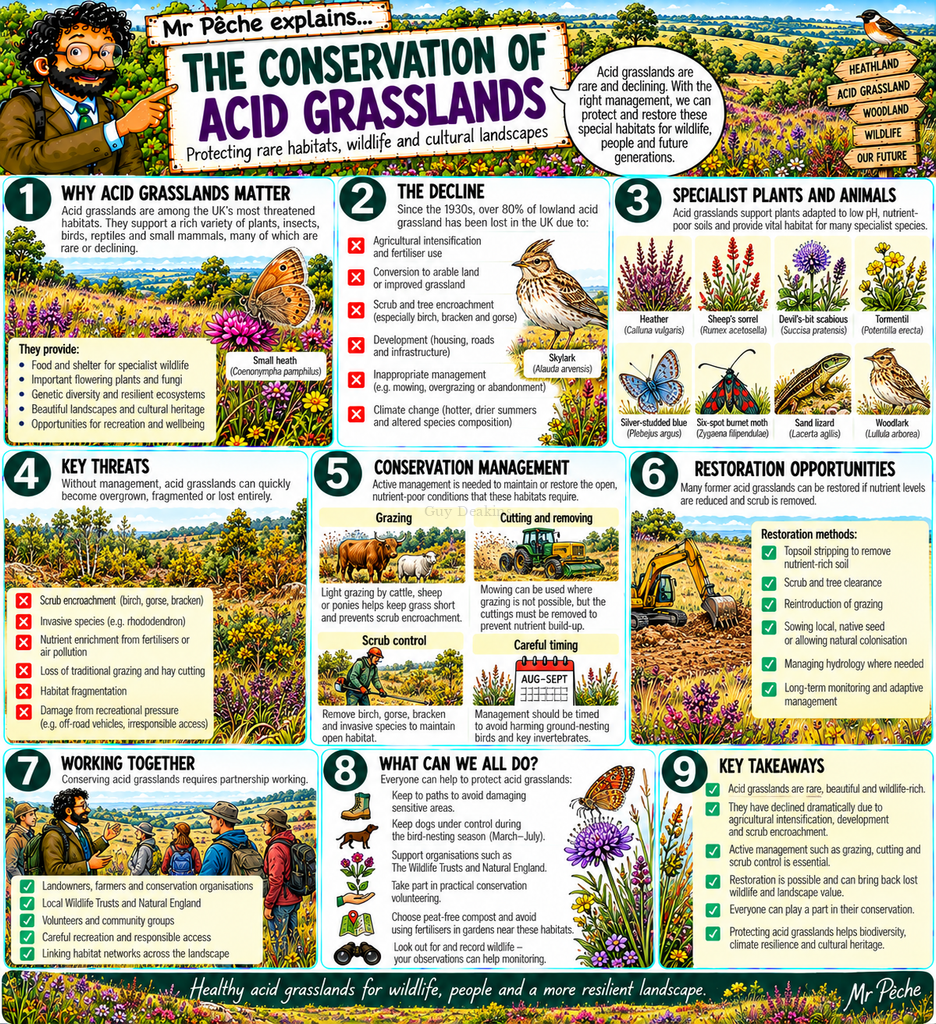
Traditional acid grassland management often involves grazing or periodic cutting to prevent scrub and dominant vegetation from taking over. In a garden, selective mowing can maintain an open sward. Cuttings should generally be removed after mowing to reduce nutrient accumulation, while some areas can be left longer to provide shelter and seed sources for wildlife.
Small patches of bare ground may benefit certain invertebrates and allow plants to regenerate. However, disturbance should be limited where erosion or damage to sensitive habitats is a concern. Where existing acid grassland survives, protecting it is usually preferable to recreating it elsewhere.
Conclusion
The acid grasslands of The Weald demonstrate the importance of geology and soil chemistry in shaping regional plant communities. By retaining low soil fertility, choosing suitable plants and managing vegetation carefully, gardeners can create naturalistic spaces that reflect the character of the Wealden landscape and contribute to local biodiversity.
Key learning points
- Acid grassland develops on acidic, generally nutrient-poor soils.
- Soil conditions influence which grasses, wildflowers and wildlife can thrive.
- Excessive fertiliser, lime and compost may damage acid grassland character.
- Appropriate mowing or grazing helps maintain open vegetation.
- Protecting existing habitat is often more valuable than attempting to recreate it.
References
British Geological Survey (n.d.) Geology of Britain. Available at: https://www.bgs.ac.uk/
Natural England (n.d.) National character areas: The Weald. Available at: https://www.gov.uk/government/publications/national-character-area-profiles-data-for-local-decision-making
Plantlife (n.d.) Grassland habitats. Available at: https://www.plantlife.org.uk/
The Wildlife Trusts (n.d.) Grassland habitats. Available at: https://www.wildlifetrusts.org/
Accessed: 18 October 2026.