
A garden is not a uniform growing space. Even within a relatively small garden, conditions can vary considerably from one area to another. Light levels, temperature, soil moisture, wind exposure, soil type, drainage, air movement and the presence of other organisms all influence the plants that can successfully grow.
For the horticulturist, understanding these differences is fundamental to good plant selection and garden management.
A useful way of thinking about a garden is as a collection of microclimates and habitats rather than as one continuous area.
A plant growing against a south-facing wall may experience very different conditions from a plant growing beneath a mature tree. A lawn in an exposed position will have different environmental conditions from a lawn surrounded by shrubs. A damp, poorly ventilated corner may provide very different conditions for plant pathogens from an open, windy border.
The garden therefore needs to be understood spatially.
Before selecting plants, designing borders or diagnosing problems, it is important to ask:
What is happening in this particular part of the garden?
1. Understanding the Garden as a Series of Areas
Garden conditions are determined by the interaction of several factors.
These include:
- sunlight;
- shade;
- temperature;
- wind;
- rainfall;
- soil moisture;
- drainage;
- soil structure;
- soil pH;
- soil fertility;
- organic matter;
- air movement;
- surrounding vegetation;
- walls and buildings;
- trees and hedges; and
- human activity.
These factors rarely occur independently.
For example, a wall may provide shelter from wind while also reflecting heat and light. A mature tree may provide shade while simultaneously competing with neighbouring plants for water. A hedge may reduce wind speed but create an area of reduced air movement immediately behind it.
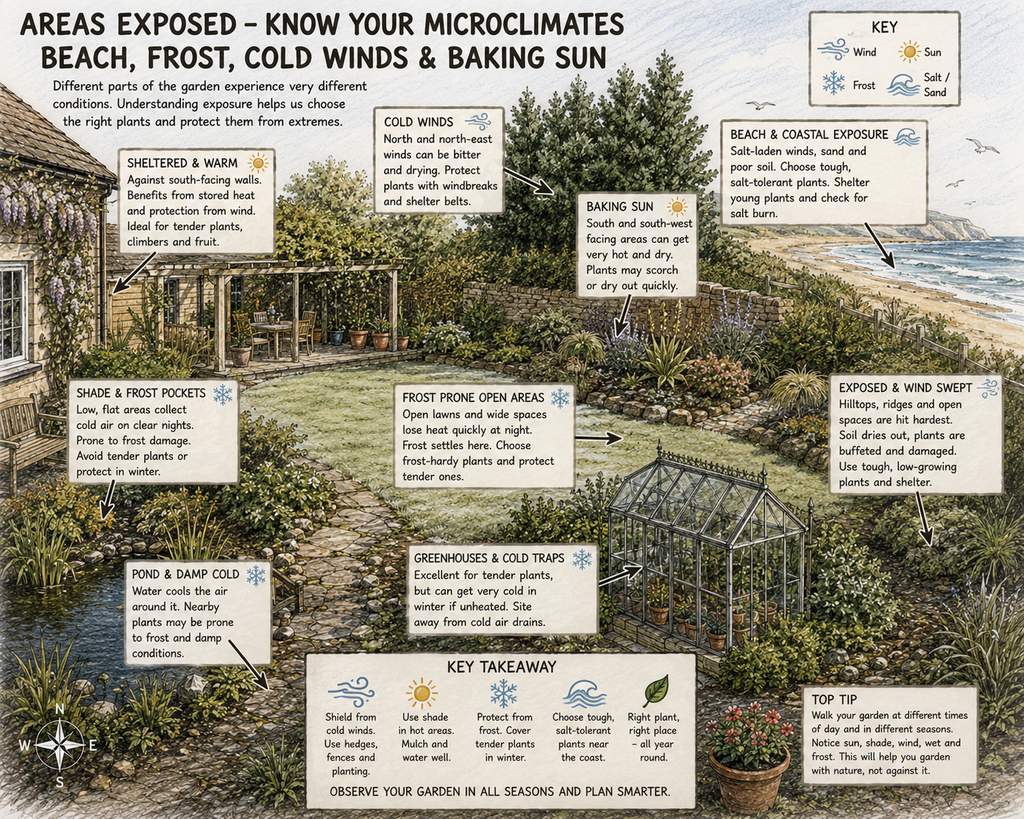
This means that the physical structure of a garden creates a series of microclimates.

2. Full-Sun Areas

Full-sun areas receive substantial direct sunlight during the day.
The exact definition of “full sun” varies between horticultural sources and geographical locations, but it generally refers to areas receiving several hours of direct sunlight, particularly during the main growing season.
Full-sun locations can provide excellent conditions for plants requiring high light levels.
Many plants adapted to sunny conditions have characteristics that help them cope with high levels of radiation and water loss. These may include:
- relatively small leaves;
- waxy leaf surfaces;
- hairs on leaves or stems;
- thickened leaves;
- aromatic oils;
- deep or extensive root systems; and
- adaptations for conserving water.
Examples of plants commonly associated with sunny conditions include lavender, rosemary, thyme, many ornamental grasses, sun-loving perennials and a wide range of annual bedding plants.
However, a sunny position is not necessarily a dry position.
A heavy clay soil in full sun may remain wet for considerable periods, while a sandy soil in the same amount of sunlight may dry rapidly.
Therefore:
light level ≠ soil moisture
Both need to be assessed separately.
3. The Hot, Dry Area
Some of the warmest areas of a garden occur beside walls, fences, paving and buildings.
Hard surfaces absorb solar radiation and can subsequently release heat.
A south- or west-facing wall can create a particularly warm microclimate, especially where it is protected from prevailing winds.
Such locations may be suitable for plants requiring warmth, but they can also produce significant water stress.
Plants growing beside walls may experience:
- high temperatures;
- reflected sunlight;
- rapid evaporation;
- reduced rainfall;
- restricted root space; and
- heat reflected from masonry or paving.
These conditions can be particularly important during periods of hot weather.
A plant that normally performs well in full sun may experience excessive heat or drought stress when planted immediately against a warm wall.
4. Shade
Shade is not simply the absence of sunlight.
There are different types and degrees of shade, and they can produce significantly different growing conditions.
Shade may be created by:
- trees;
- buildings;
- walls;
- fences;
- hedges;
- structures;
- neighbouring plants; or
- the orientation of the garden.
The duration and intensity of shade are particularly important.
A plant receiving morning sun and afternoon shade experiences different conditions from one receiving dense shade throughout the day.
5. Light Shade and Dappled Shade
Dappled shade occurs where sunlight passes through foliage, producing a constantly changing pattern of light and shade.
Woodlands often provide this type of environment.
The amount of available light changes according to:
- canopy density;
- season;
- time of day;
- weather;
- tree species; and
- the position of the plant beneath the canopy.
Many woodland plants are adapted to seasonal changes in light availability.
For example, some spring-flowering woodland plants complete much of their growth and flowering before the tree canopy becomes fully developed.
Dappled shade can therefore support a rich range of plants, but plant selection must take account of the specific conditions rather than relying simply on the word “shade”.
6. Deep Shade
Deep shade is an area where very little direct sunlight reaches the ground.
This can occur beneath dense evergreen trees, beside buildings or in enclosed corners.
Deep shade can create several challenges:
- reduced photosynthesis;
- lower temperatures;
- reduced evaporation;
- increased competition from tree roots;
- potentially limited air movement; and
- reduced flowering in plants requiring higher light levels.
Plants suitable for shade have physiological and morphological adaptations that allow them to function with lower levels of available light.
However, shade tolerance does not mean that a plant requires no light.
Photosynthesis still requires light.
The important distinction is that shade-tolerant plants can maintain growth and development at lower light levels than plants adapted to open, sunny conditions.
7. Dry Shade
One of the more challenging garden environments is dry shade.
This combination may occur beneath mature trees or large shrubs.
The plant experiences reduced light while simultaneously competing for water.
Tree roots can occupy a large volume of soil and may take up significant quantities of available water.
The canopy can also intercept rainfall before it reaches the soil.
Consequently, a shaded area beneath a mature tree may actually be relatively dry.
This is an important reminder that:
shade does not automatically mean damp.
Plant selection for dry shade requires consideration of both light and soil moisture.

8. Damp and Wet Areas
At the opposite end of the moisture spectrum are areas where water remains available for long periods.
These may include:
- poorly drained borders;
- low-lying areas;
- areas beside ponds;
- sites with heavy clay soils;
- areas receiving runoff;
- compacted ground; and
- places where drainage has been obstructed.
Persistent waterlogging reduces the amount of oxygen available in soil pore spaces.
Most plant roots require oxygen for respiration.
Consequently, prolonged waterlogging can damage roots and reduce plant growth.
Some plants have adaptations that allow them to tolerate wet or periodically flooded conditions, while others are highly sensitive to poor drainage.
Again, plant selection should respond to the actual environmental conditions.
9. Wind-Exposed Areas
Wind is another important garden factor.
Exposed gardens may experience:
- increased transpiration;
- physical damage to leaves and stems;
- broken branches;
- wind rock;
- increased evaporation;
- desiccation; and
- reduced establishment of newly planted specimens.
Wind can therefore create drought stress even when soil moisture is relatively adequate.
This occurs because moving air increases the movement of water vapour away from leaves.
Wind exposure is particularly important for young plants, newly planted trees and plants with large leaves.
Shelter can be provided by:
- hedges;
- fences;
- walls;
- trees;
- buildings; and
- carefully designed planting.
However, completely impermeable barriers are not always ideal.
A dense barrier can create turbulence on its sheltered side. More permeable vegetation can reduce wind speed while allowing some airflow to pass through.
10. The Lawn as a Distinct Garden Area
A lawn should not simply be regarded as empty space between borders.
It is a managed plant community with its own environmental requirements.
The condition of a lawn can be affected by:
- sunlight;
- mowing height;
- soil compaction;
- drainage;
- irrigation;
- nutrient availability;
- thatch;
- wear;
- shade; and
- disease pressure.
Areas of lawn beneath trees can be particularly difficult to maintain because of reduced light, root competition and changes in soil moisture.
Heavily trafficked areas may become compacted, reducing pore space and limiting the movement of air and water through the soil.
The management of a lawn should therefore respond to the conditions of the individual site.

11. Borders and Planting Beds
Borders contain multiple layers of vegetation.
A typical mixed border may include:
- trees;
- shrubs;
- herbaceous perennials;
- bulbs;
- annuals;
- ground-cover plants; and
- climbers.
Each layer occupies a different physical space and can influence the conditions around it.
Tall plants can shade shorter plants.
Dense foliage can reduce air movement.
Ground-cover plants can shade the soil surface and reduce evaporation.
Plant litter can contribute organic matter.
Roots occupy different volumes of soil.
A well-designed planting scheme therefore involves more than selecting attractive plants. It requires consideration of how plants will interact as they mature.

12. Where Pests Are Found
Pests are not distributed evenly throughout a garden.
Different organisms favour different conditions.
Aphids may be particularly noticeable on soft, actively growing shoots.
Slugs and snails are often associated with moist, sheltered conditions and abundant vegetation.
Some insects spend part of their life cycle in the soil.
Other pests may be found beneath leaves, inside stems, around roots or within developing flowers and fruits.
The location of a pest can therefore provide useful information when diagnosing a problem.
For example, damage concentrated on young shoots suggests a different group of potential causes from damage occurring underground around the roots.
Good pest diagnosis begins with observation.
Important questions include:
Where is the damage?
Which plant tissues are affected?
When did the symptoms appear?
Is the damage widespread or localised?
Can the pest itself be found?
Are there environmental factors that may have contributed?
13. Hidden Places for Pests
Many pests are difficult to see because they occupy sheltered locations.
Potential hiding places include:
- beneath leaves;
- inside curled leaves;
- at the junction between leaves and stems;
- beneath bark;
- within leaf litter;
- under pots and containers;
- in cracks and crevices;
- within dense ground cover;
- around plant crowns;
- in compost and organic debris; and
- within the soil.
This is why simply looking at the upper surface of leaves is often insufficient.
A thorough inspection may involve examining the whole plant and its immediate environment.
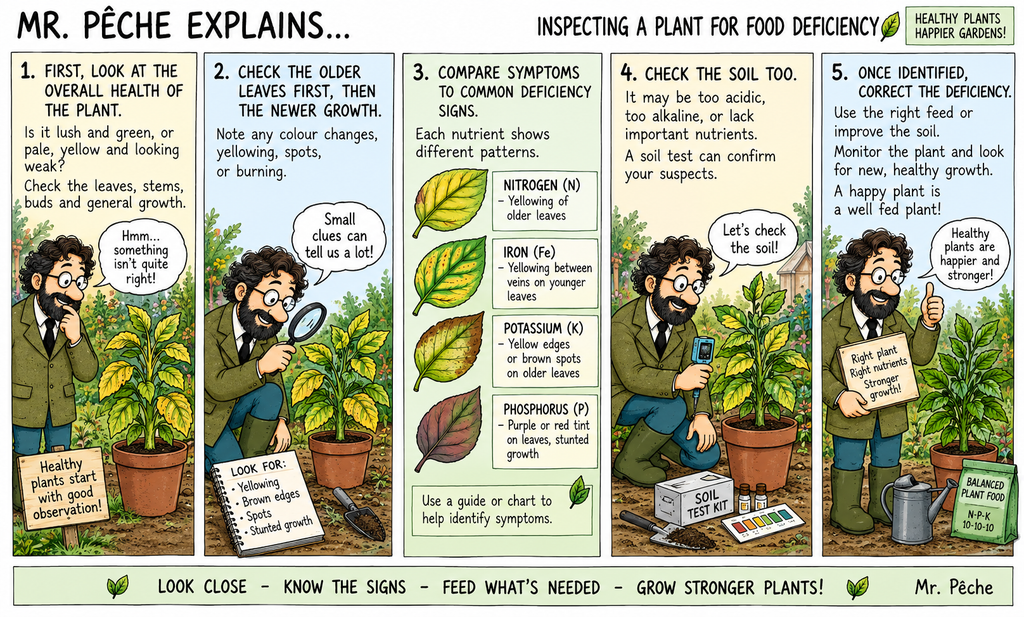
14. The Root Zone
Some of the most important plant problems occur below ground.
Root-feeding organisms may attack plants without being immediately visible.
Root problems can also result from:
- waterlogging;
- drought;
- compaction;
- poor soil structure;
- nutrient imbalance;
- physical damage;
- unsuitable planting depth; and
- soil-borne pathogens.
The symptoms may appear above ground even though the problem originates below ground.
A plant with damaged roots may develop:
- poor growth;
- yellowing leaves;
- wilting;
- premature leaf fall;
- reduced flowering; or
- general decline.
This creates an important diagnostic principle:
the location of a symptom is not necessarily the location of the cause.

15. Where Plant Diseases Develop
Plant diseases are caused by a range of biological agents, including fungi, oomycetes, bacteria, viruses and other pathogens.
The development of disease depends upon interactions between:
- a susceptible host;
- a pathogen; and
- suitable environmental conditions.
This relationship is often represented by the disease triangle.
If one of these components is absent or conditions are unsuitable, disease development may be restricted.
For example, a pathogen may be present but fail to cause significant disease because environmental conditions do not favour infection.
16. Moisture and Disease
Moisture is particularly important for many plant diseases.
Leaf surfaces that remain wet for prolonged periods can create favourable conditions for infection by some pathogens.
Dense planting can increase humidity and reduce air movement.
Overhead irrigation can increase the period for which foliage remains wet.
Poorly ventilated areas can therefore have greater disease pressure than open, well-ventilated locations.
This does not mean that all diseases require wet conditions.
Different pathogens have different environmental requirements.
Diagnosis should therefore be based on the symptoms, pathogen biology and environmental conditions rather than a single rule.
17. The Dark, Damp Corner
A neglected corner of a garden can provide a particularly complex habitat.
It may contain:
- accumulated leaf litter;
- dense vegetation;
- high humidity;
- limited air movement;
- sheltered surfaces;
- decaying organic material; and
- reduced sunlight.
Such conditions can support a wide range of organisms.
Some may be beneficial.
Others may contribute to plant problems.
It is therefore important not to assume that every organism found in a damp corner is a pest or pathogen.
A healthy garden contains enormous numbers of organisms that do not harm plants.
18. Beneficial Organisms
A garden contains far more than cultivated plants.
Beneficial or neutral organisms may include:
- pollinating insects;
- predatory insects;
- spiders;
- earthworms;
- decomposer organisms;
- soil bacteria;
- mycorrhizal fungi;
- birds; and
- other wildlife.
Predatory organisms can contribute to natural pest regulation.
For example, ladybirds and their larvae feed on aphids, while many species of hoverfly have larvae that consume aphids.
Ground beetles, spiders and other predators can also contribute to the regulation of invertebrate populations.
Consequently, the presence of insects does not automatically indicate a pest problem.
19. A Garden Is Made Up of Habitats
Different areas of a garden provide different habitats.
A pond edge is different from a dry gravel bed.
A hedge is different from an open lawn.
A mature tree is different from a sunny border.
A compost heap is different from a paved terrace.
A deadwood pile is different from a formal hedge.
Each area provides particular combinations of:
- light;
- moisture;
- temperature;
- shelter;
- food;
- nesting opportunities; and
- physical structure.
This diversity can support a wider range of organisms.

20. Designing With Microclimates
Garden design can deliberately use these environmental differences.
A sunny wall can provide a warm location for suitable plants.
A shaded border can support shade-tolerant species.
A damp area may be developed as a wetland planting area.
A sheltered corner can protect plants from prevailing winds.
A permeable hedge can reduce wind exposure.
A tree canopy can create a woodland-style planting environment.
Rather than attempting to make every part of a garden identical, good horticultural design can work with the conditions that already exist.
21. Mapping the Garden
Before planting, it can be useful to create a simple environmental map.
Record:
Light
- full sun;
- partial shade;
- dappled shade;
- deep shade.
Moisture
- dry;
- moderately moist;
- consistently moist;
- seasonally wet;
- waterlogged.
Wind
- exposed;
- moderately sheltered;
- sheltered.
Soil
- sandy;
- loamy;
- clay;
- stony;
- compacted;
- organic-rich.
Other influences
- tree roots;
- walls;
- buildings;
- paving;
- drainage channels;
- existing vegetation;
- foot traffic; and
- areas where pests or diseases have previously occurred.
This information creates a site assessment.
Plant selection can then be based upon the actual conditions rather than simply choosing plants because they are attractive.
22. The Garden Changes Through the Year
Garden conditions are not fixed.
A tree that provides dappled shade in summer may allow considerably more light to reach the ground in winter.
Soil may be saturated during winter but dry during summer.
A sheltered corner may become very hot during a summer heatwave.
Pest populations change throughout the year.
Disease risk also changes with temperature, rainfall and plant growth.
Consequently, a garden should be viewed as a dynamic environment.
The conditions observed in April may be very different from those experienced in August or December.
23. Using Observation as a Horticultural Skill
Observation is one of the most important skills in horticulture.
Before changing a plant’s environment, it is useful to establish what is actually happening.
A horticulturist can observe:
- where sunlight falls;
- where water collects;
- where the soil dries first;
- where plants grow poorly;
- where pests are concentrated;
- where disease symptoms occur;
- where wind damage occurs;
- where roots are exposed;
- where compaction occurs; and
- where beneficial organisms are present.
Patterns often provide clues.
If several unrelated plants decline in the same location, the problem may be environmental rather than a disease affecting each plant independently.
If only one species is affected while neighbouring plants remain healthy, a host-specific pest, pathogen or plant-specific environmental sensitivity may be involved.
Observation therefore provides the first stage of diagnosis.

24. From Garden Space to Garden Ecosystem
The most effective approach to garden management is to consider the relationships between different areas.
A sunny border may produce nectar for pollinators.
A hedge may provide shelter and nesting habitat.
A tree may create shade and contribute leaf litter.
The soil beneath the plants supports microorganisms and invertebrates.
A pond can provide habitat for aquatic organisms while increasing local humidity.
A compost heap provides a concentrated area of decomposition.
These areas are physically connected even though their conditions differ.
The garden is therefore better understood as a mosaic of habitats and microclimates.
Conclusion
Every part of a garden has its own environmental characteristics.
Some areas are hot and sunny. Others are cool and shaded. Some are dry because they are exposed to sunlight, wind or tree-root competition. Others remain damp because of poor drainage, heavy soils or their position within the landscape.
These differences determine which plants can thrive and influence the organisms that inhabit each area.
Pests and diseases are also influenced by environmental conditions. They may be concentrated in particular locations because of moisture, shelter, plant susceptibility, temperature or the availability of suitable host tissues.
However, not every insect, fungus or microorganism represents a problem. Gardens contain complex communities of organisms, many of which are beneficial or have little direct effect on cultivated plants.
Good horticulture therefore begins with observation and understanding.
Rather than asking simply:
“What plant should I put here?”
the more useful question is:
“What are the conditions here, and which plants are adapted to them?”
Once the environment has been understood, plant selection, planting design, maintenance and pest and disease management can all become more informed.
The garden is not one environment.
It is a collection of interconnected environments, each with its own combination of light, water, soil, temperature, air movement and biological activity.
Understanding those differences is one of the foundations of successful horticulture.
Key Terms
Microclimate – the climatic conditions experienced within a relatively small area that may differ from the surrounding environment.
Full sun – a location receiving substantial direct sunlight during the growing season.
Dappled shade – variable sunlight created when light passes through foliage or other partially obstructing structures.
Deep shade – an area receiving very limited direct or indirect light.
Transpiration – the loss of water vapour from plant surfaces, particularly through stomata.
Rhizosphere – the region of soil directly influenced by plant roots.
Pest – an organism that causes unacceptable damage to plants or reduces their value or performance.
Pathogen – an organism or infectious agent capable of causing disease.
Disease triangle – the interaction between a susceptible host, a pathogen and suitable environmental conditions required for disease development.
Habitat – the physical and biological environment in which an organism lives.
Soil compaction – the compression of soil particles that reduces pore space and can restrict the movement of air, water and roots.
Root competition – competition between plants for water, nutrients and physical space within the soil.
References
Agrios, G.N. (2005) Plant Pathology. 5th edn. Amsterdam: Elsevier Academic Press.
Burdon, J.J. and Thrall, P.H. (2008) ‘Pathogen evolution across the agro-ecological interface: implications for disease management’, Evolutionary Applications, 1(1), pp. 57–65.
CABI (2024) Plantwise Knowledge Bank. Wallingford: CAB International. Available at: CABI Plantwise Knowledge Bank (Accessed: 27 September 2026).
Davies, M.J.B. and Skeffington, M.S. (2020) RHS Gardening School: Gardening Basics. London: Dorling Kindersley.
Dixon, G.R. (2009) Plant Viruses and Their Control. Oxford: CABI.
Gange, A.C. and West, H.M. (1994) ‘Interactions between arbuscular mycorrhizal fungi and foliar-feeding insects in Plantago lanceolata L.’, New Phytologist, 128(1), pp. 79–87.
Gillman, D.S. (2010) The Truth About Garden Remedies: What Works, What Doesn’t, and Why. Portland, OR: Timber Press.
Hewitt, H.G. (1998) Fungicides in Crop Protection. Wallingford: CAB International.
Jones, H.G. (2014) ‘Plants and microclimate: a quantitative approach to environmental plant physiology’. 3rd edn. Cambridge: Cambridge University Press.
Larcher, W. (2003) Physiological Plant Ecology: Ecophysiology and Stress Physiology of Functional Groups. 4th edn. Berlin: Springer.
Royal Horticultural Society (RHS) (2024) RHS Gardening Advice. London: Royal Horticultural Society. Available at: RHS Gardening Advice (Accessed: 27 September 2026).
Scholthof, K.-B.G. (2007) ‘The disease triangle: pathogens, the environment and society’, Nature Reviews Microbiology, 5, pp. 152–156.
Taiz, L., Zeiger, E., Møller, I.M. and Murphy, A. (2015) Plant Physiology and Development. 6th edn. Sunderland, MA: Sinauer Associates.
Whipps, J.M. (2001) ‘Microbial interactions and biocontrol in the rhizosphere’, Journal of Experimental Botany, 52(Special Issue), pp. 487–511.
Wilson, E.O. (1987) The Little Things That Run the World (The Importance and Conservation of Invertebrates). Washington, DC: Conservation Biology.