Finding and Observing Plant Pests, Diseases and Disorders
Introduction
Healthy plants are at the centre of successful horticulture. A gardener needs to be able to recognise when a plant is growing normally and, equally importantly, when something is beginning to go wrong. Changes in colour, growth, leaf shape, stems, roots, flowers or fruit can provide valuable evidence about the health of a plant.
Plant problems can have many causes. A plant may be damaged by an animal or insect pest, affected by a disease-causing organism, or suffer from a disorder caused by environmental or growing conditions. The visible symptom may be similar even when the underlying cause is completely different. For example, yellow leaves can result from nutrient deficiency, waterlogging, drought, root damage, pest feeding or disease.
This means that successful plant-health observation is not simply a matter of looking at a leaf and naming the problem. It involves careful observation, gathering evidence, considering possible causes and making a reasoned identification.
Plant health is an important part of the RHS Level 2 curriculum. The RHS identifies environmental conditions, plant nutrition, competition, pests and pathogens, biosecurity and maintaining plant health as key areas of plant-health knowledge. (RHS) The RHS Level 2 practical qualification also includes identification of plants, pests, diseases, pathogens and disorders. (RHS)
1. What is plant health?
Plant health describes the condition of a plant and its ability to grow, develop and reproduce successfully.
A healthy plant will normally show characteristics appropriate to its species and growing conditions. These might include:
- healthy, appropriately coloured foliage
- normal shoot growth
- strong stems
- functioning roots
- appropriate flowering
- normal fruit or seed development
- freedom from significant pest damage
- freedom from serious disease
- appropriate response to environmental conditions.
It is important to remember that there is no single appearance that defines a healthy plant. A mature Fagus sylvatica will naturally look very different from a young Lavandula angustifolia. A plant growing in full sun may have different characteristics from the same species growing in shade.
Therefore, observation begins with knowing what normal growth looks like for the particular plant.

2. Pest, disease or disorder?
One of the most important Level 2 plant-health skills is understanding the difference between a pest, a disease and a disorder.
Plant pest
A plant pest is an organism that damages a plant through its feeding or other activities.
Common groups include:
- insects
- mites
- molluscs
- nematodes
- mammals
- some other animals.
Examples include:
- aphids
- whitefly
- vine weevil
- thrips
- spider mites
- slugs and snails
- caterpillars
- rabbits
- mice and other mammals.

Plant disease
A plant disease is a condition caused by a harmful pathogen or other infectious agent.
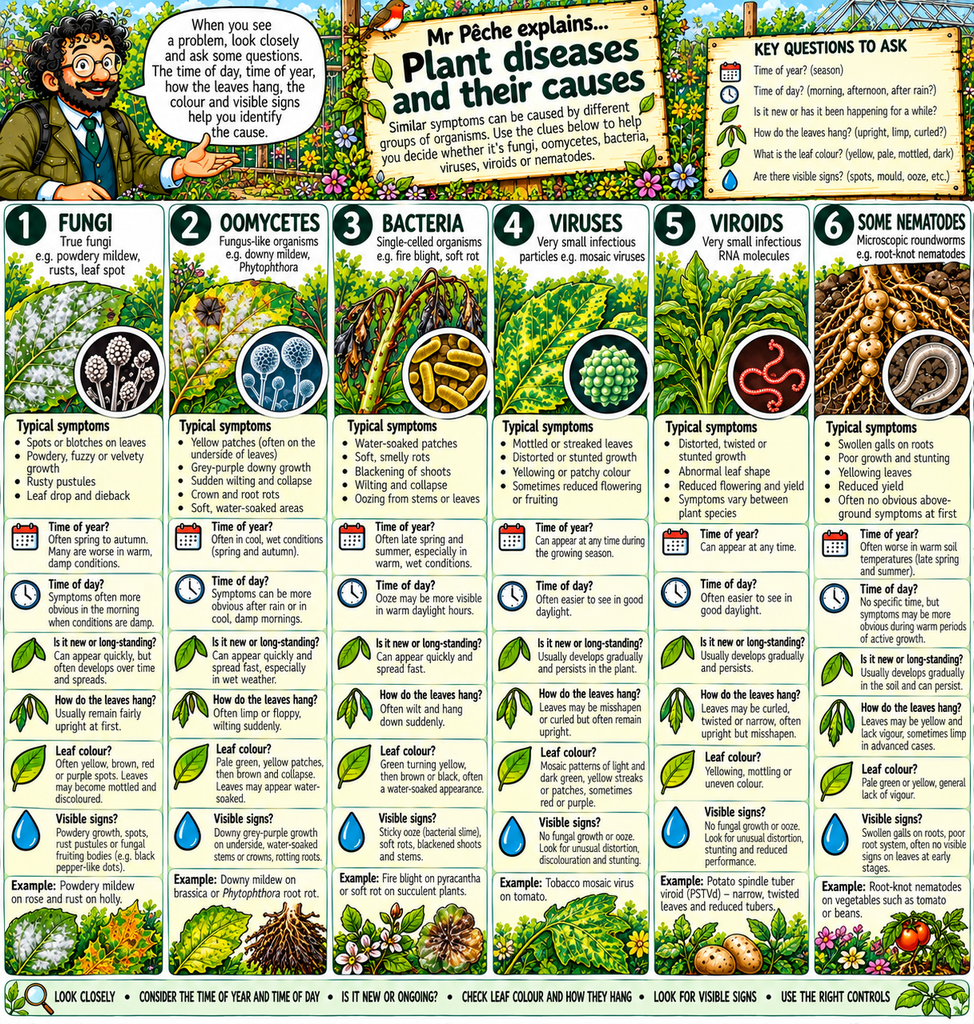
Important groups of plant pathogens include:
- fungi
- Oomycetes (fungus-like organisms)
- bacteria
- viruses
- viroids
- some nematodes.
Examples familiar to horticulturists include:
- rose black spot
- powdery mildew
- grey mould
- damping-off
- honey fungus
- potato blight.
The RHS Level 2 specification includes plant diseases such as grey mould, strawberry powdery mildew, damping-off, honey fungus, rose black spot and potato blight within its plant-health content. (RHS)

Plant disorder
A plant disorder is a problem caused by a non-infectious factor rather than by a pest or pathogen.
Possible causes include:
- nutrient deficiency
- nutrient toxicity
- drought
- waterlogging
- frost
- excessive heat
- unsuitable pH
- poor soil structure
- compaction
- root damage
- poor light levels
- chemical damage
- inappropriate cultivation.
For example, a plant with yellow leaves may have a nutrient deficiency, but yellowing does not automatically mean that the plant has a disease.
3. Symptoms and signs
A useful distinction when examining plants is between a symptom and a sign.
Symptoms
A symptom is a change in the plant caused by the problem.
Examples include:
- yellowing
- wilting
- leaf curling
- distorted growth
- leaf spots
- holes in leaves
- premature leaf fall
- dieback
- stunted growth
- poor flowering
- lesions
- discolouration
- reduced vigour.
Signs
A sign is physical evidence of the pest or pathogen itself.
Examples include:
- an aphid on a shoot
- whitefly adults flying from foliage
- caterpillar larvae
- slug slime trails
- insect eggs
- fungal mycelium
- fungal fruiting bodies
- bacterial ooze
- insect honeydew
- cast insect skins
- webbing produced by some mites.
The distinction is important because a symptom tells you that something may be wrong, whereas a sign can provide evidence about what is causing the problem.
4. Start with observation, not treatment
One of the most common mistakes in plant-health diagnosis is deciding on a treatment before identifying the problem.
A better approach is:
Observe → gather evidence → identify the likely cause → decide on action.
For example, suppose a rose has curled leaves.
It would be premature to immediately conclude that the plant needs an insecticide. The leaves could have been affected by aphids, frost, drought, herbicide drift or another factor.
The first question should therefore be:
What evidence can I find?
Look carefully at:
- the upper surface of the leaves
- the underside of leaves
- young shoots
- stems
- buds
- flowers
- fruit
- the crown of the plant
- the soil surface
- the root zone where appropriate.
A hand lens can be extremely useful when examining small insects, mites, eggs, fungal structures or other signs.
5. Observe the whole plant
A plant should not normally be diagnosed from one leaf alone.
Begin by standing back and looking at the whole plant.
Ask:
Is the problem affecting the whole plant?
If the entire plant is showing similar symptoms, consider environmental or root-related causes.
For example:
- drought
- waterlogging
- nutrient deficiency
- unsuitable growing conditions
- root damage.
Is the problem affecting only one branch?
A localised problem may indicate:
- physical damage
- pruning damage
- a canker
- localised disease
- an insect infestation
- damage to a branch or stem.
Is the problem affecting one part of the plant?
If only young leaves are affected, the cause may differ from a problem affecting older leaves.
If only roots are affected, examination of the root system may be necessary.
The distribution of symptoms is therefore an important diagnostic clue.
6. Look at the leaves
Leaves are often the first part of a plant to show visible signs of stress.
Look for:
- yellowing
- browning
- mottling
- spots
- holes
- mines
- curling
- distortion
- silvering
- scorch
- wilting
- premature leaf fall
- unusual growth.
Holes in leaves
Holes may indicate chewing or feeding damage.
Possible causes include:
- caterpillars
- beetles
- weevils
- slugs
- snails
- other chewing pests.
However, the shape and distribution of the holes can provide further evidence.
Examine the leaf carefully for the pest itself, droppings, eggs or feeding remains.
7. Examine the underside of leaves
The underside of a leaf is often overlooked.
It is an important place to search for:
- aphids
- whitefly
- thrips
- mites
- eggs
- larvae
- fungal growth
- insect cast skins.
Many sap-feeding insects are found on young shoots or the underside of leaves because these areas can provide suitable feeding sites and protection.
A plant should therefore be examined from both sides, rather than simply viewed from above.
8. Recognising common pest damage
Different pests produce different patterns of damage.

Aphids
Aphids are small sap-feeding insects.
They may cause:
- curled leaves
- distorted young shoots
- weakened growth
- sticky honeydew
- sooty mould developing on honeydew
- colonies of insects around young growth.
Aphids are often concentrated around:
- shoot tips
- young leaves
- flower buds.
Look closely rather than relying solely on the symptom.
Whitefly
Whiteflies are small, winged sap-feeding insects often associated with protected cultivation, although some species are found outdoors.
Signs may include:
- small white adults flying when foliage is disturbed
- nymphs on the underside of leaves
- honeydew
- sooty mould
- weakened or discoloured foliage.
Vine weevil
Vine weevil can produce two very different types of damage.
Adult beetles may create:
- characteristic notches around leaf edges.
The larvae can damage roots, particularly in container-grown plants.
A plant suffering root damage may show:
- wilting
- poor growth
- yellowing
- reduced vigour
- collapse despite apparently adequate watering.
This demonstrates why examining only the leaves can give an incomplete diagnosis.
Slugs and snails
Slugs and snails may produce:
- irregular holes
- shredded foliage
- damage to young plants
- damage to seedlings
- slime trails.
The damage may be particularly noticeable overnight or following wet conditions.
Mites
Some mites are extremely small and may require a hand lens to observe.
Damage can include:
- fine mottling
- bronzing
- leaf distortion
- stippling
- webbing in some infestations.
A useful observation technique is to inspect the underside of the leaf carefully and use a hand lens.
9. Recognising disease symptoms
Plant diseases can produce symptoms that overlap with pest damage and disorders.
Common disease symptoms include:
- leaf spots
- blotches
- mildew
- mould
- cankers
- dieback
- rotting
- wilting
- damping-off
- root decay
- distorted growth.
A disease may also progress through the plant over time.
For example, a small leaf spot may initially appear insignificant but develop into a larger necrotic area as the disease progresses.

10. Common diseases
Rose black spot
Rose black spot produces dark or black spots on rose leaves. (It is a disease affecting mainly those plants with the recessive gene that makes them susceptible.)
Affected leaves may:
- develop black lesions
- turn yellow
- fall prematurely.
The pattern of symptoms is important. Do not identify every dark mark on a rose as black spot without examining the plant carefully.
Powdery mildew
Powdery mildew typically produces a characteristic pale or white powdery growth on plant surfaces.
It may be associated with:
- distorted leaves
- reduced vigour
- poor appearance
- affected young growth.
Environmental conditions can influence disease development.
Grey mould
Grey mould is associated with the pathogen Botrytis cinerea.
It can produce:
- soft rotting tissue
- brown or dead plant material
- grey fungal growth.
It is particularly associated with conditions where plant material remains damp and air movement is poor.
Damping-off
Damping-off commonly affects young seedlings.
Symptoms can include:
- poor emergence
- seedlings collapsing
- soft or rotted tissue around the base of the stem
- death of young seedlings.
The growing environment is particularly important when considering damping-off.
Honey fungus
Honey fungus can affect the roots and lower stems of plants.
Symptoms can include:
- reduced vigour
- yellowing
- dieback
- wilting
- decline over time.
Diagnosis requires careful examination because several different problems can produce similar above-ground symptoms.
11. Recognising disorders
Disorders are especially important because they can easily be mistaken for pests or diseases.
Nutrient deficiency
Nutrient deficiencies may cause:
- yellowing
- poor growth
- unusual leaf colour
- leaf-edge scorching
- premature leaf fall
- poor flowering.
The pattern of the symptom can provide useful information.
Ask:
- Are older leaves affected first?
- Are younger leaves affected first?
- Is the symptom between the veins?
- Are the leaf margins affected?
- Is the entire plant affected?
However, visual symptoms alone do not always provide a definitive diagnosis.
Drought
Drought stress may cause:
- wilting
- leaf curling
- leaf scorch
- premature leaf fall
- reduced growth.
Check the soil rather than assuming that wilting always means lack of water.
A wilted plant may also be suffering from:
- root damage
- waterlogging
- disease
- root pests.
Waterlogging
Too much water can be just as damaging as too little.
Waterlogged conditions reduce the amount of oxygen available around roots and may result in:
- yellowing
- poor growth
- wilting
- root death
- increased susceptibility to some root diseases.
The surprising appearance of a wilted plant in wet soil is therefore an important diagnostic clue.
12. The importance of the growing environment

Plant health cannot be considered separately from the environment.
When observing a problem, record:
- soil type
- soil moisture
- drainage
- aspect
- light levels
- exposure
- temperature
- recent weather
- watering
- feeding
- planting density
- air movement
- surrounding vegetation.
The RHS identifies environmental conditions, nutrition and competition alongside pests and pathogens as important components of plant health. (RHS)
For example, a densely planted border may have reduced air movement. Leaves may remain wet for longer, potentially creating conditions favourable to some diseases.
Similarly, a plant growing in the wrong place may become stressed and subsequently more vulnerable to pest or disease problems.
This leads to one of the most important principles in plant health:
The symptom is not always the cause.
13. Pattern is evidence
The pattern of damage can be extremely useful.
One plant affected
Consider:
- localised pest activity
- physical damage
- plant-specific disease
- planting problem.
Several plants of the same species affected
Consider:
- pest outbreak
- disease
- unsuitable conditions for that species
- nutrient problem affecting a particular plant type.
Several different plant species affected
Consider:
- environmental conditions
- drought
- waterlogging
- chemical exposure
- nutrient problems
- weather damage.
Plants throughout an entire area affected
Consider:
- irrigation problems
- soil conditions
- drainage
- fertiliser application
- chemical application
- environmental stress.
The distribution of symptoms can therefore help distinguish between possible causes.
14. Check the plant’s history
Good observation includes finding out what has happened to the plant.
Ask:
- When was it planted?
- Has it recently been moved?
- Has it been pruned?
- Has it been watered?
- Has fertiliser been applied?
- Have chemicals been used nearby?
- Has the weather recently changed?
- Has the plant been damaged?
- Has the plant been repotted?
- Are neighbouring plants affected?
- Has the problem occurred previously?
A plant is not an isolated object. Its history can provide essential diagnostic information.
15. Use a systematic inspection method
A useful Level 2 inspection can follow a consistent sequence.
Step 1 – Identify the plant
Record:
- common name
- botanical name where known
- location.
Correct plant identification matters because different plants have different pests, diseases and environmental requirements.
Step 2 – Observe from a distance
Look at:
- overall shape
- vigour
- colour
- distribution of symptoms
- affected and unaffected areas.
Step 3 – Inspect closely
Examine:
- leaves
- stems
- buds
- flowers
- fruit
- crown
- soil surface.
Step 4 – Look underneath
Check the undersides of leaves and hidden parts of the plant.
Step 5 – Look for signs
Search for:
- insects
- eggs
- larvae
- webs
- honeydew
- fungal growth
- fruiting structures
- slime trails.
Step 6 – Examine the environment
Check:
- soil
- moisture
- drainage
- light
- shelter
- recent weather.
Step 7 – Compare
Compare the affected plant with:
- a healthy plant of the same species
- unaffected parts of the same plant
- neighbouring plants.
Step 8 – Record
Write down what has actually been observed.
Step 9 – Identify
Use reliable reference material to identify the most likely cause.
Step 10 – Decide on action
Only after identification should appropriate management be considered.
16. Recording observations
Good records are an important part of professional horticulture.
A simple plant-health record might include:
| Observation | Example |
| Plant | Rose |
| Location | South-facing border |
| Date | 28 September |
| Symptoms | Black spots and yellowing leaves |
| Distribution | Several lower leaves affected |
| Signs | No obvious insects observed |
| Environment | Dry soil, sunny position |
| Recent activity | Plant pruned two months previously |
| Initial identification | Possible rose black spot |
| Further investigation | Compare symptoms with reliable reference |
| Action | Monitor and follow appropriate plant-health guidance |
The purpose of recording is not simply to create paperwork. Records allow gardeners to identify patterns over time.
For example, if the same area repeatedly develops disease symptoms after periods of wet weather, this may indicate that the environmental conditions are contributing to the problem.

17. Observation and monitoring
Finding a problem once is not necessarily enough.
Monitoring means observing a plant or area repeatedly over time.
This can reveal:
- whether the problem is increasing
- whether new growth is affected
- whether a pest population is increasing
- whether symptoms are spreading
- whether natural enemies are present
- whether environmental conditions are changing.
The RHS emphasises surveillance and improved detection of plant pests and diseases as important aspects of plant health management. (RHS)
Regular monitoring can therefore allow a problem to be recognised before serious damage occurs.
18. Beneficial organisms must not be mistaken for pests
Not every insect found on a plant is harmful.
A garden can contain many useful organisms, including:
- ladybirds
- lacewings
- hoverflies
- parasitoid wasps
- predatory beetles
- spiders
- ground beetles.
Some of these organisms feed on pests.
For example, a plant covered with aphids may also contain ladybird larvae or hoverfly larvae feeding on them.
A gardener who sprays every insect encountered may remove both harmful and beneficial organisms.
This is one reason why identification should come before intervention.
The RHS recommends cultural control, suitable plant selection and encouraging natural predators as important elements of preventing pest and disease problems. (RHS)
19. Biosecurity and plant health
Plant-health observation is also part of horticultural biosecurity.
New pests and diseases can spread through:
- movement of plants
- contaminated growing media
- tools
- clothing
- footwear
- water
- plant debris
- vehicles
- traded plant material.
The RHS identifies plant biosecurity and plant passports as part of its Level 2 plant-health curriculum. (RHS)
Good horticultural practice therefore includes:
- inspecting incoming plants
- isolating suspect material where appropriate
- cleaning tools
- removing infected material responsibly
- avoiding unnecessary movement of contaminated material
- reporting serious or unusual plant-health concerns through appropriate channels.
Plant health is not only about protecting one plant. It can involve protecting an entire collection, garden, nursery or wider landscape.
20. Avoiding diagnostic mistakes
There are several common mistakes when identifying plant-health problems.
Mistake 1: Assuming every hole is an insect
Holes may result from:
- slugs
- snails
- caterpillars
- beetles
- weather
- physical damage.
Better approach: inspect the damage and search for evidence.
Mistake 2: Assuming every yellow leaf is a nutrient deficiency
Yellowing can have many causes.
Better approach: consider the plant, leaf age, soil, roots, watering and environmental conditions.
Mistake 3: Treating before identifying
Applying a product without knowing the cause can waste time and potentially harm beneficial organisms.
Better approach: diagnose first.
Mistake 4: Looking only at the leaves
Root problems can produce symptoms above ground.
Better approach: consider the whole plant and its growing environment.
Mistake 5: Ignoring normal seasonal change
Some plants naturally change colour or shed leaves.
Better approach: know what normal seasonal development looks like.
Mistake 6: Identifying from one symptom
Many different problems can produce similar symptoms.
Better approach: combine several pieces of evidence.
21. A practical diagnostic framework
A useful way to remember plant-health observation is:
P-L-A-N-T
P – Plant
What plant is it? What does healthy growth normally look like?
L – Look
Observe the whole plant before concentrating on the damaged area.
A – Assess
Assess symptoms, signs, distribution and environmental conditions.
N – Notice
Look for insects, fungal growth, eggs, feeding damage, root problems and other evidence.
T – Think
Consider several possible causes before identifying the most likely one.
This encourages students to become observers rather than simply memorising photographs of pests and diseases.
22. From identification to management
Identification is only the beginning of plant-health management.
Once the cause has been established, appropriate action can be considered.
Possible approaches include:
Cultural control
Changing growing conditions or horticultural practice.
Examples:
- improving air circulation
- removing heavily infected material
- improving cultivation
- avoiding overwatering
- selecting appropriate plants
- maintaining plant vigour.
Physical or mechanical control
Examples include:
- removing pests by hand
- barriers
- traps
- removing affected plant material.
Biological control
Using or encouraging natural enemies of pests.
Examples include:
- predatory insects
- parasitoids
- biological control organisms.
Chemical control
Where appropriate and legally permitted, plant-protection products may form part of an integrated approach.
However, chemical control should not be the automatic response to seeing a pest or symptom.
The RHS stresses prevention, plant selection, cultural approaches and encouraging natural predators as important ways of reducing pest and disease problems. (RHS)
23. Integrated plant-health thinking
Modern horticulture increasingly considers plant health as a system rather than a series of individual pest problems.
A healthy plant is influenced by:
Plant + Soil + Water + Nutrition + Light + Temperature + Air movement + Biodiversity + Management
Problems often occur when several stresses interact.
For example:
poor soil structure → poor root growth → plant stress → reduced vigour → greater susceptibility to pests or disease
This means that the best plant-health solution may not be to eliminate the organism that is visible on the plant. The more useful response may be to improve the conditions in which the plant is growing.
24. Practical observation exercise
Choose three plants growing in a garden, nursery, glasshouse or college horticultural area.
For each plant:
- Identify the plant.
- Observe the whole plant from a distance.
- Examine the leaves from both sides.
- Examine stems and growing points.
- Look for pests or other organisms.
- Look for disease signs.
- Record any abnormal growth.
- Examine the soil and growing conditions.
- Compare the plant with a healthy specimen where possible.
- Decide whether the evidence suggests:
- pest
- disease
- disorder
- normal growth
- or that further investigation is required.
Do not automatically identify a problem simply because a leaf looks unusual.
Record evidence such as:
“Small black insects observed on the underside of young leaves, with curled new growth and sticky honeydew.”
This is much more useful than:
“Plant has aphids.”
The first statement records the evidence. The second records the conclusion.
25. Key Level 2 knowledge
A competent horticulturist should be able to explain that:
- a pest damages a plant through its feeding or other activities
- a disease is associated with a harmful pathogen or infectious agent
- a disorder results from a non-infectious cause
- symptoms are changes shown by the plant
- signs provide physical evidence of the pest or pathogen
- similar symptoms can have different causes
- the whole plant should be examined
- the growing environment should be considered
- the distribution of symptoms can provide diagnostic evidence
- pest identification should not rely solely on damage
- beneficial organisms should not automatically be treated as pests
- monitoring is an important part of plant-health management
- accurate records can help identify patterns
- plant-health problems should be identified before management decisions are made
- biosecurity helps reduce the spread of harmful pests and diseases.
These principles directly support the City & Guilds Level 2 requirements for identifying pest damage and identifying plant diseases and disorders. (BestLearn VLE)
Conclusion
Finding plant pests, diseases and disorders is a fundamental horticultural skill. Effective observation requires more than recognising a picture from a textbook. It requires the ability to examine a plant systematically, recognise symptoms and signs, consider the growing environment, identify patterns and gather enough evidence to reach a sensible diagnosis.
The most important habit is to slow down and observe before acting.
A hole in a leaf is evidence, not automatically an identification. A yellow leaf is a symptom, not automatically a nutrient deficiency. Wilting does not necessarily mean drought. An insect on a plant is not necessarily a pest.
Professional horticultural observation therefore asks:
What can I see? What evidence can I find? Where is the problem occurring? What has changed? What could cause these symptoms?
Only after these questions have been considered should the horticulturist move from observation to identification and, finally, management.
This approach develops the practical plant-health knowledge expected at Level 2 while also establishing a professional habit that remains important throughout a horticultural career.
References
Royal Horticultural Society (RHS) (2022) RHS Level 2 Certificate in the Principles and Practices of Horticulture: Qualification Specification. London: Royal Horticultural Society. (RHS)
Royal Horticultural Society (RHS) (2022) RHS Level 2 Diploma in the Principles and Practices of Horticulture: Qualification Specification. London: Royal Horticultural Society. (RHS)
Royal Horticultural Society (RHS) (2026) RHS Level 2 Qualifications. London: Royal Horticultural Society. (RHS)
Royal Horticultural Society (RHS) (2026) Preventing pest and disease problems. London: Royal Horticultural Society. (RHS)
Royal Horticultural Society (RHS) (2026) RHS Plant Health Principles. London: Royal Horticultural Society. (RHS)
City & Guilds (2018) Level 2 Award/Certificate/Diploma in Practical Horticulture Skills (7573-02): Qualification Handbook. London: City & Guilds. (BestLearn VLE)