Soil Science – Understanding the Soil Beneath Your Feet
Introduction
A gardener can spend hours choosing the right plant, but if the soil is wrong, the plant may never thrive. Soil is not simply “dirt”. It is a complex living system made from:
- mineral particles
- organic matter
- water
- air
- living organisms
A good horticulturist needs to understand what soil is, how different soils behave and how to recognise the clues that soil gives us. One of the simplest ways to think about soil is:
Soil is the living medium in which plants anchor their roots and obtain water, air and mineral nutrients.
But soil is much more than a plant-growing medium.
It is also:
- a habitat
- a carbon store
- a water store
- a nutrient reservoir
- a biological system
- a filter for water
- part of the wider ecosystem

What Is Soil?
Soil is the upper layer of the Earth’s surface in which plants can grow. It develops through the interaction of, climate; organisms; relief; parent material; time. These factors influence how soils develop. (This is sometimes remembered using the anacronym ‘CLORPT’)

What Is Soil Made From?
A typical mineral soil contains four major components:
Mineral matter (Approximately 45%)
This comes from weathered rock and mineral material.
Organic matter (Approximately 5%)
This includes:
- decomposed plant material
- animal remains
- microorganisms
- humus (dark, organic material in soil formed from the partial decomposition of plant and animal matter)
Water (Approximately 25%)
Water occupies some of the spaces between soil particles.
Air (Approximately 25%)
Air occupies other pore spaces. These percentages are approximate.
They vary considerably between different soils and conditions.
Soil Is a Living System
As previously described, a handful of healthy soil may contain an enormous number of organisms.
These include, bacteria; fungi; protozoa; nematodes; mites; springtails; earthworms; insects and their larvae.
These organisms contribute to, decomposition; nutrient cycling; soil structure; organic matter breakdown; plant health. A soil that looks brown and inactive may actually be biologically extremely busy.

Soil Texture
One of the most important properties of soil is texture. Texture refers to the relative proportions of:
- sand
- silt
- clay
These are different sizes of mineral particles.
Sand
Sand has the largest particles of the three main soil fractions.
Sandy soils generally:
- drain quickly
- warm relatively quickly
- contain large air spaces
- are easy to cultivate
- may dry out quickly
- may have relatively low nutrient-holding capacity
Sandy soil can be described as light soil. This does not mean it is pale in colour.
“Light” refers mainly to how easily it can be cultivated.
Silt
Silt particles are smaller than sand but larger than clay.
Silty soils can:
- hold more water than sandy soils
- be fertile
- feel smooth or floury when dry
- become compacted relatively easily
- be prone to structural damage when worked wet
Clay
Clay has the smallest mineral particles.
Clay soils can:
- hold large amounts of water
- hold nutrients effectively
- become sticky when wet
- become hard when dry
- drain slowly
- be difficult to cultivate at the wrong moisture content
Clay is not necessarily a bad soil. A well-structured clay soil can be extremely productive.
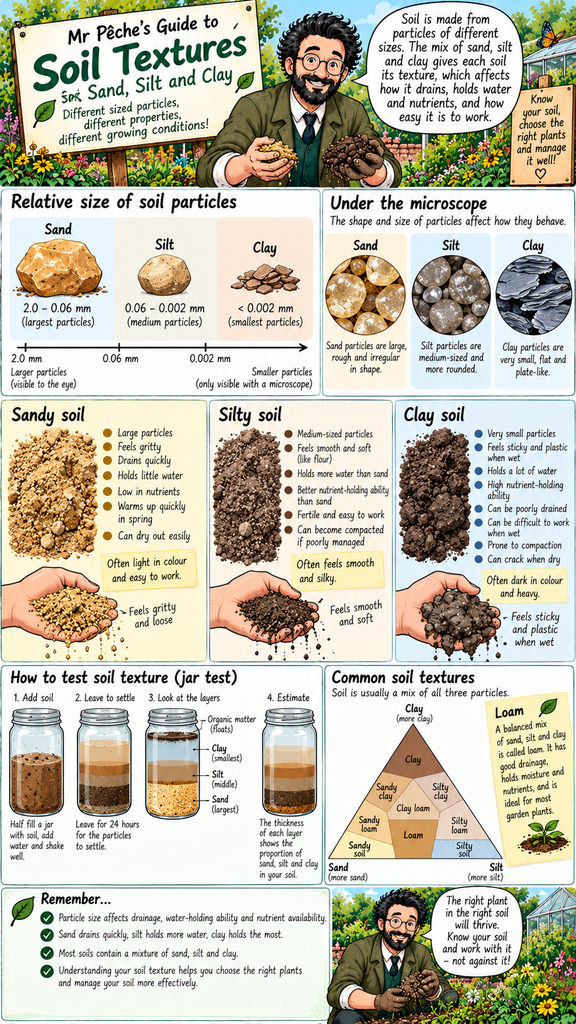
Loam
Loam is a soil with a relatively balanced mixture of:
- sand
- silt
- clay
A good loam can provide a useful balance between:
- drainage
- water retention
- nutrient retention
- aeration
- workability
This is why loam is often regarded as an excellent general-purpose horticultural soil.
However, Loam does not mean perfect soil. Structure, pH, organic matter, drainage and fertility still matter.
The Main Soil Types
For Level 2 horticulture, it is useful to recognise:
Sandy soil
Large particles, free draining.
Clay soil
Very small particles, high water and nutrient-holding capacity.
Silty soil
Fine particles, good moisture retention but potentially vulnerable to compaction.
Loamy soil
A mixture of sand, silt and clay.
Peaty or organic soils
High in organic matter. These soils have very different properties from mineral soils.

Soil Structure
Do not confuse texture with structure: Texture is the proportion of sand, silt and clay.
Structure is the way soil particles are arranged into aggregates.
Good structure can provide:
- air spaces
- water movement
- root penetration
- drainage
- biological activity
Organic matter can help support good soil structure.
Soil pH
pH describes how acidic or alkaline a soil is.
The scale generally runs from:
0 → 14
with:
7 = neutral
Below 7:
acidic
Above 7:
alkaline
Most garden soils fall somewhere within the acidic to alkaline range rather than at the extremes.
Acid Soil
An acid soil has a pH below 7. Some plants prefer acidic conditions.
Examples include:
- rhododendrons
- camellias
- azaleas
- blueberries
These are often referred to as acid-loving plants or ericaceous plants
Alkaline Soil
Alkaline soils have a pH above 7.
Plants that tolerate or prefer alkaline conditions include many species associated with:
- chalk
- limestone
- calcareous soils
Some plants are particularly sensitive to high pH.
What Is a “Sour Soil”?
“Sour soil” is an old horticultural term. It traditionally refers to soil that is Acidic.
The expression comes from older agricultural and gardening language. It does not mean that the soil literally tastes sour. It is essentially a traditional description of an acid soil. It can also mean a soil that has been acidic due to anaerobic action.
What Is a “Sweet Soil”?
“Sweet soil” is another traditional horticultural expression. It generally refers to soil that has been
Limed to reduce excessive acidity. The soil becomes less acidic and therefore “sweeter” in the traditional terminology. This is where the expression sweetening the soil comes from.

Sweetening the Soil
To “sweeten” an acidic soil traditionally means raising its pH by applying a liming material.
Common liming materials include:
- ground limestone
- calcium carbonate
- dolomitic lime
Dolomitic lime also supplies magnesium.
Why Would We Sweeten Soil?
Liming may be appropriate where soil is:
- excessively acidic
- unsuitable for the intended crop
- deficient in available nutrients because of low pH
Raising pH can improve the availability of some nutrients. However do not lime soil simply because it is acidic. Some plants require acidic conditions.
When Should We NOT Sweeten the Soil?
Do not lime simply because someone says:
“This soil is sour.”
First consider:
- soil test results
- intended planting
- existing plants
- soil type
- nutrient availability
If you are growing : Rhododendron! Raising the pH could be exactly the wrong thing to do.
Soil Testing
A soil test can provide information about:
- pH
- nutrients
- soil condition
Testing is particularly useful before applying large quantities of:
- lime
- fertiliser
- soil amendments
A test provides evidence rather than relying entirely on guesswork.
What Are Indicator Weeds?
Indicator weeds are plants that can provide clues about site conditions.
They may indicate something about:
- soil moisture
- fertility
- pH
- compaction
- disturbance
- drainage
Experienced horticulturists learn to look at naturally occurring plants as clues.
However Indicator weeds are clues, not scientific soil tests.
A weed’s presence does not prove that a soil has a particular pH or nutrient level.
Indicator Weeds and Soil Conditions
Some useful examples include:
| Plant | Possible indication |
| Creeping buttercup | Moist or poorly drained conditions |
| Horsetail (Equisetum) | Often associated with moist, compacted or acidic conditions |
| Dock | Fertile or disturbed soils; often associated with moisture |
| Stinging nettle | Nutrient-rich soils, particularly high nitrogen |
| Chickweed | Fertile, cultivated soils |
| Shepherd’s purse | Disturbed, cultivated ground |
| Dandelion | Compacted or disturbed soils; widespread and not a reliable single indicator |
| Sorrel | Often associated with acidic soils |
| Oxalis | Can occur in acidic conditions, depending on species |
| Plantain | Compaction and regularly trafficked areas |
| Moss | Can indicate shade, moisture, compaction or low fertility |
These should be interpreted alongside other evidence.

Indicator Weeds: The Important Lesson
Imagine you find plantain growing heavily in a lawn. Do not immediately conclude: The soil is deficient in nutrients.”
Consider:
- Is the ground compacted?
- Is the lawn heavily trafficked?
- Is drainage poor?
- Is mowing too short?
- Is the grass weak?
- Is the site shaded?
The weed is giving you a clue. Remember: You still need to investigate.
What Is Spent Soil?
“Spent soil” is another traditional horticultural expression.
It usually describes soil or growing media that has become:
- depleted
- structurally poor
- low in available nutrients
- biologically degraded
- unsuitable for continued intensive cropping
The term is particularly associated with intensive cultivation.
Why Does Soil Become Spent?
Repeated cropping can remove nutrients.
Problems can develop through:
- continuous cultivation
- removal of crops
- low organic matter
- poor nutrient management
- compaction
- repeated cultivation
- erosion
- poor drainage
- loss of soil biology
Container compost can also become “spent” after prolonged use.
Signs of Spent Soil
Possible signs include:
- poor plant growth
- pale foliage
- poor flowering
- poor crop yields
- weak root growth
- low organic matter
- poor structure
- reduced water-holding capacity
- poor drainage
But again poor plant growth does not automatically mean spent soil.
Improving Spent Soil
Adding organic matter
For example:
- well-rotted garden compost
- well-rotted manure
- suitable green compost
Improve soil structure
Avoid unnecessary cultivation when soil is wet.
Grow cover crops or green manures
These can help protect soil and contribute organic matter.
Reduce compaction
Avoid unnecessary traffic.
Use crop rotation
Where appropriate, rotate crops to reduce nutrient depletion and pest and disease build-up.
Maintain living roots
Plants contribute organic material and support soil biology.
Soil and Organic Matter
Organic matter is one of the most important components of a healthy soil.
It can help:
- improve structure
- increase water retention in sandy soils
- support biological activity
- contribute nutrients
- improve aggregation
- increase the soil’s ability to hold nutrients
But adding huge quantities of organic matter is not automatically beneficial.
The material must be:
- appropriate
- mature
- free from harmful contamination
- applied at a suitable rate
Soil Compaction
Compaction reduces the size and number of soil pore spaces.
This can restrict:
- air
- water movement
- root growth
- soil organisms
Compaction can result from:
- heavy machinery
- repeated foot traffic
- working soil when wet
- livestock
- construction
Indicator plants such as plantain can sometimes provide a clue that compaction is present.
Why We Should Not Cultivate Wet Soil
This is particularly important with clay soils.
When wet clay is cultivated, soil aggregates can be damaged.
The result can be:
- smearing
- compaction
- poor structure
- reduced drainage
- large hard clods when the soil dries
The old gardening rule is Do not cultivate soil when it is too wet.
A simple field test is the hand-feel test. Take a small amount of soil and squeeze it.
If it forms a sticky smear rather than breaking apart appropriately, it may be too wet to cultivate.
Chalk Is Not a Soil Type
This is an important distinction. Chalk is a rock. It is primarily composed of calcium carbonate
Chalk is a form of limestone made largely from the accumulated remains of microscopic marine organisms.
Therefore chalk ≠ soil
However, chalk can be the parent material from which a soil develops.
Chalky Soil
A soil developed over chalk may be described as:
Chalky or calcareous
Such soils are commonly associated with:
- calcium carbonate
- alkaline conditions
- free-draining characteristics in some landscapes
But the soil itself still contains:
- mineral particles
- organic matter
- water
- air
- organisms
It is therefore not correct to list “chalk” alongside , sandy soil; clay soil; silty soil; loam, as if they were equivalent soil texture categories.
Chalk vs Clay
These terms describe completely different things.
Chalk
A type of rock/parent material.
Clay
A soil particle-size fraction.
A chalk-derived soil can actually contain:
- clay
- silt
- sand
- organic matter
The presence of chalk does not tell us the soil’s texture by itself.
Calcareous Soil
A calcareous soil contains significant amounts of calcium carbonate.
It may develop over:
- chalk
- limestone
- other calcareous materials
Such soils often have an alkaline reaction.
Calcareous soils can support a distinctive range of plants.
Plants Associated with Chalky Conditions
Plants adapted to chalky or alkaline soils can include:
- many wildflowers
- lavender
- thyme
- some orchids
- many Mediterranean or New Zealand plants
- several native grassland species
However, plant selection should be based on the actual site rather than simply the word “chalk”.
Consider:
- drainage
- exposure
- soil depth
- pH
- fertility
- moisture
Acidic Soil vs Chalky Soil
| Acidic soil | Chalky/calcareous soil |
| pH generally below 7 | Usually alkaline |
| May develop over acidic parent materials | Often associated with chalk or limestone |
| May suit ericaceous plants | May suit calcicole plants |
| Aluminium and iron availability can be important | Iron may become less available at high pH |
| Lime may raise pH | Lime is generally unnecessary |

Calcicole and Calcifuge
These two words are useful horticultural terms.
Calcicole
A plant that generally prefers or tolerates calcareous, calcium-rich soils.
Think: calci = calcium
Calcifuge
A plant that generally avoids or struggles on calcareous soils.
Many acid-loving plants can be described as calcifuges.
Soil: A Simple Diagnostic Approach
When arriving at a new site, ask:
1. What is the soil texture?
Sand, silt, clay or a mixture?
2. What is the structure?
Is it:
- crumbly?
- compacted?
- cloddy?
- well aggregated?
3. What is the moisture?
- dry?
- moist?
- wet?
- waterlogged?
4. What is the pH?
Acidic, neutral or alkaline?
5. What is growing naturally?
Look at indicator plants.
6. What is the history?
Has the area been:
- cultivated?
- heavily trafficked?
- built on?
- fertilised?
- neglected?
7. What does the soil test tell us?
Use evidence to confirm your observations.
Soil Profile
If you dig a soil pit, you may see different layers or horizons.
A simplified profile might contain:
O Horizon
Organic material.
A Horizon
Topsoil.
Contains mineral material mixed with organic matter.
B Horizon
Subsoil.
Often contains materials moved down from above.
C Horizon
Less-weathered parent material.
R Horizon
Underlying bedrock.
The exact profile varies between soils.

Topsoil
Topsoil is the upper layer of soil used for growing plants.
It generally contains:
- mineral material
- organic matter
- roots
- soil organisms
- air
- water
Good topsoil should not simply be judged by colour.
A very dark soil is not automatically a good soil.
Subsoil
Subsoil lies beneath the topsoil.
It can have very different properties.
It may be:
- clay-rich
- compacted
- stony
- poorly drained
- alkaline
- acidic
When landscaping, mixing subsoil into good topsoil can reduce its quality.
Soil and Plant Selection
Good horticulture means matching the plant to the soil.
For example:
Acid-loving plant
Choose a suitable acidic soil or growing medium.
Chalk-loving plant
Choose a plant adapted to alkaline/calcareous conditions.
Moisture-loving plant
Choose a suitable moisture-retentive site.
Drought-tolerant plant
Choose well-drained conditions.
The best solution is often:
Right plant → right place
rather than trying to force the soil to suit every plant.
Practical Soil Investigation
Site: ______________________________
Date: ______________________________
Texture
☐ Sandy
☐ Silty
☐ Clay
☐ Loamy
Structure
☐ Good
☐ Compacted
☐ Cloddy
☐ Poor
Moisture
☐ Dry
☐ Moist
☐ Wet
☐ Waterlogged
pH
Reading: __________
Organic matter
☐ Low
☐ Medium
☐ High
Indicator plants observed
What might these plants indicate?
Student Challenge: Indicator Weeds
Walk around your college or garden.
Find five plants growing without being deliberately planted.
Record:
| Plant | Where found | Possible soil clue |
Then ask:
Is the evidence strong enough to make a diagnosis?
Why?
Student Questions
1. What is soil?
2. Name the three main mineral particle sizes.
3. What is loam?
4. What is the difference between soil texture and soil structure?
5. What is soil pH?
6. What is meant by “sour soil”?
7. What is meant by “sweetening the soil”?
8. Why might a gardener apply lime?
9. Why should you not lime every acidic soil?
10. What is an indicator weed?
11. Give three examples of plants that can provide clues about soil conditions.
12. What is spent soil?
13. Give three ways of improving depleted or degraded soil.
14. Why is chalk not a soil type?
15. What is the difference between chalk and clay?
The Big Soil Lesson
When looking at soil, avoid thinking:
“Is this good soil or bad soil?”
Instead ask:
“What type of soil is this?”
“How does it behave?”
“What is its pH?”
“What is its structure?”
“How much organic matter does it contain?”
“How wet is it?”
“What is growing in it?”
“What plants will suit it?”
This is the difference between simply digging soil and understanding soil.
Remember
- Sand, silt and clay describe particle size.
- Texture describes the proportions of sand, silt and clay.
- Structure describes how those particles are arranged.
- pH describes acidity or alkalinity.
- Organic matter supports soil structure and biological activity.
- Indicator weeds provide clues, not proof.
- “Sour soil” traditionally means acidic soil.
- “Sweetening the soil” traditionally means reducing excessive acidity, usually with lime.
- Spent soil has become depleted or degraded through use or poor management.
- Chalk is rock, not soil. (A chalk-derived soil may be chalky or calcareous, but chalk itself is not a fourth soil texture alongside sand, silt, clay and loam.)
The skilled horticulturist learns to read the soil before changing the soil.
Sometimes the correct answer is to improve the soil.
Sometimes it is to select a different plant.
And sometimes the best horticultural decision is simply leave the soil alone and work with what is already there.
Key references
- Royal Horticultural Society (RHS), guidance on soils, soil structure, soil types, pH, liming and organic matter.
- British Geological Survey (BGS), information on chalk, limestone and geological parent materials.
- Soil Survey of England and Wales / Cranfield University, Soilscapes and UK soil information.
- Agriculture and Horticulture Development Board (AHDB), resources on soil structure, fertility and soil management.
- Brady, N.C. and Weil, R.R., The Nature and Properties of Soils.
- White, R.E., Introduction to the Principles and Practice of Soil Science.