Lawn Mowing, Repair, Turfing, Scarifying and Reseeding
Introduction
A good lawn is not simply a piece of grass that is cut regularly.
A healthy lawn depends on:
- appropriate mowing
- adequate nutrition
- suitable soil conditions
- drainage
- moisture
- light
- correct grass species
- seasonal management
- controlling pests, diseases and weeds
Before carrying out any lawn operation, the gardener should first ask:
What is wrong with the lawn?
A brown patch, thin grass or excessive moss may have completely different causes.
The professional approach is:
Observe → Diagnose → Select the operation → Carry out the work → Monitor the result

The Seasonal Lawn
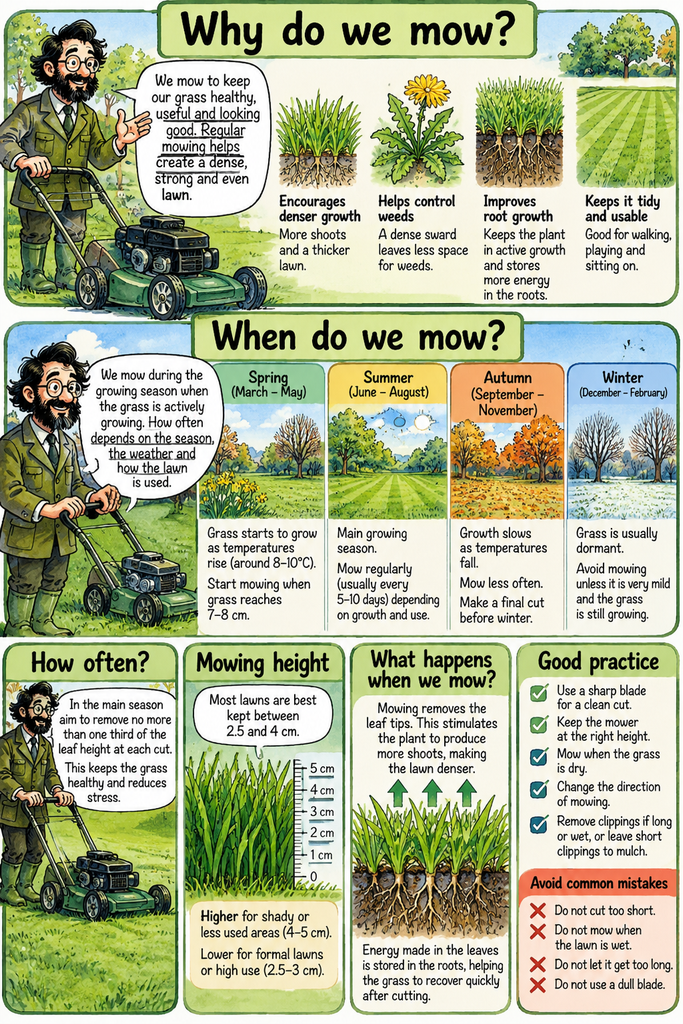
Grass grows at different rates throughout the year.
The weather affects:
- growth
- colour
- rooting
- mowing frequency
- recovery from damage
- disease
- moss
- drought stress
A lawn therefore requires different management at different times of year.
Spring
Spring is the period when grass begins to grow actively as temperatures and light levels increase.
Typical tasks include:
- mowing as required
- removing winter debris
- repairing small damaged areas
- scarifying where appropriate
- aerating compacted areas
- applying appropriate fertiliser
- reseeding
- controlling weeds
Avoid working excessively wet lawns. Walking or operating machinery on saturated soil can cause compaction and surface damage.
Spring warning
Do not automatically scarify every lawn heavily in spring. The lawn should first be assessed.
Summer
Summer can provide excellent growing conditions, but heat and drought can create considerable stress.
Tasks may include:
- regular mowing
- maintaining an appropriate mowing height
- irrigation during prolonged drought where appropriate
- repairing small damaged areas
- monitoring for pests and diseases
During hot, dry periods:
Do not scalp the lawn.
Leaving slightly more leaf area can help the grass tolerate stress.
Autumn
Autumn is often an excellent period for lawn renovation.
The soil can remain warm while temperatures become cooler and rainfall may increase.
Suitable tasks include:
- scarifying
- aeration
- removing moss and thatch
- reseeding
- patch repair
- mowing
- applying appropriate autumn fertilizer.
Autumn renovation can allow new grass to establish before winter.
Winter
Grass growth is generally reduced.
Avoid unnecessary mowing when the grass is not actively growing.
Most importantly:
Avoid walking or driving machinery repeatedly across saturated or frozen lawns.
This can cause:
- compaction
- rutting
- surface damage
- poor drainage
Winter is often more about protecting the lawn than forcing it to grow.

Signs of Lawn Stress
Before repairing a lawn, identify the symptoms.
| Symptom | Possible cause |
| Brown grass | Drought, heat, disease, animal damage or scalping |
| Yellow grass | Nutrient deficiency, waterlogging or poor roots |
| Thin grass | Compaction, shade, poor nutrition or excessive wear |
| Moss | Shade, poor drainage, acidic conditions or weak grass |
| Water pooling | Compaction or poor drainage |
| Bare patches | Wear, drought, pests, disease or physical damage |
| Long, weak grass | Insufficient mowing or poor light |
| Scalped areas | Mowing too short or uneven ground |
| Excessive thatch | Accumulation of dead organic material |
| Weeds | Thin grass and favourable conditions for weed establishment |
One symptom may have several causes.
Do not treat the symptom before identifying the cause.

Lawn Mowing
Mowing is the most regular lawn maintenance operation.
Its purpose is not simply to make the grass shorter.
Correct mowing encourages:
- tillering
- a dense sward
- an attractive appearance
- appropriate growth
- reduced competition from some weeds
The One-Third Rule
A useful mowing principle is:
Never remove more than approximately one-third of the grass leaf at one mowing.
For example, if the lawn is 6 cm high, removing approximately 2 cm is preferable to cutting it immediately down to 3 cm.
Removing too much leaf can cause:
- stress
- scalping
- reduced photosynthesis
- poor recovery
- brown patches
Mowing Height
The correct mowing height depends on:
- grass species
- lawn use
- season
- weather
- soil
- mowing frequency
A fine ornamental lawn may be maintained shorter than a hard-wearing recreational lawn.
During drought or heat, raising the mowing height can help reduce stress.
Mowing Direction
Changing mowing direction can help reduce:
- compaction
- wheel marks
- grain
- uneven growth
Alternating the direction also produces different visual patterns.
Avoid repeatedly turning machinery in exactly the same place.
Mowing Wet Grass
Mowing very wet grass can cause:
- clumping
- uneven cutting
- blocked machinery
- soil compaction
- wheel damage
- poor appearance
Where possible, wait until conditions are suitable.

Mowing Safety
Before mowing:
☐ Check the lawn for stones, branches and other objects.
☐ Check the mower.
☐ Check guards are fitted.
☐ Wear appropriate PPE.
☐ Keep other people away from the immediate working area.
☐ Never put hands near moving blades.
☐ Stop the machine before clearing blockages.

Patching a Lawn
Patch repair is suitable where damage is localised.
Examples include:
- wear
- pet damage
- small areas of drought damage
- localised disease
- removal of a small object
- damage caused by machinery
There is little point replacing an entire lawn because of a small damaged area.
Basic Patch Repair
Step 1 — Identify the cause
Do not simply cover the damaged area.
Step 2 — Remove dead material
Cut away dead grass and damaged turf.
Step 3 — Prepare the soil
Loosen the surface and remove debris.
Step 4 — Add suitable topsoil if necessary
The surface should finish level with the surrounding lawn.
Step 5 — Seed or turf
Choose a grass mixture compatible with the existing lawn.
Step 6 — Firm
Ensure good seed or turf-to-soil contact.
Step 7 — Water
Keep the repair adequately moist during establishment.
Matching the Grass
A repair can look obvious if the wrong grass mixture is used.
Consider:
- leaf colour
- texture
- growth rate
- shade tolerance
- wear tolerance
For example, a fine ornamental lawn may look very different if repaired with a coarse, vigorous grass mixture.

Laying Turf
Turf provides an almost immediate grass surface compared with seed.
It can be useful where:
- rapid establishment is required
- the area needs to look finished quickly
- conditions are suitable for establishment
- seed would be vulnerable to disturbance
However, turf is not a shortcut around poor soil preparation.
Preparing for Turf
Preparation is critical.
Remove existing vegetation
Clear the area of:
- weeds
- old grass
- roots
- stones
- debris
Prepare the soil
Cultivate the soil to a suitable depth.
Level the area
Remove hollows and high spots.
Firm the soil
The surface should be firm but not compacted.
Create a suitable final surface
The finished soil level should allow for the thickness of the turf.
Laying Turf
Turf should ideally be laid promptly after delivery.
Start with a straight edge
This provides a reference point.
Lay the turf closely
Avoid large gaps.
Stagger the joints
Like brickwork:
Row 1: █████ █████ █████
Row 2: █████ █████ █████
Row 3: █████ █████ █████
Staggering reduces the likelihood of continuous lines of weak joints.
Butt the edges together
Do not overlap the turf.
Firm the turf
Ensure good contact with the soil.
Water thoroughly
Water immediately after laying where appropriate.
Why Stagger Turf Joints?
Staggering the joints:
- reduces long continuous seams
- improves stability
- creates a stronger surface
- reduces the chance of joints opening
- gives a more natural finished appearance
This is similar to the principle used when laying bricks.
Turf Aftercare
New turf must not be allowed to dry out.
Check the turf regularly.
Signs that it may need water include:
- curling leaves
- loss of colour
- dry soil underneath
- turf lifting easily from the soil
Avoid excessive traffic until the turf has rooted.
A simple test is to carefully lift a corner.
If roots are beginning to hold the turf firmly to the soil, establishment is progressing.
Scarifying
Scarifying removes accumulated material from the surface of the lawn.
This can include:
- moss
- dead grass
- thatch
- surface debris
The purpose is to improve the relationship between:
air + water + soil + grass roots
What is Thatch?
Thatch is a layer of dead and living organic material between the grass leaves and soil surface.
A small amount can be useful.
Excessive thatch can:
- restrict water movement
- reduce nutrient penetration
- harbour pests and diseases
- encourage moss
- reduce rooting
- make the surface spongy
When to Scarify
Scarifying is generally most appropriate when grass is actively growing and able to recover.
Common periods include:
Spring
and
Early autumn
Autumn can be particularly useful because:
- soil remains relatively warm
- rainfall often increases
- grass can recover
- competition from some summer stresses is reduced
Avoid aggressive scarification during:
- drought
- extreme heat
- prolonged wet conditions
- severe cold
- periods when grass cannot recover effectively

How to Scarify
Step 1
Mow the lawn slightly shorter than normal if appropriate.
Step 2
Remove the grass clippings.
Step 3
Set the scarifier correctly.
Step 4
Work systematically.
Step 5
Remove the material brought to the surface.
Step 6
Assess the lawn.
Step 7
Reseed thin areas where necessary.
Step 8
Water appropriately.
Do Not Confuse Scarifying with Raking
Light raking removes surface debris.
Scarifying is more aggressive and removes accumulated organic material from within the turf.
Too much scarification can damage the grass.
The aim is:
Remove excess material without unnecessarily destroying the lawn.
Reseeding
Reseeding introduces new grass seed into:
- bare patches
- thin areas
- worn areas
- renovated lawns
It can be used following scarification.
When to Reseed
The best conditions are generally when:
- soil temperatures are suitable
- moisture is available
- grass can establish
- competition from existing grass is manageable
Spring and early autumn can be suitable.
Early autumn is often particularly favourable.
Avoid sowing during severe drought unless reliable irrigation is available.
Reseeding Process
1. Prepare the surface
Remove dead material and loosen the soil.
2. Select the seed
Choose a mixture suitable for:
- light
- soil
- wear
- lawn use
3. Sow evenly
Avoid creating dense clumps.
4. Lightly cover
Seed should have suitable contact with the growing medium.
5. Firm
Good seed-to-soil contact improves establishment.
6. Water
Keep the seedbed appropriately moist.
7. Protect
Reduce traffic until the grass is established.
Lawn Renovation
Sometimes several operations are required together.
For example:
Mow
↓
Scarify
↓
Aerate if required
↓
Top-dress if appropriate
↓
Reseed
↓
Water
This is called lawn renovation.
It is more intensive than normal maintenance.
Aeration
Compaction can reduce the amount of air available to roots and restrict water movement.
Aeration creates channels through the surface.
Methods include:
- garden fork
- hollow-tine aerator
- solid-tine aerator
- mechanical aerator
The appropriate method depends on the severity of compaction and the type of lawn.
Seasonal Lawn Management
| Season | Main considerations |
| Winter | Protect from compaction; avoid unnecessary traffic; limited mowing |
| Spring | Growth increases; mowing, repair, scarification and reseeding may be appropriate |
| Summer | Monitor drought and heat stress; raise mowing height where appropriate |
| Autumn | Excellent period for renovation, scarifying and reseeding |
| Winter | Protect the established lawn and avoid working saturated ground |

Signs of Lawn Stress
A stressed lawn may show:
☐ Yellowing
☐ Browning
☐ Wilting
☐ Thin growth
☐ Bare patches
☐ Excessive moss
☐ Poor rooting
☐ Footprint retention
☐ Water pooling
☐ Uneven growth
☐ Increased weed invasion
The symptoms are clues.
The gardener needs to identify the cause.
Common Causes of Stress
Drought
Grass may:
- lose colour
- wilt
- become brown
- stop growing
Compaction
May cause:
- poor drainage
- shallow roots
- weak growth
- moss
- waterlogging
Excessive shade
Can result in:
- thin grass
- weak growth
- moss
Incorrect mowing
Cutting too short can cause stress.
Poor nutrition
Can produce weak or pale growth.
Waterlogging
Roots may suffer from reduced oxygen availability.
Excessive wear
Repeated foot traffic can damage the sward.
Choosing the Correct Operation
| Problem | Possible solution |
| Small bare patch | Patch repair |
| Thin lawn | Reseeding and improved management |
| Excessive thatch | Scarification |
| Compaction | Aeration |
| Entire lawn beyond repair | Turf replacement or major renovation |
| Drought stress | Improve moisture management and mowing practice |
| Moss | Identify underlying cause; improve conditions and scarify where appropriate |
| Poor drainage | Investigate soil and drainage before reseeding |
| Uneven surface | Levelling/top-dressing as appropriate |
PPE and Health & Safety
| Task | Main hazards | Typical controls / PPE |
| Mowing | Flying objects, noise, moving blades | Eye/face protection, hearing protection, safety footwear |
| Scarifying | Flying debris, noise | Eye/face protection, hearing protection, safety footwear |
| Turf laying | Manual handling, kneeling | Gloves, safety footwear, suitable manual handling |
| Reseeding | Dust, repetitive work | Gloves; avoid unnecessary dust |
| Aeration | Manual handling | Gloves, safety footwear, appropriate technique |
| Using powered equipment | Noise, vibration, moving parts | Equipment-specific PPE and training |
| Wet ground | Slips and machinery damage | Assess ground conditions before work |
Always follow the manufacturer’s instructions for powered equipment.
Practical Lawn Assessment
Inspect the Lawn
Site: ______________________________
Date: ______________________________
Season: _____________________________
What can you see?
☐ Brown areas
☐ Yellow areas
☐ Bare patches
☐ Moss
☐ Thatch
☐ Weeds
☐ Compaction
☐ Waterlogging
☐ Thin grass
☐ Excessive wear
Diagnose
Most likely cause of the problem:
Evidence for your diagnosis:
Recommended treatment:
Practical Task
Choose one area of lawn requiring maintenance.
Decide whether it requires:
Mowing / Patch repair / Turfing / Scarifying / Reseeding / Aeration / Combination
Explain your decision
What season is it?
Is this the appropriate time to carry out the work?
What risks are associated with the task?
Student Questions
1. Why should no more than approximately one-third of the grass leaf normally be removed at one mowing?
2. Why might mowing too short stress a lawn?
3. What is the difference between patch repair and replacing an entire lawn?
4. Why should turf joints be staggered?
5. What is the purpose of scarifying?
6. Why can excessive thatch be a problem?
7. Why is early autumn often a good time for reseeding?
8. Name three signs of lawn stress.
9. Why should a lawn not normally be worked when it is saturated?
10. Why should the cause of a lawn problem be identified before treatment?
The Professional Lawn-Care Sequence
When faced with a poor lawn, do not immediately reach for the mower.
Use this sequence:
OBSERVE
What can you see?
↓
DIAGNOSE
What is causing the problem?
↓
PLAN
What operation is appropriate?
↓
SELECT
What tools, machinery, materials and PPE are required?
↓
PREPARE
Is the soil and weather suitable?
↓
CARRY OUT
Complete the work correctly.
↓
AFTERCARE
Water, protect and monitor.
↓
REVIEW
Has the lawn improved?
Remember
A lawn is a living system.
If it is thin, brown, mossy or damaged, the answer is not always more fertiliser or more water.
The problem might be:
Compaction.
Poor drainage.
Shade.
Drought.
Incorrect mowing.
Excessive wear.
Thatch.
Or simply the wrong grass for the situation.
The professional gardener learns to read the lawn before deciding what to do.
Mowing maintains it.
Patching repairs it.
Turfing replaces it.
Scarifying renovates it.
Reseeding rebuilds the grass population.
And the seasons tell you when each operation has the best chance of success.
Key references
- Royal Horticultural Society (RHS), guidance on lawn care, mowing, scarifying, reseeding and turfing.
- Royal Horticultural Society (RHS), guidance on repairing and renovating lawns.
- Health and Safety Executive (HSE), guidance on safe use of garden machinery.
- Provision and Use of Work Equipment Regulations 1998 (PUWER).
- Personal Protective Equipment at Work Regulations 1992, as amended.
- Management of Health and Safety at Work Regulations 1999.
CLASS MATERIALS