
The book, the legend.
Mr Pêche Explains…

Introduction
Chapter One: Garden Health, Soil Life and Biodiversity.
A healthy garden is not simply a garden that looks tidy, it is a fully functioning ecosystem. What does this mean? It contains interactions between a multitude of different aspects. These include the following:

The gardener is therefore part of this system. Every action we take can affect something else.
Gardening affects flowering plants. Flowering plants affect insects. Insects affect birds. Birds affect pest populations. Organic matter affects microorganisms. Microorganisms affect nutrient availability. Roots interact with fungi and bacteria. When we inhale the smell of a healthy soil, that is affecting our gut microbiome (in a good way!) – which makes us want to garden more.
The important principle is:
A garden is a system of relationships rather than a collection of individual plants.

The Carbon Cycle
Plants absorb carbon dioxide during photosynthesis. Carbon is incorporated into plant tissues. When plants: die, shed leaves, release root exudates, are eaten they all form part of the carbon cycle.
Carbon also enters other parts of the ecosystem via other means: Some carbon returns to the atmosphere.
Some remains in the soil as organic matter, in roots and in woody material. Therefore garden management affects carbon cycling.
Garden Biodiversity
Biodiversity means the variety of life. In a garden, biodiversity can include:
Plant diversity – Trees, shrubs, herbaceous plants, grasses, wildflowers, climbers.
Animal diversity – Insects, spiders, birds, mammals, amphibians, reptiles.
Soil biodiversity – Bacteria, fungi, protozoa, nematodes, earthworms, mites, springtails.
Thus a biodiverse garden contains many interactions.

Why Does Biodiversity Matter?
Biodiversity can contribute to:
- pollination
- pest regulation
- decomposition
- nutrient cycling
- soil formation
- resilience
- habitat provision
A diverse ecosystem can sometimes be more capable of responding to environmental change.
However: Biodiversity is not a magic solution to every gardening problem.
Structural Diversity
Biodiversity is not simply about counting plant species. A gardener should also consider:
Vertical Structure
Canopy / Shrub layer / Herbaceous layer / Ground layer / Soil / Underground habitat
Remember: A garden containing several layers can provide habitat for more organisms than a garden with only a short lawn.

Habitat Diversity
Different habitats support different organisms.
A garden might contain a pond, a hedge, meadow, lawn, woodland edge, flower border, compost heap, dead wood, bare soil, rockery, tree canopy
Even a small garden can contain several habitats.

Dead Wood Is Not Dead to Everything
Bearing in mind that we are talking biodiversity, remember everything in the garden has purpose. Dead does not mean ‘dead to the world’. Remember dead wood can support:
- fungi
- beetles
- larvae
- bacteria
- mosses
- lichens
Standing dead wood can provide:
- nesting sites
- feeding sites
- shelter
Therefore: Tidying everything away can reduce biodiversity.
Nb: Safety must always come first, particularly where dead trees or branches present a hazard.
Soil Trophisms
A trophic level describes a position within a feeding relationship.
In a garden, organisms can be broadly grouped as:
Decomposers (these recycle)
Organisms that break down dead organic material. They can be beneficial as well as destructive, but they are a natural part of any garden lifecycle.
Fun Fact: The largest living single organism is a fungus that exists in North America. It stretches 2385 acres or 3.7 square miles!
Important decomposers include:
- bacteria
- fungi
Producers
Plants and other photosynthetic organisms.
They capture energy from sunlight.
Primary consumers
Organisms that feed directly on plants or plant material.
Examples include:
- aphids
- caterpillars
- slugs
- some nematodes
Secondary consumers
Predators that feed on other animals.
Examples include:
- ladybirds
- spiders
- predatory beetles
- birds
These relationships are not always simple. (Many organisms occupy more than one ecological role.)

*The Soil Food Web Is Not a Simple Food Chain*
A food chain suggests:
A → B → C → D
Real soil systems are much more complicated.
They are better represented as a ‘Web’ because organisms may have several food sources and several predators.
For example:
Plant roots can interact with:
- fungi *
- bacteria
- herbivores
*Fungi can interact with:
- plant roots
- bacteria
- soil animals and other microorganisms*
Predatory nematodes can feed on:
- other nematodes
- *microorganisms
This creates a complex network.
Microorganisms
Microscopic organisms are fundamental to soil health.
Important groups include:
- bacteria
- fungi
- archaea
- protozoa
They contribute to:
- decomposition
- nutrient cycling
- organic matter breakdown
- soil aggregation
- carbon cycling
- plant interactions
A teaspoon of healthy soil may contain an enormous number of microorganisms.
Most are not visible to the gardener.
Fun Fact: Many soil microorganisms are beneficial to humans. Some are antibiotics, some are anti-depressants, some are needed in our gut, some are needed on a our skin. Interacting with a healthy soil actually produces happy chemicals in our brain!
Bacteria
Bacteria are extremely important in soil.
They participate in:
- decomposition
- nutrient cycling
- nitrogen transformations
- organic matter breakdown
Some bacteria live close to plant roots.
The area immediately surrounding roots is called the: Rhizosphere
The rhizosphere can contain a particularly active microbial community.
The Rhizosphere
The rhizosphere is the zone of soil directly influenced by plant roots.
Roots release substances known as:
root exudates
These can include:
- sugars
- amino acids
- organic acids
- other compounds
These substances influence microbial communities around the root.
In return, microorganisms can influence:
- nutrient availability
- root growth
- plant health
- soil structure
The root is therefore not simply sitting in the soil.
It is interacting with the soil ecosystem.

Fungi
Fungi are major components of healthy soils.
They can:
- decompose organic matter
- break down difficult-to-decompose materials
- contribute to soil structure
- interact with plant roots
- form important ecological relationships
The visible mushroom is only part of the organism.
Most of the fungal body may be hidden within the soil or organic material.
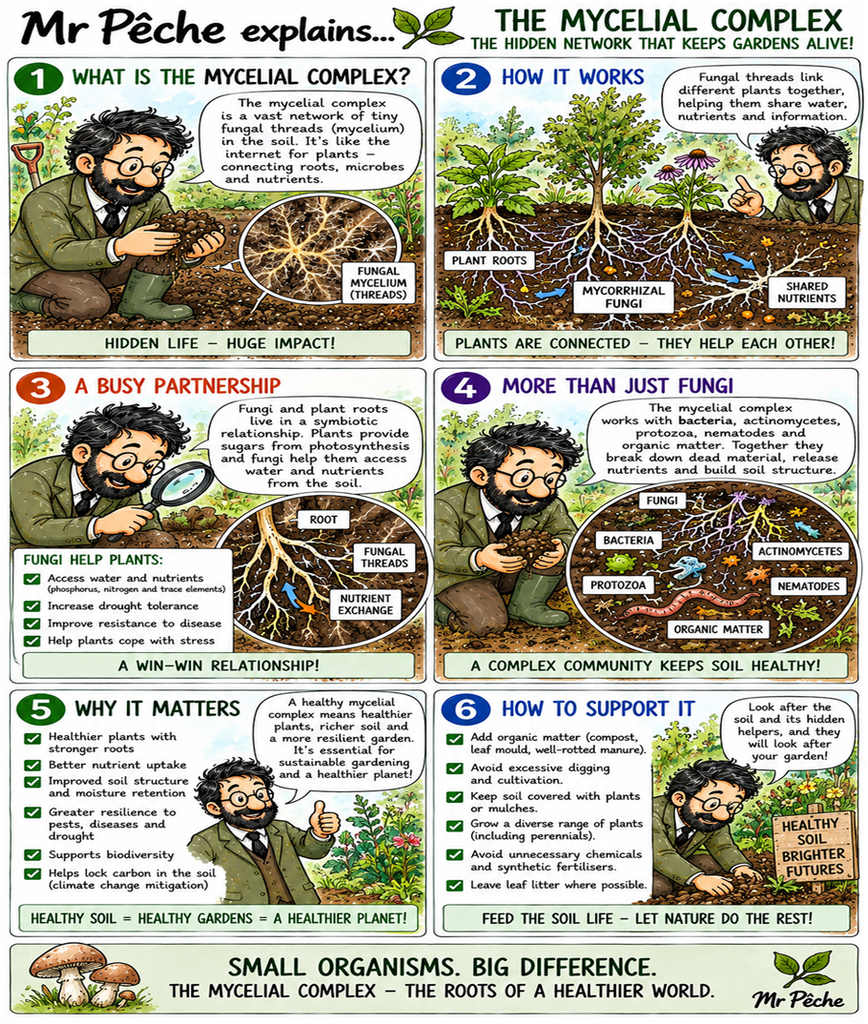
The Mycelial Complex
The network of fungal threads is called:
mycelium
Individual fungal threads are called:
hyphae
Together they can form an extensive underground network.
Think of it as:
a living underground network rather than a collection of mushrooms.
Mushrooms are reproductive structures produced by some fungi.
The mycelium may remain in the soil long after the mushroom disappears.
Mycorrhizal Fungi
Some fungi form close relationships with plant roots.
These are called:
mycorrhizae
The relationship can benefit both partners.
The fungus may help the plant access:
- water
- phosphorus
- other nutrients
The plant supplies the fungus with carbon compounds produced through photosynthesis.
This is an example of: Symbiosis
Not All Fungi Are Beneficial
This is important.
“Fungi are good for the garden” is too simplistic.
Fungi can be:
- decomposers
- mutualists
- pathogens
Some fungal species cause plant diseases. Therefore, the aim is not: “Remove all fungi.”
It is: Maintain a diverse and functioning fungal community.
Mycorrhizae and Garden Management
Some gardening practices can influence fungal communities.
These include:
- excessive cultivation
- soil disturbance
- fungicide use
- fertiliser application
- compaction
- loss of organic matter
However, claims about commercial “mycorrhizal products” should be treated critically.
Not every plant needs a commercially supplied mycorrhizal inoculant.
The existing soil may already contain suitable fungi.
Earthworms
Earthworms are important soil organisms, helping open the soil pores as well as breaking down dead material into nutrients for other organisms to feed on and in turn release for plants to consume. They are also becoming rarer! (Some are endangered) .
They can:
- create channels
- improve soil aeration
- redistribute organic material
- contribute to nutrient cycling
- produce casts
Earthworm activity can help create a more porous soil structure. However: More worms does not automatically mean better soil. Different earthworm species occupy different parts of the soil profile and have different ecological roles. In dry weather they dive deeper to stay moist, in wet weather they may come to the surface to avoid drowning.
Decomposition
When leaves, stems and roots die, they do not simply disappear.
They enter a decomposition process. A simplified sequence is:
Dead organic material
↓
Fungi and bacteria
↓
Smaller organic particles
↓
Soil organisms
↓
Nutrients released
↓
Plant uptake:
This interaction is part of nutrient cycling and ultimately helps your soil to have not only biodiversity but also balance.
Remember: Nature wants balance and a garden as much as we describe it as ‘balanced’ is (to nature) an abomination. Gardens are a falsehood – a creation and a mechanism of control. If we look at gardens as an invention aside from nature, then it is easier to understand why it feels like we are constantly fighting it!

The Role of Weeds in a garden
This is a very contentious, perhaps even a controversial subject and leads to much argument. Conservationists describe gardeners with derision. Gardeners in turn describe conservationists as messy and uncoordinated. Both statements are true and both statements are false in equal measure!
The word Weed describes a plant growing where it is not wanted.
It does not necessarily mean: An ecologically worthless plant. Some plants commonly regarded as weeds provide:
- nectar
- pollen
- seeds
- shelter
- food for caterpillars
- soil cover
It is therefore good to remember the following tenet: “The correct management question is: Does this plant need controlling here? rather than: Is this plant good or bad?”
Leading from this one must ask another question.
Is Garden Health Is More Than Appearance?
A garden can look perfectand still have poor ecological health.
For example:
- a closely mown lawn may contain very little plant diversity
- a heavily sprayed border may contain few insects
- bare soil may provide little habitat
- imported ornamental plants may provide limited food for native insects
- excessive tidying can remove overwintering habitat
- artificial fertilisers can disrupt nutrient relationships
- excessive irrigation can alter soil biology
Conversely, a garden with fallen leaves; dead stems; amounts of moss; insects; fungi; rough grassed areas; may actually have considerable ecological value. It is up to the gardener to see this ecological value and to assess it for it’s aesthetic benefit. Perhaps a stand of nettles appear ugly (or even threatening), but it is a vital source of food for certain insects such as butterflies. The hollow stems are also important over-wintering opportunities for predators like the lace-wing. You decide.
The Soil Food Web
Soil is not simply a mixture of minerals.
It contains a complex food web.
Plants capture energy through photosynthesis.
That energy enters the soil ecosystem through:
- roots
- root exudates
- dead leaves
- dead roots
- organic matter
This supports microorganisms and other organisms.
A simplified sequence is:
Plants – Bacteria and fungi – Protozoa and nematodes – Earthworms and arthropods – Larger predators. This is sometimes described as the: Soil food web

So. What Do We Mean by Garden Health?
Garden health describes the overall condition and functioning of a garden ecosystem. A healthy garden should be able to:
- support a variety of organisms
- cycle nutrients
- retain and filter water
- maintain healthy soils
- support plant growth
- provide habitat
- recover from disturbance
- resist or tolerate environmental stress
This does not mean that every garden must look wild. A formal garden can still be ecologically healthy. The important question one must ask ourselves is:
How well does the garden function?
Garden Health, Microbes and Biodiversity
A healthy garden is not necessarily a tidy garden. Nor is a wild-looking garden automatically healthy. Garden health is about function. A healthy garden should be capable of:
- cycling nutrients
- supporting plant growth
- providing habitat
- retaining and filtering water
- supporting a diversity of organisms
- responding to environmental stress
Therefore it is important to fist understand the soil food web. Plants are producers. They support herbivores and microorganisms. These support predators and decomposers. The resulting relationships form a food web rather than a simple food chain.
Mycelium
The visible mushroom is often only the reproductive structure of a much larger organism. The main body may consist of microscopic (sometimes much larger) threads called Hyphae. Together these form the Mycelium. This network can occupy large areas of soil or organic material. It is one reason why soil should be thought of as a living environment rather than an inert substance.

Biodiversity action plans
What is a Biodiversity Action Plan? It is a method to which you, as the gardener or land manager can establish a baseline of what already exists and research ways to encourage a wider biodiversity into the garden. This may include putting up bat and bird boxes, composting more waste, reducing the use of heavy machinery.
A biodiversity plan should establish:
- What exists?
- What is missing?
- What should change?
- What action is required?
- Who will carry it out?
- How will success be measured?
Plans often fail because they become statements of intention rather than practical management documents. “Improve biodiversity” is not an adequate objective. “Provide flowering plants from March to October and record pollinator activity monthly” is measurable.
Soil Health and the Living Soil
All soil is alive (or should be). Within it are bacteria, fungi, protozoa, nematodes, mites, springtails, worms and many other organisms. Together these form a complex food web. Plants provide carbon. Microorganisms decompose organic matter. Predators feed upon smaller organisms. Nutrients move through the system. The soil is therefore not simply a warehouse of nutrients. It is a functioning ecosystem.
The rhizosphere
The area immediately surrounding plant roots is called the rhizosphere. Roots release compounds into this area which influence microbial activity. Plants and microorganisms therefore interact continuously below ground.
Mycorrhizal fungi
Some fungi form associations with plant roots. The fungal network can extend beyond the immediate root system and help plants access water and nutrients. In return, the plant provides carbon compounds to the fungus. This is one example of the complex relationships hidden beneath the soil surface.
Garden Health and Soil Cultivation *. The Benefits and Pitfalls. (see other chapters as to how to do it)
Cultivation can:
- relieve some forms of compaction
- prepare seedbeds
- incorporate organic matter
But excessive cultivation can:
- disturb soil organisms
- damage fungal networks
- break soil aggregates
- expose organic matter to rapid decomposition
- disturb soil structure
*Nb. This obvious imbalance between pros and cons is one reason why reduced-digging approaches have become increasingly popular.
No-Dig and Garden Health
No-dig systems aim to minimise soil disturbance. Potential benefits include:
- reduced disturbance of soil organisms
- protection of soil structure
- improved organic matter
- reduced erosion
- less disruption to fungal networks
However, no-dig is not a universal answer. Problems can occur if:
- excessive compost is applied
- weeds are not managed
- organic material is poorly sourced
- the system is applied without understanding the soil
- perennial weeds are ignored
Good horticulture therefore requires understanding rather than following a method as a rule.
Using a garden Biodiversity Action Plan for your garden
A biodiversity action plan sets out what you want to achieve and how you intend to achieve it. A simple garden action plan might include:
- Survey the existing site.
- Identify habitats.
- Identify important species.
- Identify problems.
- Set objectives.
- Choose actions.
- Allocate responsibilities.
- Set timescales.
- Monitor results.
- Review and adapt.
Example Garden Biodiversity Action Plan
| Objective | Action | Timescale | Indicator of success |
| Increase pollinators | Increase flowering plants | Spring | More pollinator observations |
| Improve soil | Add suitable organic matter | Autumn | Improved structure |
| Increase habitat | Retain suitable dead wood | Winter | Increased habitat use |
| Reduce pesticide use | Introduce IPM | Ongoing | Reduced applications |
| Improve bird habitat | Plant native shrubs | Autumn | Increased bird activity |
| Improve water habitat | Create/maintain pond | Autumn | Aquatic species observed |
Where Biodiversity Action Plans Fall Down
A plan can look excellent on paper and still fail. Common reasons include:
1. No baseline survey
If you do not know what was there originally, how can you measure improvement?
2. Vague objectives
“Improve biodiversity” is difficult to measure.
It is better if you follow a more rigorous approach, perhaps: “Increase the number of flowering plant species available to pollinators from March to October.”
3. No responsibility
Who is actually going to do the work?
4. No money
Actions may require: plants; materials; tools; labour; monitoring.
5. No timescale
Without deadlines, actions can simply be postponed.
6. Poor monitoring
If you do not measure the result, you do not know whether the action worked.
7. Targeting fashionable species
A biodiversity plan should be based on the site rather than simply copying popular environmental projects. All gardens are unique spaces and many have different soils.
8. Creating the wrong habitat
A pond in the wrong location or poorly designed habitat can provide little ecological value.
9. Excessive management
A habitat may be created successfully and then destroyed by inappropriate maintenance.
10. Failure to adapt
Environmental management should be: plan → do → monitor → review
not: plan → forget.
Biodiversity: More Is Not Always Better
This is an important point.
Introducing more species does not automatically improve biodiversity.
For example:
- invasive plants can damage native ecosystems
- inappropriate planting can reduce habitat value
- excessive fertilisation can favour a small number of vigorous species
- introducing animals without understanding their needs can cause problems
The aim is appropriate biodiversity rather than simply maximum biodiversity.
Native Plants
Native plants can provide valuable resources for local wildlife. However native does not automatically mean good and non-native does not automatically mean bad.
Some non-native ornamental plants provide:
- nectar
- pollen
- shelter
- structural diversity
The ecological value of a plant depends on:
- species
- cultivar
- flowering period
- structure
- location
- management

Garden Health and Climate Change
Gardens are increasingly affected by drought; heat; intense rainfall; storms; altered pest; populations; changing growing seasons.
Healthy soils and diverse planting can contribute to resilience.
Useful measures include, improving soil structure; increasing organic matter appropriately; selecting suitable plants; providing shade; retaining water; increasing habitat diversity; reducing unnecessary disturbance.
The Healthy Garden Model
Think of garden health as a series of connected layers.
Layer 1 – Soil
Minerals + organic matter + air + water
Layer 2 – Microorganisms
Bacteria + fungi
Layer 3 – Soil organisms
Worms + nematodes + arthropods
Layer 4 – Plants
Roots + stems + leaves + flowers
Layer 5 – Herbivores and pollinators
Insects + slugs + other animals
Layer 6 – Predators
Birds + spiders + beetles + mammals
Layer 7 – The gardener
Management decisions affect all the layers!
Practical Garden Health Survey
Site: ______________________________
Date: ______________________________
Soil
☐ Good structure
☐ Compacted
☐ Waterlogged
☐ Dry
☐ High organic matter
☐ Low organic matter
Plants
Number of plant species observed:
Pollinators
☐ Bees
☐ Hoverflies
☐ Butterflies
☐ Moths
☐ Other
Predators
☐ Ladybirds
☐ Spiders
☐ Beetles
☐ Birds
☐ Other
Soil organisms
☐ Earthworms
☐ Fungi
☐ Springtails
☐ Other
Habitat
☐ Hedge
☐ Pond
☐ Long grass
☐ Dead wood
☐ Flower border
☐ Bare soil
☐ Compost area
Garden Biodiversity Action Plan Exercise
Choose one area of the garden.
1. What is currently present?
2. What is missing?
3. What is the main problem?
4. What biodiversity improvement would you like to make?
5. What action will you take?
6. When will you do it?
7. Who will be responsible?
8. How will you measure success?
9. What could go wrong?
10. How could the plan be changed?
Student Questions
1. What is biodiversity?
2. What is the soil food web?
3. What is the rhizosphere?
4. What is mycelium?
5. What is a mycorrhizal relationship?
6. Why are fungi important in soil?
7. Give three examples of soil organisms.
8. What is a trophic level?
9. Why can dead wood be valuable in a garden?
10. Why is excessive tidying sometimes harmful to biodiversity?
11. Give three ways a gardener can improve garden biodiversity.
12. Why can biodiversity action plans fail?
The Golden Rule of Garden Health
A garden is not healthy because it is:
tidy.
It is not healthy because it contains:
lots of plants.
And it is not healthy simply because it has:
lots of insects.
Garden health is about the relationships between living organisms and their physical environment.
The soil supports the plants.
The plants support microorganisms.
The microorganisms help cycle nutrients.
The plants support insects.
The insects support predators.
Dead material returns to the soil.
The gardener influences all of these processes.
Good gardening therefore becomes less about controlling every part of nature and more about managing relationships within a living system.
The most useful question is not:
“How do I make this garden look perfect?”
It is:
“How can I make this garden function better?”
Key references
- Royal Horticultural Society (RHS), guidance on soil health, garden biodiversity, wildlife gardening, composting and sustainable horticulture.
- Natural England, guidance on biodiversity, habitats and ecological management.
- Department for Environment, Food & Rural Affairs (Defra), biodiversity and environmental improvement guidance.
- Soil Association, resources on soil health and soil biodiversity.
- British Ecological Society, resources on ecology, biodiversity and ecosystems.
- Coleman, D.C., Crossley, D.A. and Hendrix, P.F., Fundamentals of Soil Ecology.
- van der Heijden, M.G.A., Bardgett, R.D. and van Straalen, N.M., research on soil biodiversity and ecosystem functioning.