The Basics of Garden Design
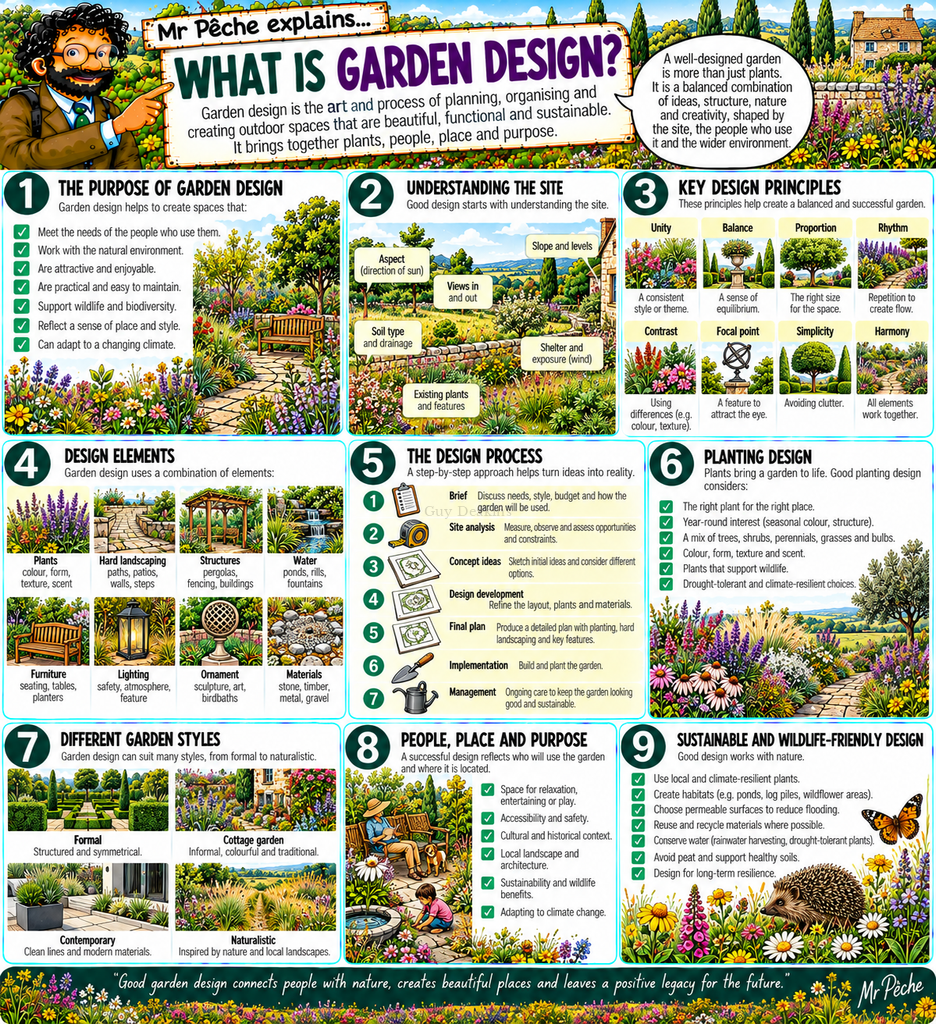
Garden design is the process of organising plants, materials, structures and open spaces to create an attractive, functional and sustainable outdoor environment. A successful garden responds to its location, the needs of its users, the character of the site and the conditions in which plants must grow.
Garden design combines practical horticultural knowledge with principles of visual composition. Understanding space, proportion, balance, rhythm, colour, texture and form helps gardeners create spaces that are both aesthetically pleasing and useful.
1. Understanding the Site
Before developing a design, the site must be assessed. A site survey provides the information needed to make appropriate design decisions. Remember the key tenet: Site; Soil; Situation
Important considerations include:
- Aspect and sunlight: Identify sunny and shaded areas, including seasonal changes in light.
- Soil: Assess soil texture, structure, drainage, fertility and pH (see other chapters).
- Topography: Record slopes, level changes and potential drainage problems.
- Climate and exposure: Consider prevailing winds, frost pockets, rainfall and heat.
- Existing features: Record trees, boundaries, buildings, paths, utilities and structures that may need to be retained.
- Users and purpose: Establish who will use the garden and whether it needs to provide recreation, privacy, food production, wildlife habitat or accessible circulation.
A design that responds to these conditions is more likely to succeed than one based on appearance alone.
2. Function and Layout
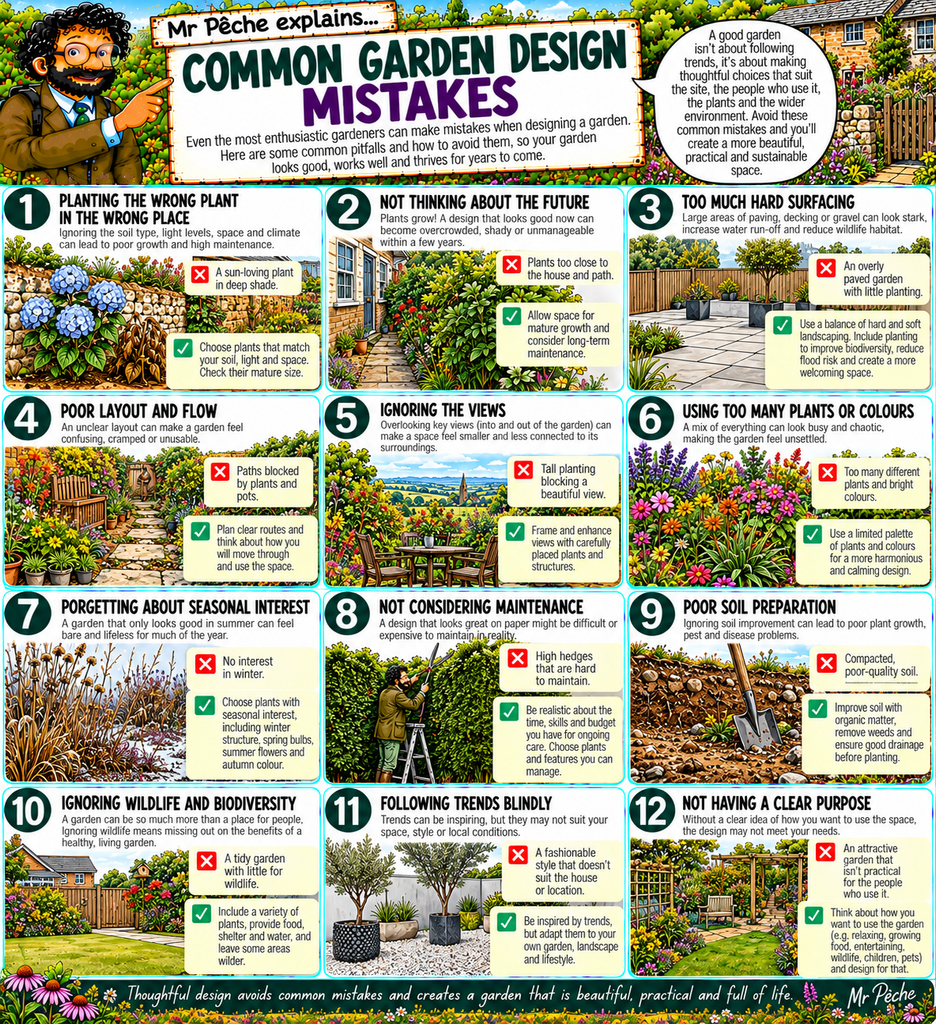
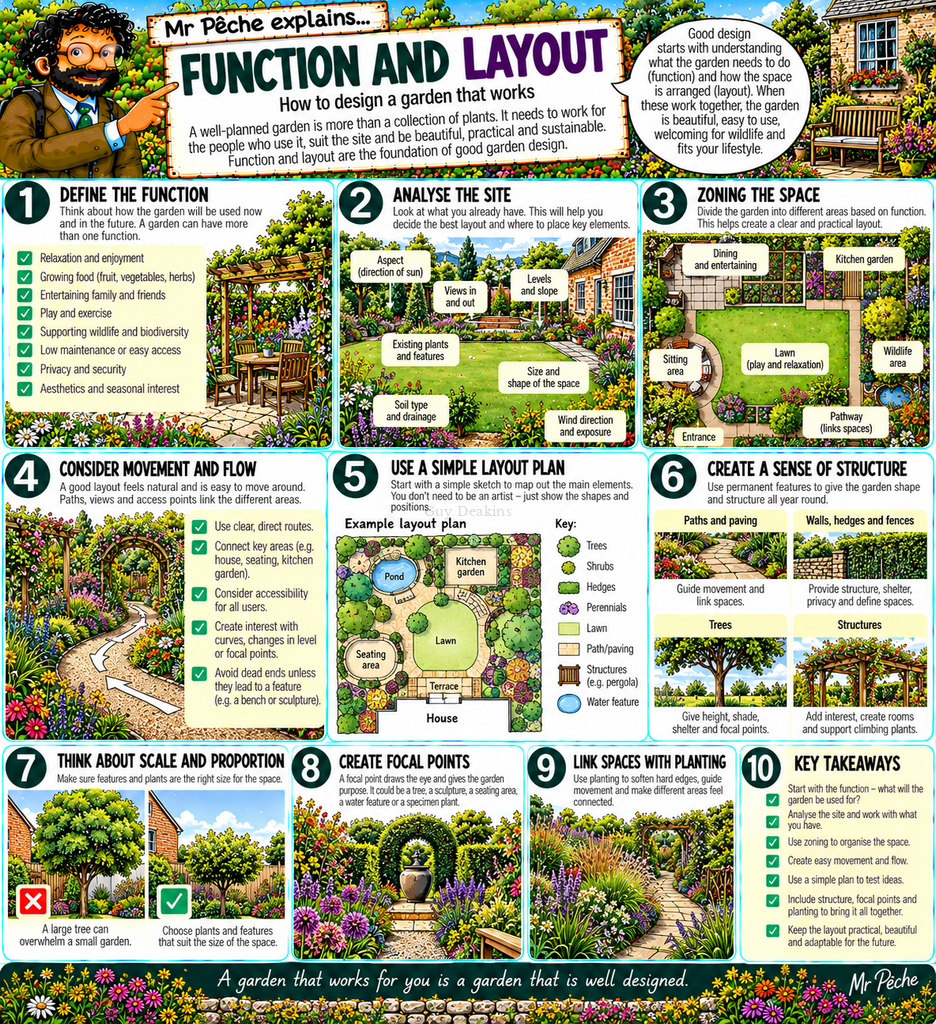
The first stage of planning is to identify the activities the garden must accommodate. These may include seating, entertaining, play, growing vegetables, composting, storage or quiet relaxation.
The garden can then be divided into functional areas, sometimes called zones. Paths and circulation routes connect these areas and should provide convenient, safe movement. Their width, surface and gradients must reflect the intended users, maintenance requirements and accessibility needs.
A clear layout helps prevent overcrowding and ensures that practical features are integrated into the overall design.
3. Space, Scale and Proportion
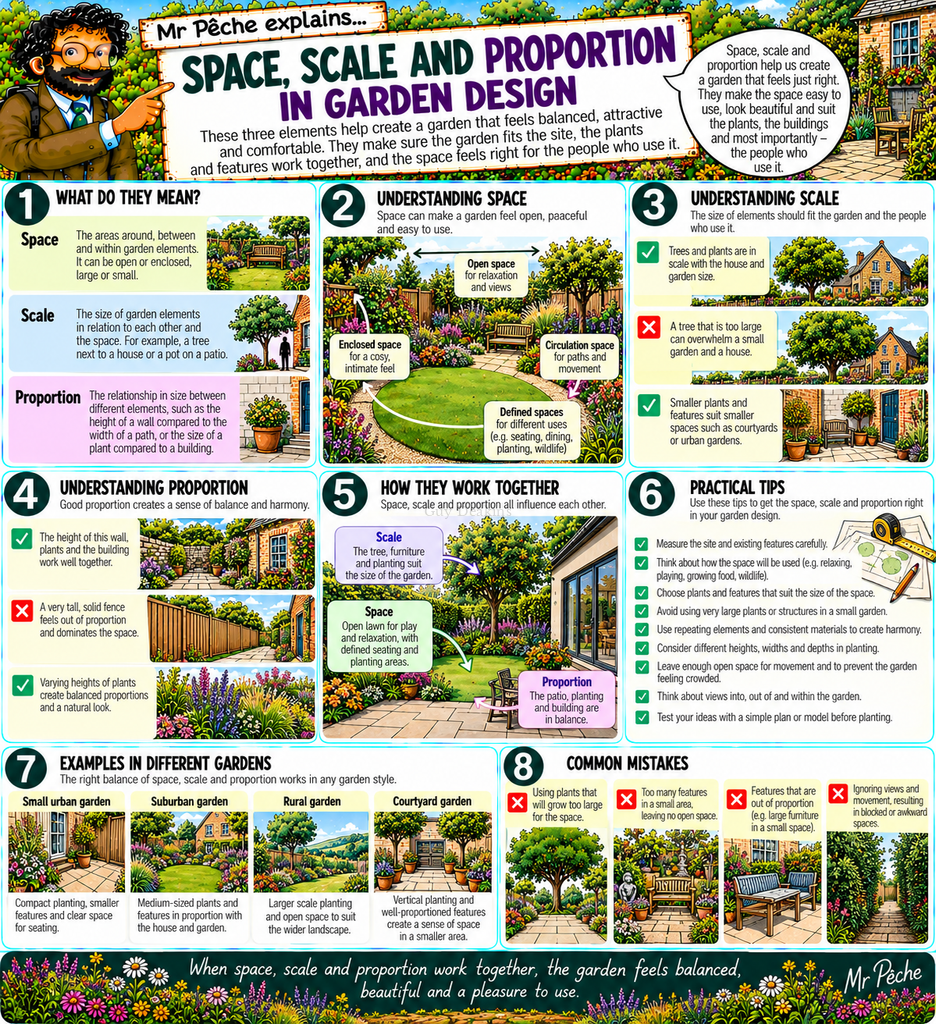
Space refers to the areas between and around garden features. Scale describes the relative size of an object in relation to its surroundings, while proportion concerns the relationship between the sizes of different elements.
Large trees may dominate a small garden, while tiny plants can appear insignificant in a large landscape. Choosing appropriately sized plants and structures helps establish visual harmony.
Designers consider both positive and negative space. Positive space is occupied by features such as planting beds, buildings and furniture. Negative space is the open area around them, including lawns, courtyards and clearings. Open space is not wasted space: it allows the eye to rest and gives individual features room to be appreciated.
4. Balance and Unity
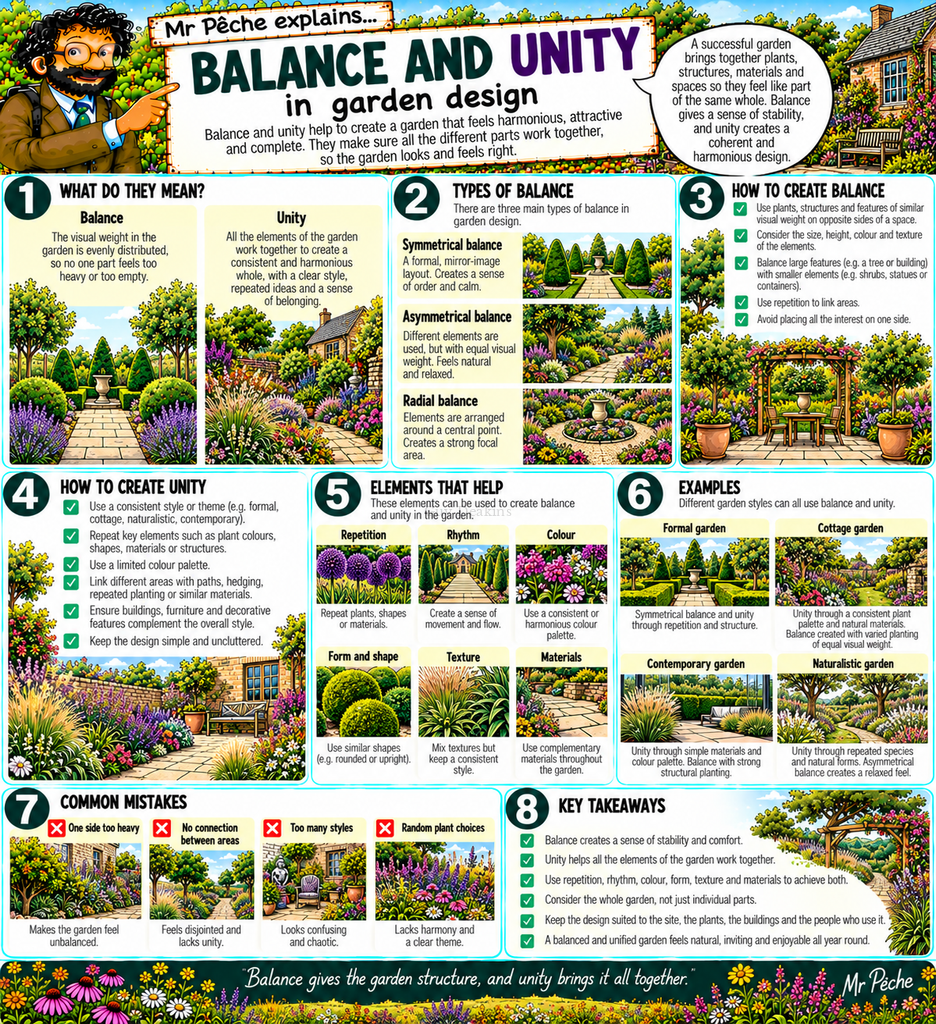
Balance concerns the visual distribution of weight within a design.
- Symmetrical balance: Features are arranged similarly on either side of a central line. This often creates a formal appearance.
- Asymmetrical balance: Different features are arranged to achieve visual equilibrium without mirroring each other. This can produce a more naturalistic effect.
Unity is achieved when the different parts of a garden appear to belong together. Repeating materials, colours, plant forms or design motifs can create coherence. However, excessive repetition may make a garden monotonous, so variation is also important.
5. Rhythm, Repetition and Movement
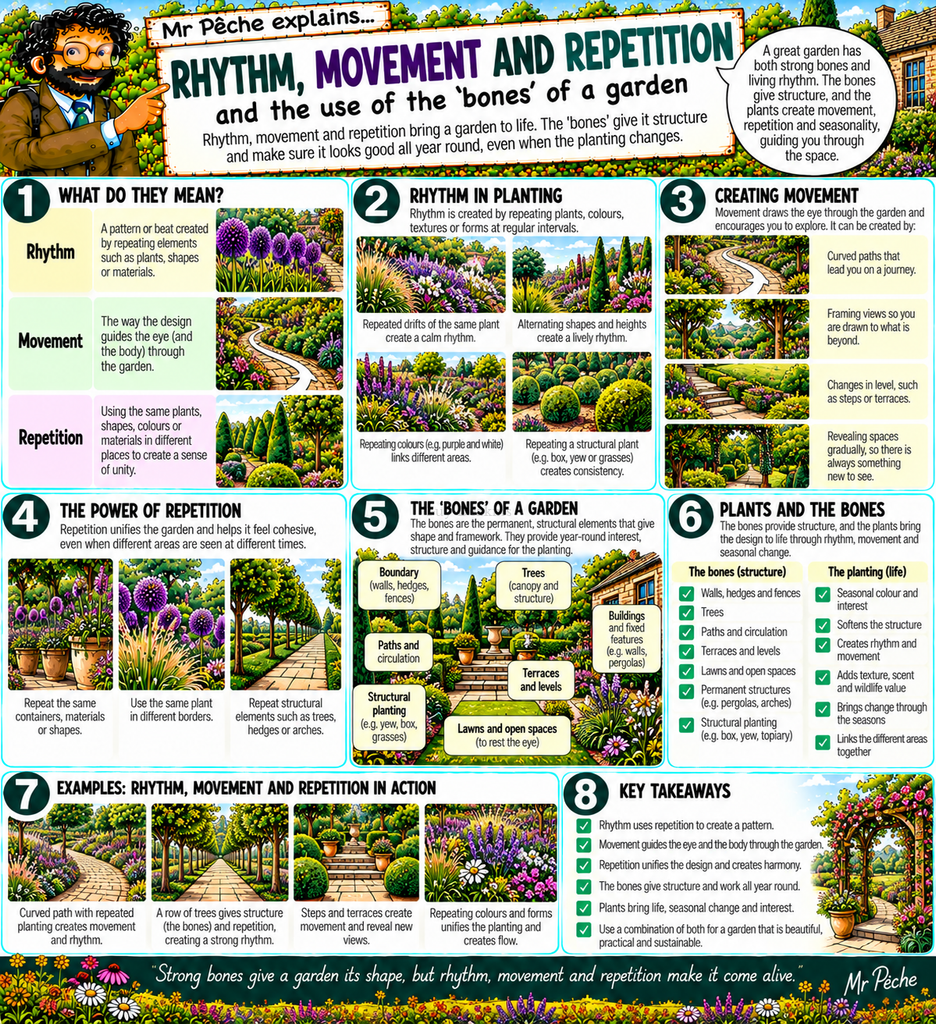
Rhythm guides the eye through a garden. It can be created by repeating plants, paving patterns, structural elements or changes in height.
Repetition provides continuity, while changes in form, colour or texture introduce interest. A sequence of trees along a path, repeated groups of ornamental grasses or regularly spaced containers can establish rhythm.
Movement also arises from the way people travel through a space and from natural processes such as the movement of grasses in the wind, flowing water and seasonal changes in vegetation.
6. Form, Line and Texture
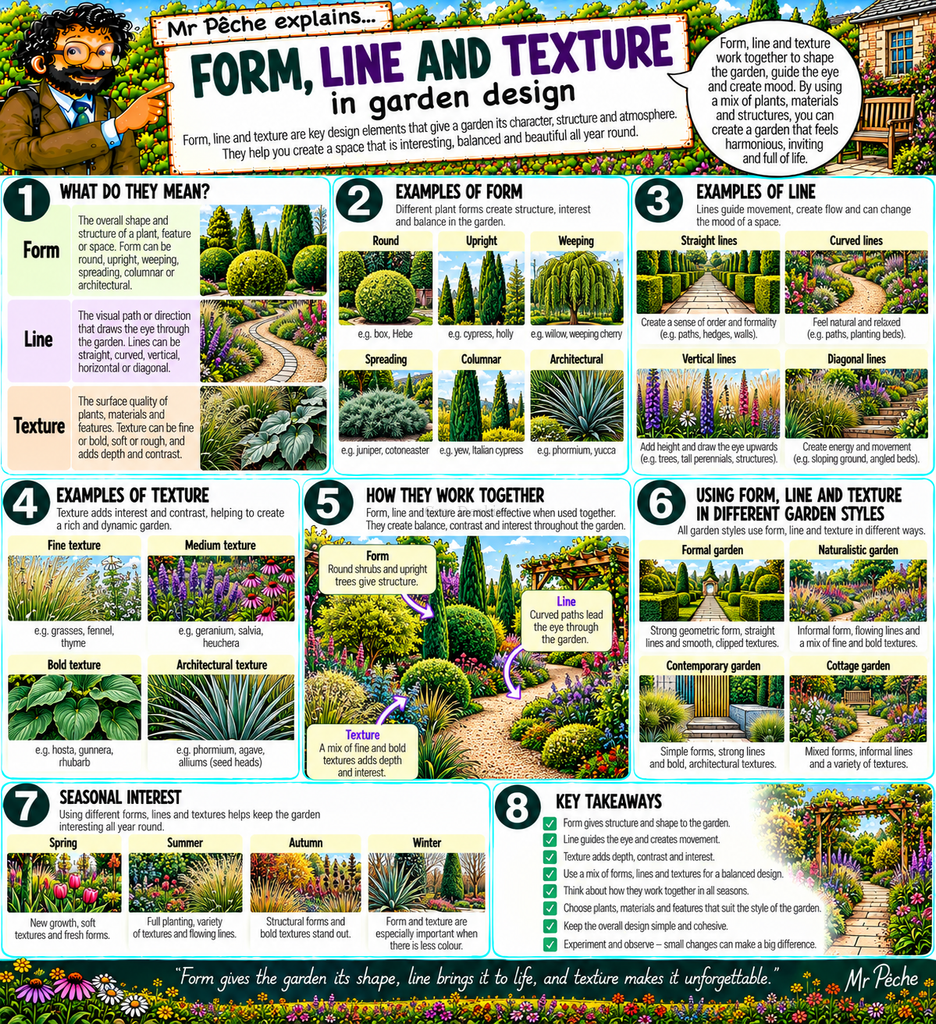
Form describes the overall shape of a plant or structure. Upright, rounded, spreading, columnar and weeping forms all contribute differently to a composition.
Line is created by paths, borders, walls, hedges and the edges of lawns. Straight lines often appear formal and directional, whereas curved lines can create a softer effect. Curves should have a clear purpose rather than being introduced simply for decoration.
Texture describes the visual and sometimes tactile character of a surface. Fine foliage may appear delicate, while large leaves create a bolder effect. Combining contrasting textures adds depth and interest, particularly where flower colour is limited.
7. Colour and Seasonal Interest
Colour influences how a garden is perceived. Warm colours, such as red, orange and yellow, often attract attention, while cool colours, including blue, violet and many greens, can create a quieter impression.
Complementary colours sit opposite each other on the colour wheel, while analogous colours sit beside one another. Both approaches can produce effective planting schemes.
Colour is only one consideration. Foliage, bark, seed heads, flowers and evergreen structure can all contribute to the garden’s appearance. A successful design considers the whole year, including spring growth, summer flowering, autumn colour and winter structure.
8. Planting Design
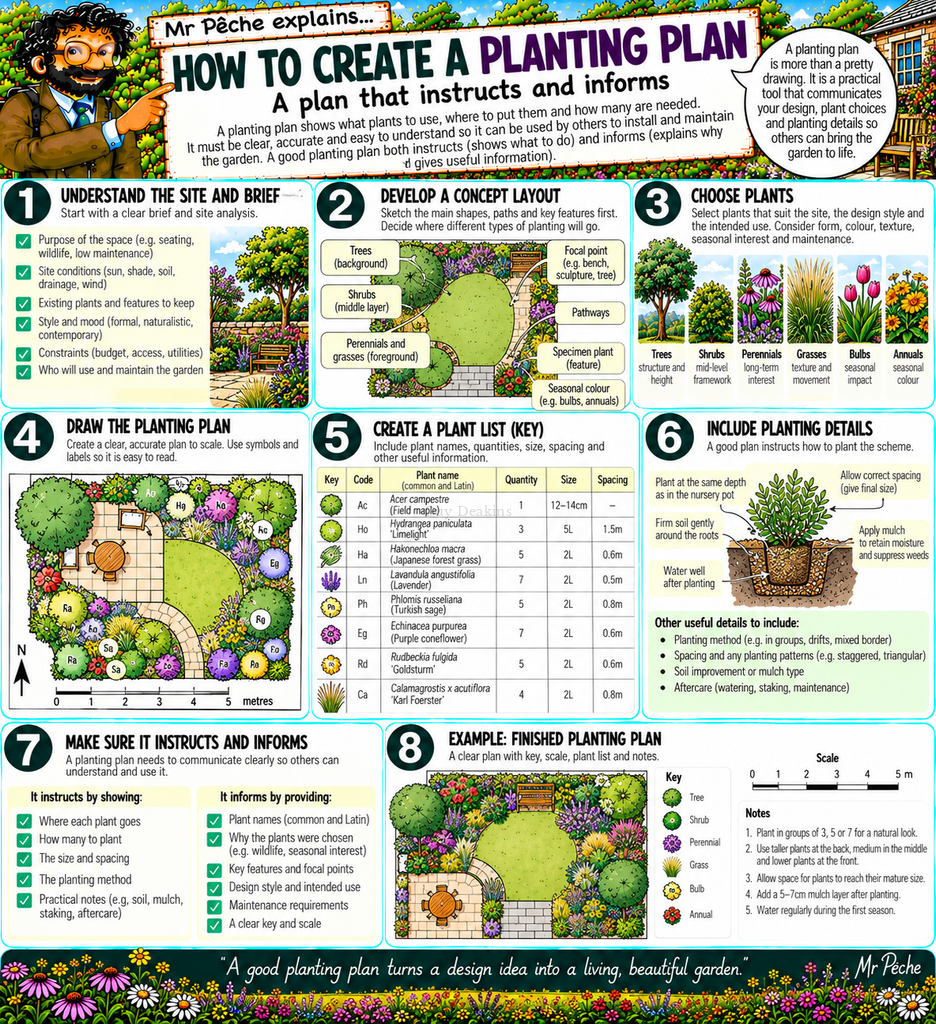
Plants should be selected according to their environmental requirements, mature dimensions and role within the composition.
A planting scheme may include:
- Structural plants: Trees, hedges and large shrubs that provide enclosure, height and permanence.
- Focal plants: Specimens that attract attention because of their size, form, colour or position.
- Seasonal plants: Species selected for flowering, foliage or other features at particular times of year.
- Ground-cover plants: Plants that cover soil, reduce opportunities for weed establishment and contribute to habitat.
- Bulbs and herbaceous perennials: Plants that provide seasonal change, repeat flowering or long-term planting interest.
Planting in groups or drifts can create stronger visual effects than scattering individual plants throughout a border. Mature plant size must be considered to avoid overcrowding and excessive maintenance.
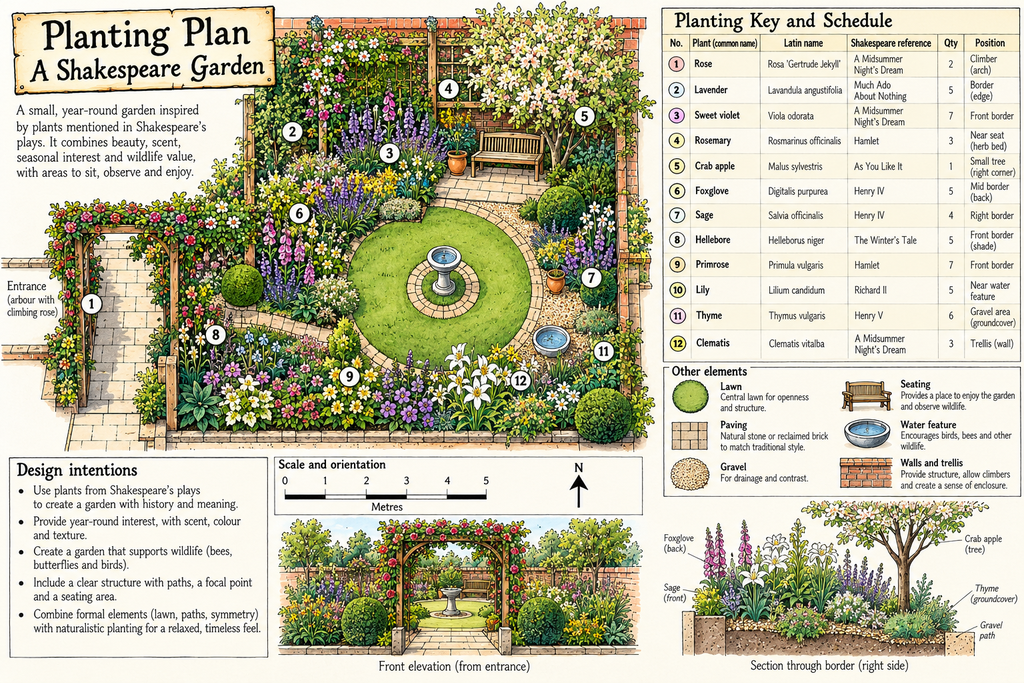

9. Focal Points and Views

A focal point is a feature that draws the eye. It might be a specimen tree, sculpture, water feature, distinctive container or carefully framed view.
Focal points can help organise a composition and encourage exploration. They should be positioned deliberately, taking account of where people enter, sit or move through the garden.
Views can be opened, framed or screened. A hedge may conceal an unattractive boundary, while a gap in planting may reveal a distant tree or landscape feature. The careful management of views can make a small garden feel more spacious.
10. Sustainability and Ecology
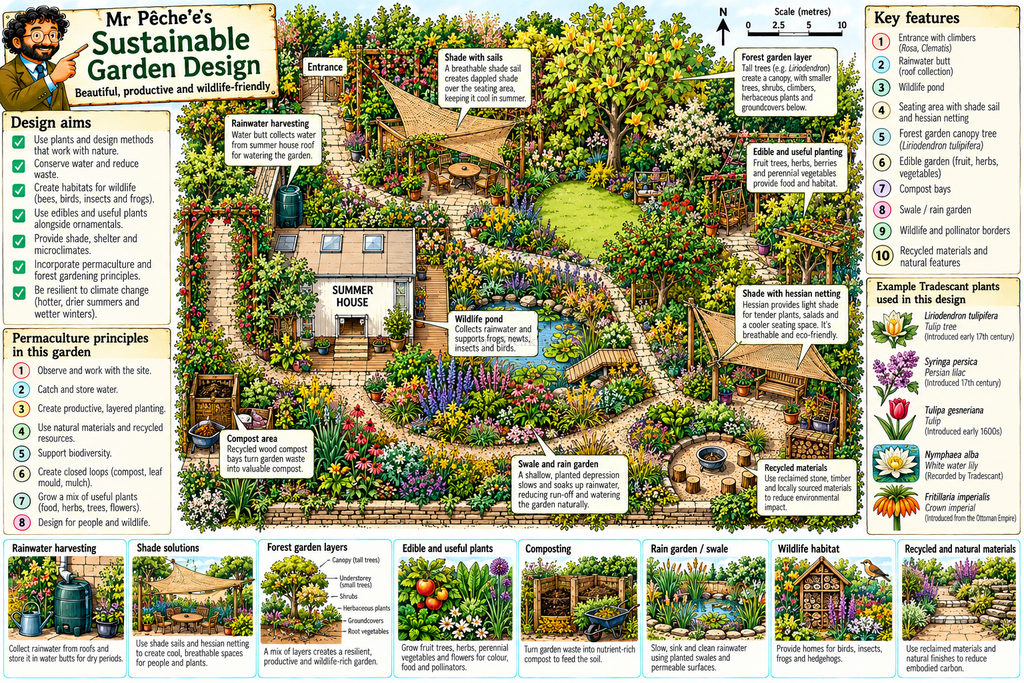
Contemporary garden design should consider environmental performance alongside appearance. Sustainable choices include:
- Selecting plants suited to the local soil and climate.
- Collecting rainwater and reducing unnecessary irrigation.
- Improving soil through appropriate organic matter and careful cultivation.
- Using permeable surfaces where suitable to help manage rainfall.
- Retaining existing trees and valuable habitats wherever possible.
- Providing flowers, shelter, water and nesting opportunities for wildlife.
- Choosing durable, responsibly sourced materials and reducing waste.
Climate change makes resilience increasingly important. Planting schemes should anticipate hotter summers, periods of drought and intense rainfall, while avoiding the assumption that any single plant is suitable for every site.
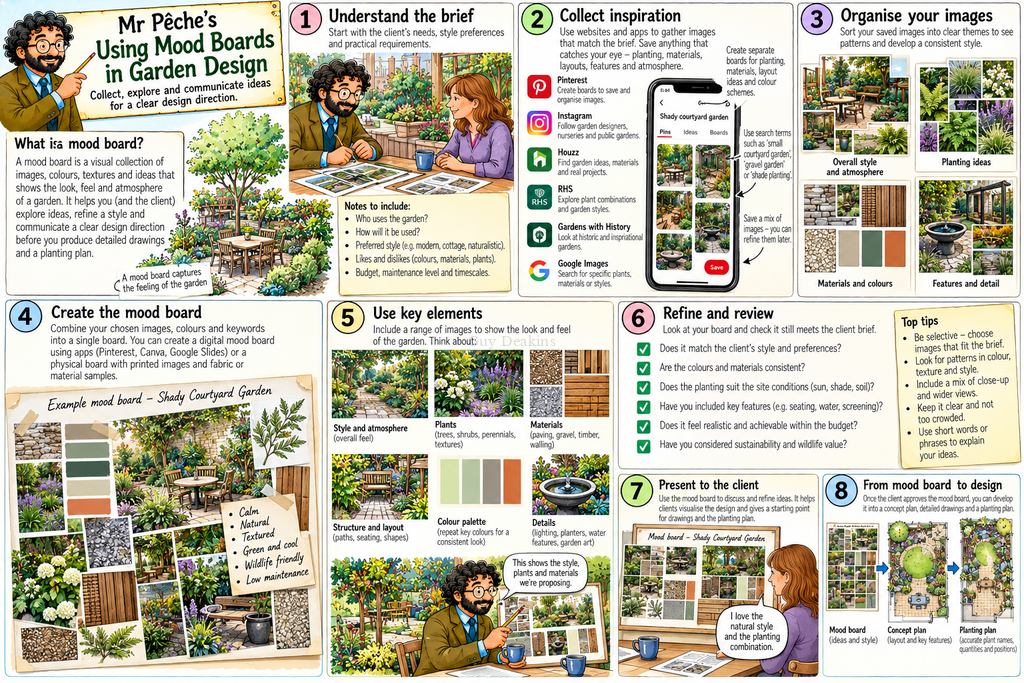
11. From Concept to Planting Plan
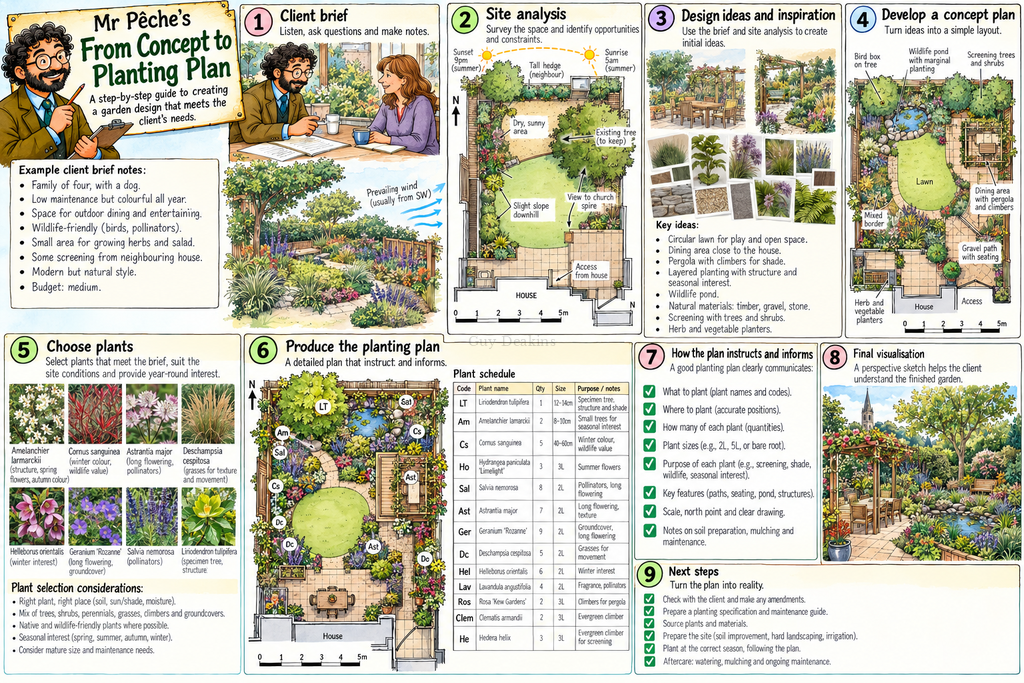
A practical garden design develops through a sequence of stages:
- Survey the site and identify its opportunities and constraints.
- Establish the garden’s purpose and the requirements of its users.
- Develop a concept showing the main areas, routes and focal points.
- Produce a scaled layout plan.
- Select hard landscaping materials and structural features.
- Prepare a planting plan with plant names, quantities, spacing and mature sizes.
- Estimate costs, plan construction and schedule planting.
- Review the completed garden and adapt its maintenance as it matures.
A scaled plan helps ensure that dimensions, circulation routes and planting areas are realistic before work begins.
Conclusion
Garden design is a balance between horticultural science, visual composition and practical use. Site assessment provides the foundation; layout establishes function; and the principles of space, balance, rhythm, texture, colour and form guide the composition. Plant selection, sustainability and maintenance determine whether the design remains successful over time.
The strongest gardens are not simply collections of attractive plants. They are coherent, functional environments in which the site, materials, planting and needs of the people using the space work together.
Key learning points
- Assess the site before selecting plants or materials.
- Design around the intended users and activities.
- Use scale, proportion, balance and negative space to organise the garden.
- Combine colour, form, texture and rhythm to create visual interest.
- Select plants according to site conditions and mature dimensions.
- Incorporate biodiversity, water management and climate resilience.
- Develop a scaled plan before construction and planting.
References
Bell, S. (2012) Landscape: Pattern, Perception and Process. 2nd edn. London: Routledge.
Booth, N.K. and Hiss, J.E. (2012) Residential Landscape Architecture: Design Process for the Private Residence. 6th edn. Upper Saddle River, NJ: Pearson.
Royal Horticultural Society (n.d.) Garden design. Available at: https://www.rhs.org.uk/garden-design (Accessed: 18 October 2026).
Gertrude Jekyll (1919) Colour Schemes for the Flower Garden London: Country Life
Percy Cane. (1956) The Earth Is My Canvas, London : Methuen
Percy Cane. (1934) Garden design of to-day, London : Methuen
Noel Kingsbury and Piet Oudolf (2016) Planting: A New Perspective, Timber Press