
Building and Maintaining a Simple Garden Pond
Introduction
A pond can transform a garden by introducing water, reflection, movement, new planting opportunities and a wide range of wildlife habitats. Even a relatively small pond can support aquatic plants, amphibians, insects and other invertebrates. A well-designed pond can therefore contribute to biodiversity while also becoming an important design feature within the garden.
Building a pond is not simply a matter of digging a hole and filling it with water. Good pond construction requires consideration of location, depth, water retention, safety, access for wildlife, planting, water quality and future maintenance.
Maintenance should also be carefully considered before construction begins. A pond that is easy to inspect, reach and manage will generally be more successful than one that becomes difficult to access.
For Level 2 horticulture students, pond construction provides an opportunity to apply knowledge of soil preparation, drainage, planting, wildlife, tools, materials, health and safety and sustainable horticultural practice.
1. What is the purpose of the pond?
Before constructing a pond, establish what it is intended to achieve.
A pond might be designed as:
- a wildlife pond;
- a formal ornamental feature;
- a pond for aquatic plants;
- a fish pond;
- part of a rain garden;
- a water-storage feature;
- a focal point within a planting scheme;
- or a combination of these purposes.

The intended use affects the design.
For example, a wildlife pond normally benefits from shallow, gently sloping margins and a variety of depths. A heavily stocked fish pond may require filtration, aeration and more intensive maintenance.
For a simple garden project, a wildlife pond with no fish is often the most straightforward option.
The RHS recommends that even small ponds can provide valuable wildlife habitat. A pond does not have to be large to be useful.
2. Choosing a suitable location
Location has a major influence on the success of a pond.
Consider:
- sunlight;
- shade;
- surrounding trees;
- falling leaves;
- access;
- visibility;
- underground services;
- proximity to buildings;
- soil conditions;
- drainage;
- safety;
- and the intended use of the surrounding garden.
A pond should generally receive a good amount of sunlight, although some shade can help reduce excessive algae growth.
The RHS recommends a location with sun or partial shade, with at least part of the pond receiving full sun.
Avoid excessive shade
A pond beneath dense tree cover may receive too little light for some aquatic plants.
It may also receive large quantities of:
- leaves;
- twigs;
- blossom;
- pollen;
- and other organic material.
These materials eventually decompose and can contribute to nutrient accumulation.
Avoid major tree roots
Large roots can make excavation difficult and may potentially damage a pond liner.
Trees should therefore be considered during the planning stage rather than after construction has begun.
Check for underground services
Before digging, establish whether water pipes, electricity cables, drainage systems or other services cross the proposed site.
For larger or deeper ponds, particularly where excavation is substantial, professional advice may be necessary.
3. Designing the pond
A simple wildlife pond should ideally contain several different zones.
These can include:
- deep water;
- shallow water;
- marginal planting areas;
- a gently sloping wildlife access area;
- a surrounding terrestrial habitat.
This creates greater structural diversity.
Different organisms use different parts of the pond.
For example:
| Pond zone | Possible function |
| Deep water | Refuge, aquatic plants and overwintering habitat |
| Shallow water | Feeding and breeding habitat |
| Marginal zone | Emergent plants and invertebrates |
| Sloping edge | Wildlife access |
| Pond margin | Shelter and terrestrial habitat |
The RHS recommends incorporating a long, shallow slope on at least one side of a wildlife pond. This allows animals to enter and leave the water and provides additional damp habitat.

4. Pond depth
Depth should vary rather than creating a container with vertical sides and one uniform depth.
A small pond can contain:
- very shallow margins;
- intermediate shelves;
- and a deeper central area.
The RHS recommends varying pond depth according to the intended use. Its wildlife-pond guidance gives approximately 20–60 cm as a useful range for many wildlife ponds, while its general pond-construction guidance recommends deeper areas for larger ponds and notes that very shallow ponds can overheat more easily during summer.
The design should therefore consider the size of the pond rather than applying one depth to every situation.
5. Making the excavation
Once the position and design have been established, mark out the pond.
Useful materials include:
- rope;
- hosepipe;
- pegs;
- marking paint;
- spade;
- shovel;
- wheelbarrow;
- spirit level;
- rake;
- tape measure.
Step 1 – Mark the outline
Lay a hosepipe or rope around the proposed pond.
This allows the shape to be changed before digging begins.
Avoid creating unnecessarily complicated shapes. A simple organic outline is often easier to construct and maintain.
Step 2 – Remove vegetation
Remove turf and vegetation from the marked area.
Turf can potentially be reused elsewhere in the garden if it is still in good condition.
Step 3 – Excavate the pond
Dig progressively deeper rather than removing a large amount of soil from one area at once.
Create shelves where appropriate.
Check levels regularly.
A spirit level and straight piece of timber can help establish whether the pond edges are approximately level.
Step 4 – Create a wildlife slope
At least one side should form a gradual slope into the water.
This is particularly important for:
- frogs;
- toads;
- newts;
- hedgehogs;
- small mammals;
- birds;
- and other animals that may accidentally enter the pond.

6. Protecting the pond liner
Flexible liners are commonly used for small garden ponds.
Before installing the liner:
- remove sharp stones;
- check the excavation for roots;
- create a smooth surface;
- add a protective layer of sand or suitable underlay;
- position the liner carefully.
The protective layer reduces the risk of sharp objects puncturing the liner.
The RHS recommends using sand or pond underfelt beneath a liner where necessary to protect it from punctures.
7. Installing the liner
Install an underlay (such as carpet or specialised liner to prevent stones or roots breaking the liner). Lay the liner (either plastic or butyl rubber) into the excavation carefully. Do not pull it excessively tight.
The liner needs sufficient material to conform to:
- corners;
- shelves;
- slopes;
- and changes in depth.
Begin adding water gradually. As the pond fills, the weight of the water will pull the liner into the shape of the excavation. Adjust folds and creases as the water level rises.
Avoid standing unnecessarily on the liner.
8. Finishing the pond edge
The edge is one of the most important parts of the construction.
A poorly finished edge can expose the liner, allow it to deteriorate in sunlight or create an unattractive transition between water and garden.
The edge can be finished using:
- stones;
- gravel;
- cobbles;
- paving;
- turf;
- marginal plants;
- logs;
- or other appropriate materials.
The pond should look as though it belongs within the wider garden rather than appearing as an isolated hole in the ground.
9. Creating safe wildlife access
A pond must allow animals to escape.
Steep-sided ponds can become traps.
A simple wildlife ramp can be constructed from:
- timber;
- stones;
- logs;
- bricks;
- or other stable materials.
A ramp should provide grip rather than presenting a smooth surface.
The RHS recommends ramps or shallow slopes where natural access is not possible.
10. Filling the pond
Rainwater is generally preferable for establishing a wildlife pond.
Water collected in a water butt can be used where it is suitable and uncontaminated.
Mains water can contain substances and nutrients that may encourage algae.
The RHS recommends rainwater where possible and advises using tap water only when necessary.
Do not assume that adding water from another pond will make a new pond develop more quickly.
It may instead introduce:
- diseases;
- parasites;
- invasive species;
- unwanted plants;
- or organisms that are inappropriate for the new site.
The best approach is often to allow wildlife to colonise naturally.
11. Choosing pond plants
Pond plants perform several functions.
They can:
- provide shelter;
- provide breeding habitat;
- provide food;
- shade the water;
- oxygenate the water;
- stabilise margins;
- provide places for insects to emerge;
- and improve the appearance of the pond.
Plants can be divided into several broad groups.
| Planting group | Position |
| Deep-water plants | Deeper water |
| Floating plants | Surface |
| Oxygenating plants | Underwater |
| Marginal plants | Shallow water |
| Bog plants | Permanently damp margins |
| Terrestrial plants | Surrounding soil |
Avoid planting too densely.
Aquatic plants can spread rapidly, and excessive vegetation can eventually reduce the amount of open water.
The RHS suggests keeping approximately half the water surface free of excessive vegetation as a useful maintenance target.
12. Do not introduce wildlife unnecessarily
A common mistake is to collect frogspawn, tadpoles, pond water, mud or aquatic plants from another pond and transfer them to a new pond.
This can introduce diseases or invasive species.
It can also move organisms between populations that would otherwise remain separate.
A new pond should therefore be allowed to develop naturally wherever possible.
Wildlife can arrive surprisingly quickly. Pond skaters, diving beetles and other invertebrates may colonise a new pond naturally, while amphibians and dragonflies may arrive later.

13. Pond maintenance
Ponds require maintenance, but over-maintenance can be just as damaging as neglect.
A pond is an ecosystem rather than a swimming pool.
The aim is to maintain a healthy balance rather than make the water completely sterile or permanently clear.
Regular checks should include:
- water level;
- plant growth;
- algae;
- fallen leaves;
- damaged liner;
- wildlife access;
- pumps and electrical equipment where fitted;
- and general safety.
14. Removing excessive plant growth
Aquatic plants can become vigorous.
Remove or reduce plants when they begin to dominate the pond.
Do not remove everything at once.
Excessive clearance can:
- destroy habitat;
- remove shelter;
- disturb amphibians;
- remove invertebrates;
- expose wildlife to predators;
- and destabilise the ecosystem.
Where vegetation is removed, place it beside the pond for a period before composting it.
This gives animals an opportunity to escape back into the water.
The RHS recommends this approach when removing pond vegetation.
15. Managing algae
Algae are natural components of aquatic ecosystems.
The problem occurs when algae become excessively abundant.
Possible causes include:
- excessive nutrients;
- too much sunlight;
- decaying vegetation;
- fertiliser entering the water;
- excessive fish stocking;
- and stagnant water.
Management should focus on the underlying cause rather than simply removing algae repeatedly.
Useful measures include:
- reducing nutrient inputs;
- removing excessive vegetation;
- preventing fertiliser entering the pond;
- increasing appropriate shade;
- maintaining healthy aquatic plants;
- and improving oxygenation where appropriate.
A small amount of algae is not necessarily a problem.
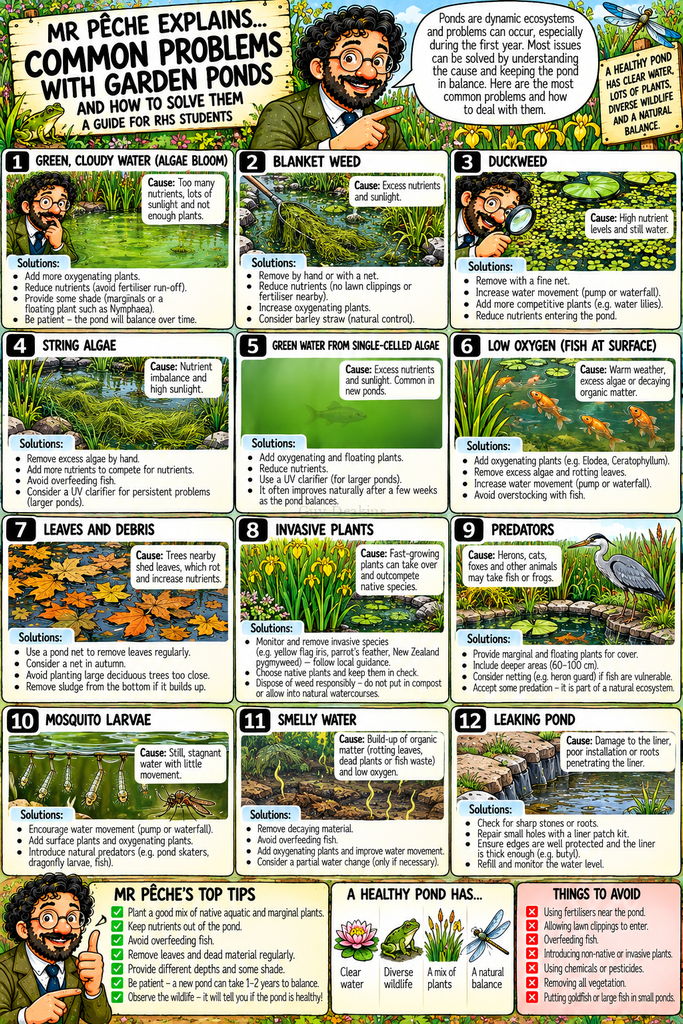
16. Blanket weed
Blanket weed forms masses of filamentous algae and it can rapidly cover parts of a pond.
One simple removal method is to twirl the algae around a rough stick and lift it from the water.
However, the removed material should not immediately be thrown onto the compost heap.
It should first be left beside the pond so that aquatic animals can return to the water.
The RHS recommends this approach for blanket weed and floating weeds.
17. Fallen leaves
A small number of leaves entering a pond is not necessarily harmful. However, large quantities can accumulate and contribute to sediment and nutrient levels.
In autumn:
- remove excessive leaves;
- use a pond net where appropriate;
- inspect removed material for wildlife;
- and leave material beside the pond temporarily before disposal.
Avoid creating unnecessary disturbance.
18. Topping up water
Pond water levels naturally fluctuate.
This is particularly noticeable during hot, dry weather.
A wildlife pond without fish does not necessarily need to be kept at a constant level.
If topping up is necessary, rainwater is preferable.
If mains water must be used, introduce it carefully rather than rapidly changing the temperature or chemistry of the pond.
A sudden unexplained drop in water level may indicate:
- evaporation;
- a leak;
- liner damage;
- or another drainage problem.
19. Oxygen levels
Aquatic organisms require oxygen.
Oxygen enters water through:
- contact with the atmosphere;
- photosynthesis;
- water movement;
- and aeration.
Hot weather can create problems because warmer water holds less dissolved oxygen.
This can become particularly important in ponds containing fish.
Possible measures include:
- maintaining healthy aquatic plants;
- avoiding excessive organic material;
- reducing overcrowding;
- using a fountain or air pump where appropriate;
- and maintaining water movement in ornamental or fish ponds.
The RHS recommends additional aeration during hot weather, particularly where fish are present.
20. Fish and wildlife ponds
Fish change the management requirements of a pond.
Fish:
- consume aquatic organisms;
- produce waste;
- increase nutrient levels;
- can eat amphibian eggs and larvae;
- and may contribute to algae problems.
For this reason, a pond designed primarily for wildlife does not normally need fish.
The RHS specifically warns that fish such as goldfish can reduce biodiversity and contribute to nutrient and algae problems in wildlife ponds.
21. Cleaning a pond
A complete pond clean-out should not automatically be part of annual maintenance.
Removing all the water, plants, sediment and wildlife can seriously disrupt the pond ecosystem.
Instead, use selective maintenance.
Only consider a major clean-out when a pond has become:
- heavily silted;
- severely overgrown;
- structurally damaged;
- or otherwise difficult to manage.
If a major clean-out is necessary, early autumn can reduce the impact on wildlife.
Wildlife should be removed carefully into suitable temporary containers containing pond water, and aquatic plants should be kept moist and shaded.
Some original sediment and water can be retained to help re-establish the biological community.
22. Pond maintenance and climate change
Climate change is increasingly relevant to water management in gardens.
Future gardens may experience:
- hotter summers;
- periods of drought;
- intense rainfall;
- flooding;
- longer growing seasons;
- changes in aquatic plant growth;
- and changes in the distribution of insects and other organisms.
Ponds can help gardens manage water and provide habitat, but they must be designed with changing conditions in mind.
A rain-fed pond can also form part of a rain garden, helping to intercept and temporarily store rainfall.
The RHS identifies rain-fed ponds as one way of incorporating water management and wildlife habitat into garden design.
23. Emerging disease risks and garden water
Climate change also requires horticulturists to think about vector-borne diseases.
A vector is an organism that can transmit a disease-causing pathogen between hosts. Mosquitoes are important vectors of several diseases.
One example attracting increasing attention is dengue fever.
Dengue is a viral disease transmitted principally by Aedes mosquitoes. In the UK, dengue cases currently remain associated with travel, rather than established local transmission. UKHSA reported 336 travel-associated cases in England in 2025, while its 2026 surveillance continues to monitor the situation.
A particular concern is the Asian tiger mosquito, Aedes albopictus.
This mosquito:
- is established in parts of mainland Europe;
- can transmit dengue, chikungunya and Zika;
- lays eggs in small containers of water;
- can live close to human habitation;
- and is capable of exploiting relatively small water-filled objects.
As of 2026, Aedes albopictus has not become established in the UK, although its eggs have been detected in south-east England and UKHSA operates surveillance for invasive mosquito species.
This is important because it demonstrates that water management is part of future public-health thinking, not simply a horticultural issue.
Does this mean garden ponds should be removed?
No.
A properly designed wildlife pond is a valuable habitat and should not be confused with the small artificial containers that can provide breeding sites for invasive mosquitoes. The important principle is responsible water management.
Gardeners should:
- avoid leaving unnecessary containers full of stagnant water;
- empty or cover water butts appropriately;
- keep gutters and drains clear;
- turn over unused containers;
- avoid accumulating discarded tyres or similar water-holding objects;
- maintain ponds appropriately;
- and report suspected invasive mosquitoes through the appropriate UK surveillance system.
UKHSA notes that Aedes albopictus commonly uses small containers such as buckets, old tyres, clogged gutters, drains and unused paddling pools.
This distinction is important: a biodiverse pond is not the same thing as unmanaged standing water in discarded containers.
24. Pond hygiene and biosecurity
Good pond management also involves biosecurity.
Avoid transferring between ponds without an appropriate reason and suitable precautions. :
- pond water;
- mud;
- aquatic plants;
- frogspawn;
- tadpoles;
- fish;
- or other pond organisms
Equipment can also transfer pathogens and invasive organisms.
Where equipment has been used in different water bodies, consider appropriate cleaning and disinfection procedures.
This is particularly important for professional horticulturists who may work across several sites.
RHS guidance specifically warns that moving pond water, sediment or frogspawn can inadvertently spread amphibian diseases or invasive species.
25. Pond safety
Water features introduce additional hazards into a garden.
Consider:
- children;
- pets;
- slips and trips;
- steep sides;
- unstable paving;
- electrical equipment;
- pumps;
- cables;
- and access for emergency services where relevant.
A pond should be designed so that people and animals can use the surrounding garden safely.
Where electrical equipment is installed, it must be suitable for outdoor use and installed in accordance with relevant electrical safety requirements.
Wildlife safety must also be considered.
Avoid leaving loose netting where animals can become trapped.
26. Seasonal maintenance
| Season | Useful pond jobs |
| Spring | Check plants, inspect equipment, remove excessive dead material, monitor algae and wildlife |
| Summer | Monitor water levels, oxygen levels and algae; control excessive plant growth; top up with rainwater where necessary |
| Autumn | Remove excessive leaves, divide vigorous plants where appropriate and undertake major maintenance if genuinely necessary |
| Winter | Check water levels, inspect for damage and avoid unnecessary disturbance |
The exact timing will vary according to weather and the type of pond.
27. A simple maintenance routine
A useful routine for a small wildlife pond is:
Weekly or fortnightly during active growth
- inspect the pond;
- check water level;
- look for excessive algae;
- check wildlife access;
- inspect vigorous plants.
During hot weather
- check water levels more frequently;
- look for signs of oxygen stress;
- avoid unnecessary disturbance;
- maintain appropriate shade and plant cover.
Autumn
- remove excessive leaf accumulation;
- inspect plants;
- reduce overcrowding where necessary.
Annual review
Ask:
- Is the pond still retaining water?
- Are the edges secure?
- Is there sufficient open water?
- Are plants becoming overcrowded?
- Can wildlife enter and leave safely?
- Is algae becoming excessive?
- Is equipment functioning safely?
- Has sediment accumulated excessively?
- Has anything changed in the surrounding garden?

28. Common mistakes
Making the pond too shallow
Very shallow water can heat rapidly during hot weather.
Creating vertical sides everywhere
This makes it difficult for wildlife to escape.
Adding too many plants
Aquatic plants can rapidly fill a small pond.
Adding fish to a wildlife pond
Fish can alter the ecological balance and reduce amphibian and invertebrate populations.
Using excessive fertiliser near the pond
Nutrients can enter the water and encourage algae.
Cleaning too frequently
Excessive intervention can repeatedly disrupt the ecosystem.
Moving wildlife between ponds
This can spread diseases and invasive species.
Ignoring water levels
A sudden drop can indicate a leak.
Allowing containers to hold stagnant water unnecessarily
Small artificial water-holding containers can provide breeding sites for mosquitoes, making responsible water management increasingly important as the climate changes.
29. Practical exercise: Constructing a simple pond plan
Students can produce a scaled design for a small wildlife pond.
The plan should show:
- proposed location;
- pond dimensions;
- maximum depth;
- shallow margins;
- wildlife access slope;
- liner;
- surrounding planting;
- aquatic planting zones;
- water source;
- maintenance access;
- safety considerations.
Extension task
Add a maintenance schedule showing the jobs required during:
- spring;
- summer;
- autumn;
- winter.
Students should explain why each job is necessary rather than simply listing tasks.
30. Practical investigation: Pond maintenance
Where an existing pond is available, students can conduct a structured inspection.
Record:
- pond size;
- approximate depth;
- water clarity;
- water level;
- percentage of open water;
- aquatic plant coverage;
- algae coverage;
- condition of the pond edge;
- wildlife access;
- evidence of wildlife;
- fallen leaf accumulation;
- safety hazards;
- maintenance requirements.
Students should then identify which jobs are necessary, which are desirable, and which could cause unnecessary disturbance.
This develops the important professional skill of distinguishing between maintenance that improves the pond and maintenance that simply changes its appearance.
31. Key terminology
Aquatic – living or growing in water.
Bog – permanently or seasonally waterlogged habitat.
Dissolved oxygen – oxygen present within water and available to aquatic organisms.
Emergent plant – a plant rooted underwater or in saturated soil with stems and leaves growing above the water.
Liner – waterproof material used to retain water.
Marginal plant – a plant growing in shallow water or permanently damp soil at the pond edge.
Pond ecosystem – the interacting community of organisms and environmental conditions within and around a pond.
Rain garden – a planted area designed to receive and manage rainwater.
Vector – an organism capable of transmitting a pathogen between hosts.
Wildlife pond – a pond designed primarily to provide habitat for wildlife rather than to support fish or purely ornamental features.
32. Knowledge check
- Why is location important when constructing a pond?
- Why should a wildlife pond have a shallow slope?
- What is the purpose of a pond liner?
- Why should the liner be protected from sharp stones?
- Why is rainwater often preferable to mains water?
- Why should fish generally be avoided in a wildlife pond?
- What problems can excessive algae cause?
- Why should removed pond vegetation be left beside the pond temporarily?
- Why should pond water or frogspawn not routinely be transferred between ponds?
- Why can excessive pond cleaning damage wildlife?
- What is dissolved oxygen?
- Why can hot weather create problems for pond life?
- What is a vector?
- What is Aedes albopictus?
- Why is responsible management of unnecessary standing water becoming increasingly important?
- What is the difference between a wildlife pond and an unmanaged container holding stagnant water?
33. Key Level 2 knowledge
A Level 2 horticulture student should be able to:
- explain the purpose of a garden pond;
- identify suitable pond locations;
- describe basic pond construction;
- understand the purpose of different pond depths;
- explain the importance of shallow wildlife access;
- describe the use of pond liners;
- select appropriate pond plants;
- explain the importance of water quality;
- recognise excessive algae;
- describe basic pond maintenance;
- understand the relationship between temperature and dissolved oxygen;
- explain why fish can alter a wildlife pond ecosystem;
- understand the importance of pond biosecurity;
- identify common pond safety hazards;
- explain why wildlife should not routinely be moved between ponds;
- understand how climate change may affect garden water management;
- explain the basic concept of vector-borne disease;
- recognise the significance of invasive mosquitoes such as Aedes albopictus;
- and understand why responsible management of artificial standing water is becoming an increasingly important horticultural and public-health consideration.
Conclusion
A successful garden pond is not simply a hole containing water. It is a carefully designed habitat in which water, plants, soil, microorganisms, invertebrates, amphibians, birds and other animals interact.
Good pond construction creates the physical conditions for this ecosystem to develop. Good maintenance then involves observation and selective intervention, rather than constant cleaning.
For modern horticulturists, pond management also needs to be considered within a changing climate. Water availability, extreme weather, biodiversity, invasive species and vector-borne diseases are increasingly interconnected. The emerging surveillance of invasive mosquitoes such as Aedes albopictus demonstrates why gardeners need to distinguish between valuable aquatic habitats and unnecessary accumulations of stagnant water.
The best pond management therefore combines horticultural skill, ecological understanding, practical maintenance, safety and environmental responsibility.
References
RHS (2026a) How to make a new pond. Royal Horticultural Society. Available through RHS Gardening Advice.
RHS (2026b) Wildlife ponds: how to make them. Royal Horticultural Society. Available through RHS Gardening Advice.
RHS (2026c) Pond care. Royal Horticultural Society. Available through RHS Gardening Advice.
RHS (2026d) Rain-fed wildlife-friendly pond. Royal Horticultural Society. Available through RHS Gardening Advice.
UKHSA (2026a) Non-native mosquito species profiles. UK Health Security Agency. Available at GOV.UK.
UKHSA (2026b) National contingency plan for invasive Aedes mosquitoes in England. UK Health Security Agency. Available at GOV.UK.
UKHSA (2026c) One Health vector-borne disease surveillance report 2025. UK Health Security Agency.
UKHSA (2026d) Travel-associated infections in England, Wales and Northern Ireland: 2025. UK Health Security Agency.