Introduction
Plants require the right combination of light, water, air, suitable temperatures, oxygen around their roots and mineral nutrients to grow successfully. Good horticulture therefore involves more than watering and planting. The gardener must understand what plants need, where those resources come from and how growing conditions affect their availability.
Plant foods and fertilisers are used to supply nutrients to plants, but feeding should not be treated as a universal solution to poor growth. A plant may appear unhealthy because it lacks a nutrient, but similar symptoms can result from unsuitable soil pH, poor drainage, root damage, drought, waterlogging, pests or disease.
Correct plant nutrition therefore begins with observation and diagnosis.
At Level 2, students should understand the main plant nutrients, their functions, sources and deficiency symptoms, as well as the principles of applying fertilisers safely and effectively.
A useful principle is:
Feed the plant according to its needs, not simply according to a calendar.

1. What do plants need?
Plants require several essential resources for healthy growth.
These include:
- light
- water
- carbon dioxide
- oxygen
- suitable temperature
- mineral nutrients.
Plants obtain carbon dioxide from the atmosphere and water mainly through their roots. Mineral nutrients are absorbed predominantly from the growing medium as dissolved ions.
Some nutrients are required in relatively large quantities, while others are needed in much smaller amounts.
This leads to two broad categories:
Macronutrients
Required in relatively large quantities.
The main mineral macronutrients are:
- nitrogen (N)
- phosphorus (P)
- potassium (K)
- calcium (Ca)
- magnesium (Mg)
- sulphur (S).
Micronutrients
Required in much smaller quantities.
Important micronutrients include:
- iron (Fe)
- manganese (Mn)
- boron (B)
- zinc (Zn)
- copper (Cu)
- molybdenum (Mo)
- chlorine (Cl)
- nickel (Ni).
The fact that micronutrients are required in small amounts does not make them unimportant. A deficiency can still seriously affect plant growth.


2. What is a plant food?
The term plant food is commonly used in horticulture for fertiliser products supplied to plants.
Strictly speaking, plants manufacture their own food through photosynthesis.
During photosynthesis, plants use light energy to convert carbon dioxide and water into carbohydrates, releasing oxygen as a by-product.
Therefore, fertiliser does not literally provide plants with their food in the same way that human food provides nutrition to people.
Instead, fertilisers supply mineral nutrients required for plant growth and development. Generally speaking, you do not feed the plant, you feed the soil, which converts the minerals into forms plants can absorb.
This distinction is useful because it helps explain why simply adding more fertiliser cannot solve every plant-health problem.
3. What is a fertiliser?
A fertiliser is a material applied to plants or growing media to supply plant nutrients.
Fertilisers may be:
- solid
- liquid
- granular
- powdered
- slow-release
- controlled-release
- organic
- inorganic.
The choice of fertiliser depends on:
- the plant
- the growing medium
- the stage of growth
- the nutrients required
- the method of application
- the desired rate of nutrient release.

4. Organic and inorganic fertilisers
Organic fertilisers
Organic fertilisers are derived from plant, animal or naturally occurring organic materials.
Examples include:
- well-rotted manure
- composted plant material
- blood, fish and bone
- seaweed-based products
- pelleted organic fertilisers.
Organic materials can provide nutrients as they decompose.
They may also contribute to soil organic matter and improve soil structure.
However, nutrient concentrations can vary considerably between products and materials.
Inorganic fertilisers
Inorganic fertilisers are manufactured or processed mineral fertilisers.
They may contain specific nutrients in readily available forms.
Examples include:
- nitrogen fertilisers
- potash fertilisers
- compound fertilisers
- soluble fertilisers
- controlled-release fertilisers.
Their nutrient content is usually more precisely defined than that of many organic materials.
5. The NPK numbers
One of the most important pieces of information on a fertiliser label is its NPK analysis.
NPK refers to:
N – Nitrogen
P – Phosphorus
K – Potassium
For example, a fertiliser labelled:
7–7–7
contains nitrogen, phosphorus and potassium in the proportions indicated by the product formulation.
A fertiliser labelled:
10–5–5
has a relatively higher proportion of nitrogen than phosphorus or potassium.
The three numbers should always be interpreted according to the information provided on the product label because formulations and labelling conventions can vary.
6. Nitrogen
Nitrogen is an essential nutrient involved in:
- leaf growth
- shoot growth
- chlorophyll production
- proteins
- enzymes
- overall vegetative development.
Nitrogen is particularly important for producing healthy foliage.
Nitrogen deficiency
Typical symptoms can include:
- pale green foliage
- yellowing
- reduced growth
- smaller leaves
- premature leaf ageing.
Nitrogen deficiency often becomes noticeable first in older leaves, because nitrogen can be redistributed within the plant.
However, yellowing does not automatically mean nitrogen deficiency.
Other causes must be considered.

7. Too much nitrogen
More fertiliser is not necessarily better.
Excess nitrogen can encourage:
- excessive soft vegetative growth
- weak growth
- poor flowering in some plants
- increased susceptibility to some pests and diseases
- nutrient imbalance
- environmental pollution through nutrient loss.
Plants need a balanced supply of nutrients rather than simply large quantities.
8. Phosphorus
Phosphorus is involved in:
- energy transfer
- root development
- cell processes
- flowering and reproduction
- seed formation.
Phosphorus is particularly important during establishment and reproductive development.
Phosphorus deficiency
Symptoms can include:
- poor growth
- weak development
- dark or unusual foliage colour
- poor root development.
Some plants may develop reddish or purplish colouring under phosphorus deficiency, although this symptom can also occur because of environmental stress.
Diagnosis should therefore consider the whole plant and growing conditions.
9. Potassium
Potassium plays an important role in:
- water regulation
- enzyme activity
- photosynthesis
- movement of substances within plants
- overall plant strength and function.
Potassium is sometimes associated with improving plant resilience and quality, although it should not be regarded as a cure-all.
Potassium deficiency
Symptoms may include:
- yellowing or scorching around leaf margins
- browning of leaf edges
- reduced growth
- weak or poor-quality growth.
Symptoms can begin on older leaves.
Again, leaf-edge scorching can have several causes, so observation is essential.
10. Calcium
Calcium is important for:
- cell walls
- cell structure
- growing points
- root development.
Calcium has limited mobility within the plant compared with some other nutrients.
Calcium deficiency
New growth may become:
- distorted
- damaged
- poorly developed.
Root tips and growing points can be particularly affected.
Calcium problems are not always caused simply by a lack of calcium in the soil. Water movement and root function can affect calcium transport within the plant.
11. Magnesium
Magnesium is an important component of chlorophyll.
It therefore has a major role in photosynthesis.
Magnesium deficiency
A common symptom is:
interveinal chlorosis
This means the tissue between the leaf veins becomes yellow while the veins remain relatively green.
Magnesium deficiency often becomes visible on older leaves.
12. Sulphur
Sulphur is required for:
- proteins
- enzymes
- plant metabolism.
Sulphur deficiency can result in:
- pale foliage
- reduced growth
- general chlorosis.
Unlike magnesium deficiency, symptoms of sulphur deficiency may be more apparent on younger growth because sulphur is less mobile within the plant.
13. Micronutrients
Plants also require smaller quantities of micronutrients.
These include:
- iron
- manganese
- boron
- zinc
- copper
- molybdenum
- chlorine
- nickel.
Although only small amounts are required, they are essential for normal plant function.
A deficiency of one micronutrient can produce significant symptoms.
14. Iron
Iron is important for:
- chlorophyll formation
- photosynthetic processes
- enzyme activity.
Iron deficiency
A characteristic symptom is interveinal chlorosis of young leaves.
The leaf tissue becomes pale or yellow while the veins remain greener.
Iron availability is strongly influenced by soil pH.
Iron deficiency can occur even when the soil contains iron if the iron is present in a form that plants cannot readily access.
This is an important example of why:
Nutrient availability is not the same as nutrient presence.
15. Manganese
Manganese is involved in:
- photosynthesis
- enzyme activity
- plant metabolism.
Deficiency can produce:
- interveinal chlorosis
- reduced growth
- leaf spotting or other abnormalities.
Symptoms can resemble those of other nutrient deficiencies, so careful diagnosis is necessary.
16. Boron
Boron is important for:
- cell development
- growing points
- reproductive development.
Deficiency can affect:
- young shoots
- roots
- flowers
- developing tissues.
Because boron is required in very small quantities, excessive application can also be harmful.
This illustrates the importance of correct fertiliser use.
17. Zinc
Zinc contributes to:
- enzyme function
- growth regulation
- plant development.
Deficiency can cause:
- reduced growth
- smaller leaves
- shortened internodes
- chlorosis.
Again, symptoms can overlap with other nutritional problems.

18. Nutrient availability and soil pH
Soil pH is extremely important because it affects the availability of many nutrients.
A soil may contain a nutrient but still fail to supply it effectively to plants if the nutrient is chemically unavailable.
Different plants also have different pH preferences.
For example:
- acid-loving plants prefer acidic conditions
- many garden plants perform well in mildly acidic to neutral soils
- some plants are adapted to alkaline or calcareous conditions.
This is why simply adding fertiliser may not solve a nutrient deficiency.
If the pH is unsuitable, changing the availability of the nutrient may be more important than adding more of it.
19. Fertiliser is not always the answer
A plant showing poor growth may be suffering from:
- pest damage
- disease
- poor drainage
- drought
- root damage
- unsuitable pH
- compaction
- lack of light
- excessive competition.
Adding fertiliser without establishing the cause can make the situation worse.
For example, a plant with damaged roots may be unable to absorb nutrients effectively.
Adding additional fertiliser will not repair the damaged roots.
This is why diagnosis must come before feeding.
20. Plant disorders
A plant disorder is a problem caused by a non-infectious factor.
In this chapter, the focus is on disorders associated with:
- nutrient deficiency
- nutrient excess
- unsuitable pH
- environmental conditions affecting nutrient uptake
- chemical injury
- poor growing conditions.
Unlike a disease, a disorder is not caused by an infectious pathogen.
Unlike a pest problem, it is not caused by an animal feeding on the plant.
However, the symptoms can sometimes look very similar.

21. Nutrient deficiency symptoms
Nutrient deficiencies can produce:
- chlorosis
- necrosis
- leaf-edge scorch
- distorted growth
- poor flowering
- reduced vigour
- premature leaf fall
- stunted growth.
Chlorosis
Chlorosis means loss of green colour from plant tissue.
Necrosis
Necrosis means death of plant tissue.
A leaf may therefore progress from:
green → yellow → brown → dead tissue
depending on the cause and severity.
22. Older leaves or younger leaves?
The location of symptoms can provide an important clue.
Some nutrients are relatively mobile within the plant.
When these nutrients are deficient, the plant can move them from older leaves towards newer growth.
Consequently, deficiency symptoms may appear first on older leaves.
Other nutrients are relatively immobile.
Deficiency symptoms may therefore appear first on younger growth.
This gives students an important diagnostic question:
Where on the plant did the symptom appear first?
The answer can help narrow down possible causes.
It should not, however, be used as the only method of diagnosis.
23. Nutrient toxicity
Plants can also suffer from too much of a nutrient.
Excessive fertiliser can cause:
- leaf scorch
- root damage
- poor growth
- wilting
- nutrient imbalance.
High concentrations of soluble fertiliser can increase the concentration of salts around roots.
This can make it more difficult for plants to take up water.
Therefore:
More fertiliser does not mean more growth.
Plants require nutrients within appropriate ranges.

24. Fertiliser burn
Fertiliser burn can occur when excessive fertiliser damages plant tissue or roots.
Symptoms may include:
- brown leaf margins
- scorched foliage
- wilting
- damaged roots
- reduced growth.
It can result from:
- excessive application
- incorrect application
- concentrated fertiliser contacting foliage
- fertiliser accumulating around roots.
Always follow the manufacturer’s instructions when using fertiliser products.
25. Liquid feeding
Liquid fertilisers are dissolved in water before application.
They can be useful when:
- plants need readily available nutrients
- container plants require feeding
- controlled feeding is required
- a soluble fertiliser is appropriate.
Liquid feeds can act relatively quickly because nutrients are supplied in solution.
However, the same principle applies:
correct concentration matters.
A stronger solution is not necessarily better.
26. Granular fertilisers
Granular fertilisers are applied as solid particles.
They may be:
- incorporated into soil
- applied around plants
- watered in
- used as part of a controlled-release system.
Application must be carried out according to the product instructions.
Granules should not be allowed to accumulate against sensitive stems or foliage unless the product specifically states that this is appropriate.
27. Slow-release and controlled-release fertilisers
Slow-release fertilisers release nutrients over an extended period.
Controlled-release fertilisers are designed to release nutrients at a more controlled rate, often influenced by factors such as temperature and moisture.
Advantages can include:
- reduced frequency of application
- more consistent nutrient supply
- reduced risk of sudden nutrient release.
However, the release period depends on the product and conditions.
The label should always be consulted.
28. Organic matter and plant nutrition
Organic matter is important in soil.
Sources include:
- compost
- well-rotted manure
- leaf mould
- decomposed plant material.
Organic matter can:
- contribute nutrients
- support soil organisms
- improve soil structure
- improve water-holding capacity
- improve soil biological activity.
However, organic matter is not simply a replacement for all fertilisers.
Different materials have different nutrient contents and release nutrients at different rates.
29. Feeding container-grown plants
Container-grown plants have a relatively small volume of growing medium.
Nutrients can therefore become depleted more quickly than in established soil.
Feeding requirements depend on:
- plant species
- container size
- growing medium
- time of year
- plant growth
- watering
- type of fertiliser.
Overfeeding containers can be particularly damaging because salts can accumulate in the growing medium.
30. Feeding plants in the garden
Established plants growing in the ground do not automatically require regular fertiliser.
Before feeding, consider:
- soil fertility
- plant requirements
- plant age
- growth rate
- soil organic matter
- symptoms
- previous applications.
Some established plants may require little additional fertiliser when growing in suitable soil.
The objective should be appropriate nutrition, not maximum nutrition.
31. Feeding at the right time
Plants have different nutrient requirements at different stages of growth.
For example:
- young plants may require nutrients for establishment
- actively growing plants require nutrients to support growth
- flowering and fruiting plants have particular nutritional demands
- plants entering dormancy have different requirements from plants in active growth.
Feeding should therefore take account of the plant’s natural growth cycle.
Applying fertiliser at an inappropriate time may encourage soft growth or result in nutrients being wasted.
32. Soil testing
Soil testing can provide useful information about:
- pH
- nutrient levels
- soil fertility.
Testing can help establish whether a nutrient deficiency is actually likely.
Visual diagnosis can be useful, but it is not always definitive.
Where symptoms are unclear, soil testing or professional diagnosis may be appropriate.
33. A systematic approach to diagnosing disorders
A useful sequence is:
Step 1 – Identify the plant
Different plants have different nutritional requirements.
Step 2 – Observe the symptoms
Record:
- colour
- location
- shape
- severity
- distribution.
Step 3 – Determine where symptoms began
Ask:
- older leaves?
- younger leaves?
- growing points?
- roots?
Step 4 – Examine the growing medium
Check:
- pH
- drainage
- moisture
- structure
- fertility where known.
Step 5 – Consider recent management
Record:
- fertiliser applications
- watering
- liming
- compost or manure additions
- transplanting
- chemical applications.
Step 6 – Compare
Compare affected and healthy plants.
Step 7 – Investigate
Use reliable references and, where appropriate, soil or laboratory testing.
Step 8 – Act
Only after establishing the likely cause should corrective action be taken.
34. Common diagnostic mistakes
Mistake 1: Assuming yellow leaves mean nitrogen deficiency
Yellowing has many possible causes.
Mistake 2: Adding fertiliser without diagnosis
This can worsen the problem.
Mistake 3: Assuming more fertiliser means healthier plants
Excess nutrients can damage plants.
Mistake 4: Ignoring soil pH
Nutrients may be present but unavailable.
Mistake 5: Ignoring the roots
Poor root health can prevent nutrient uptake.
Mistake 6: Treating the symptom instead of the cause
A fertiliser may change the appearance temporarily without addressing the underlying problem.
35. Plant food and the environment
Incorrect fertiliser use can have environmental consequences.
Excess nutrients can be lost from soil through:
- leaching
- runoff
- erosion.
Nutrients entering watercourses can contribute to eutrophication, where excessive nutrient availability promotes algal and plant growth and can reduce oxygen availability in water.
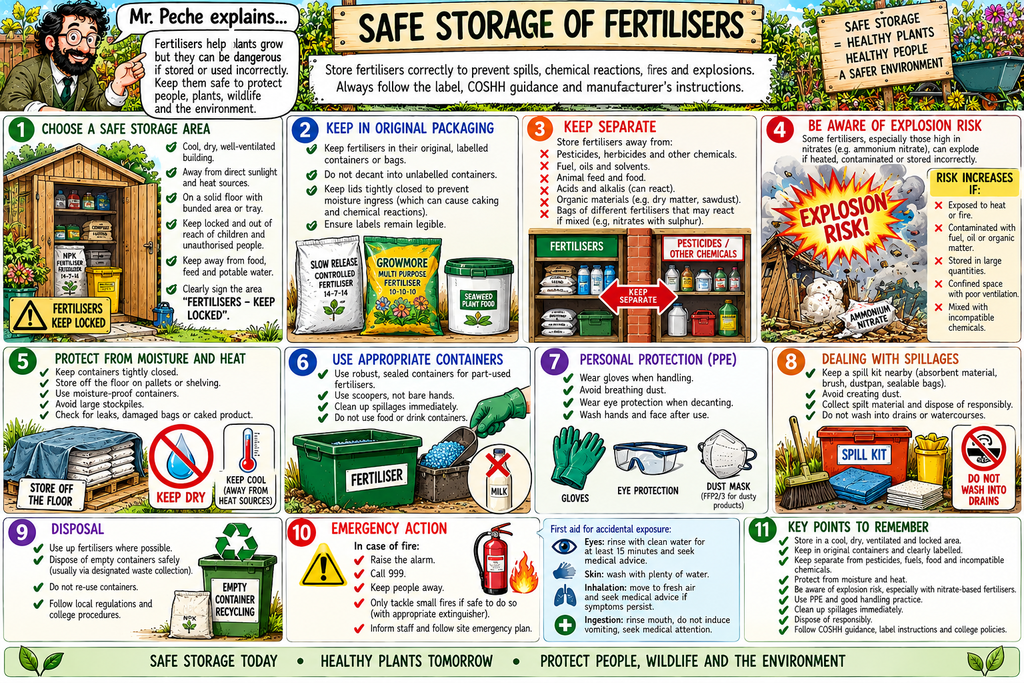
Responsible fertiliser use therefore involves:
- applying only what is required
- following product instructions
- avoiding unnecessary applications
- preventing fertiliser from entering water
- storing fertilisers safely.
Good horticulture considers both plant health and environmental responsibility.
36. A practical Level 2 investigation
Select three plants showing different levels of growth or foliage condition.
For each plant, record:
1. Plant identification
- common name
- botanical name where known.
2. Symptoms
- colour
- leaf position
- pattern
- severity.
3. Distribution
- older leaves
- younger leaves
- whole plant
- isolated areas.
4. Growing conditions
- soil or growing medium
- light
- moisture
- drainage.
5. Feeding history
- fertiliser used
- approximate timing
- application method.
6. Initial diagnosis
Suggest the most likely nutritional problem, if any.
7. Further evidence required
State what additional evidence would help confirm the diagnosis.
8. Recommended action
Explain what should be investigated or changed before applying fertiliser.
37. The N-E-E-D observation method
A useful way to remember nutritional diagnosis is:
N – Notice
Observe the symptoms carefully.
E – Examine
Look at where the symptoms occur on the plant.
E – Environment
Check the soil, growing medium, pH, moisture and growing conditions.
D – Diagnose
Use the evidence to identify the most likely cause before feeding.
This reinforces the principle:
Do not feed first and ask questions later.
38. Key Level 2 knowledge
Students should be able to:
- explain why plants require mineral nutrients
- distinguish macronutrients from micronutrients
- identify the main plant nutrients
- describe the basic functions of nitrogen, phosphorus and potassium
- recognise common nutrient deficiency symptoms
- explain the importance of magnesium, calcium, sulphur and iron
- understand the importance of soil pH
- explain the purpose of fertilisers
- recognise different types of fertiliser
- understand NPK analysis
- distinguish organic and inorganic fertilisers
- understand liquid, granular and controlled-release fertilisers
- understand the risks of overfeeding
- recognise fertiliser burn
- explain the importance of correct application
- understand the role of organic matter
- recognise that nutrient deficiency symptoms can resemble other plant-health problems
- understand that plant disorders are non-infectious
- understand that diagnosis should take place before corrective feeding
- understand the environmental consequences of inappropriate fertiliser use.
39. Knowledge check
Question 1
What is the difference between a plant’s food and a fertiliser?
Question 2
What does NPK stand for?
Question 3
Give three functions of nitrogen.
Question 4
What is phosphorus important for?
Question 5
Give two functions of potassium.
Question 6
What is chlorosis?
Question 7
What is necrosis?
Question 8
What is interveinal chlorosis?
Question 9
Why can soil pH affect nutrient availability?
Question 10
Why might adding more fertiliser fail to solve a plant-health problem?
Question 11
What is fertiliser burn?
Question 12
Give two environmental problems associated with excessive fertiliser use.
Question 13
Why can container-grown plants require regular feeding?
Question 14
Why is it important to follow fertiliser manufacturer’s instructions?
Question 15
Why should the location of symptoms on the plant be recorded when diagnosing a deficiency?

Conclusion
Plant nutrition is fundamental to horticulture, but successful feeding is not simply a matter of adding fertiliser whenever a plant looks unhealthy.
Plants require a balanced supply of essential nutrients, and those nutrients must be available in forms that roots can absorb. Soil pH, moisture, root health, growing conditions and the biology of the plant all influence nutrient availability.
Plant foods and fertilisers can be valuable tools, but they should be used carefully and for a reason.
The most important principles are:
Know the plant.
Observe the symptoms.
Understand the growing conditions.
Identify the likely cause.
Then decide whether feeding is necessary.
A good horticulturist therefore does not simply ask:
“What fertiliser should I use?”
The better question is:
“What does this plant need, and what evidence tells me that it needs it?”
Understanding plant foods, feeding and disorders allows students to make more informed horticultural decisions, avoid unnecessary fertiliser use and maintain healthier plants while reducing environmental impacts.
References
Royal Horticultural Society (RHS) (2022) RHS Level 2 Certificate in the Principles and Practices of Horticulture: Qualification Specification. London: Royal Horticultural Society.
Royal Horticultural Society (RHS) (2022) RHS Level 2 Diploma in the Principles and Practices of Horticulture: Qualification Specification. London: Royal Horticultural Society.
Royal Horticultural Society (RHS) (2026) RHS Level 2 Qualifications. London: Royal Horticultural Society.
Royal Horticultural Society (RHS) (2026) Soil, compost and mulch. London: Royal Horticultural Society.
Royal Horticultural Society (RHS) (2026) Fertilisers and plant nutrition. London: Royal Horticultural Society.
City & Guilds (2018) Level 2 Award/Certificate/Diploma in Practical Horticulture Skills (7573-02): Qualification Handbook. London: City & Guilds.