Conservation and the Role of Gardening

Introduction
Conservation is the protection and management of the natural and historic environment. Gardening has an important role to play because gardens occupy a large area of land across the UK and form part of a much wider network of habitats.
A garden can provide food, shelter and breeding sites for wildlife, but it can also become a poor habitat if it is heavily paved, intensively managed or dependent on excessive chemicals, water and artificial inputs.
For the Level 2 horticulturist, conservation is therefore not simply about leaving a garden untouched. It is about managing plants, soil, water and habitats in ways that maintain or improve their environmental value.
This approach supports the practical principles found within City & Guilds Level 2 horticulture and the RHS emphasis on sustainable gardening, biodiversity, soil health and responsible resource use.
1. What is conservation?
Conservation means managing something carefully so that its important qualities are maintained for the future.
In horticulture this can include the conservation of:
- plants;
- wildlife;
- soil;
- water;
- habitats;
- genetic diversity;
- historic landscapes;
- and natural resources.
Conservation does not always mean preventing change.
A meadow, for example, may require cutting at particular times of year to maintain its biodiversity.
A hedge may need management to prevent it becoming overgrown.
A pond may need selective removal of excessive vegetation.
Good conservation therefore involves appropriate management rather than simply doing nothing.

2. Why do gardens matter?
A single garden may appear insignificant when considered on its own.
However, gardens collectively form a substantial part of the landscape.
They can provide:
- nesting sites;
- nectar;
- berries;
- seeds;
- shelter;
- overwintering sites;
- water;
- and connections between larger habitats.
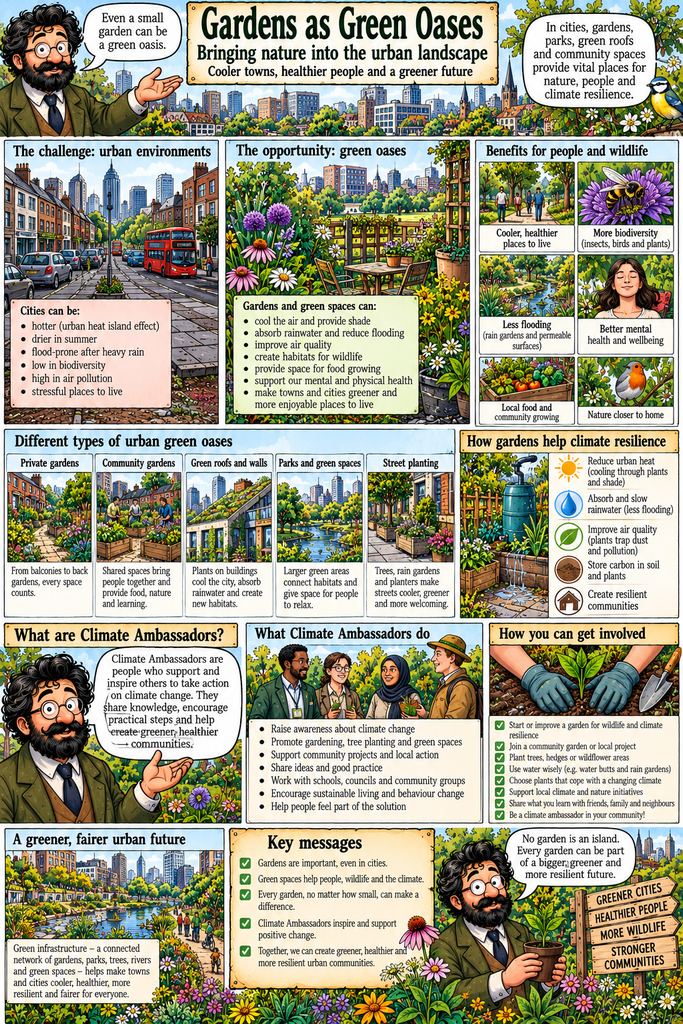
A garden can therefore act as a stepping stone between parks, woodland, hedgerows, allotments, cemeteries and other green spaces.
This is particularly important in towns and cities where natural habitats may be fragmented.
3. Biodiversity
Biodiversity means the variety of living organisms within a particular area.
It includes:
- plants;
- animals;
- fungi;
- microorganisms;
- and the habitats in which they live.
A conservation-focused garden does not need to be untidy.
A well-designed garden can combine:
aesthetic value + practical use + biodiversity.
For example, a formal garden could contain:
- flowering plants for pollinators;
- fruiting shrubs for birds;
- a pond;
- mature trees;
- native plants;
- areas of long grass;
- and composting facilities.
4. Plants and wildlife
Plants form the foundation of many garden food webs.
They provide:
- nectar;
- pollen;
- leaves;
- seeds;
- fruits;
- shelter;
- nesting material;
- and places for insects to live.
Different plants support different organisms.
This is one reason why a diverse planting scheme can be more valuable than a garden containing a very small number of plant species.
Native plants can be particularly valuable to local wildlife, although non-native plants can also provide nectar, pollen, fruit and habitat.
Conservation gardening should therefore focus on the actual ecological function of planting rather than assuming that every non-native plant is harmful.
5. Pollinators
Bees, hoverflies, butterflies and other insects transfer pollen between flowers.
They are important components of many ecosystems and are also essential to the reproduction of numerous plants.
Gardens can support pollinators by providing flowers across a long season.
Consider including plants that flower in:
- spring;
- summer;
- and autumn.
Avoid relying entirely on a single flowering period.
Where appropriate, allow some plants to flower rather than cutting them immediately after flowering.
6. Hedges as conservation features
Hedges can be extremely valuable wildlife habitats.
They can provide:
- nesting sites;
- shelter;
- berries;
- flowers;
- insects;
- and routes through the landscape.
A hedge can also act as a wildlife corridor.
Hedge management should therefore balance appearance with ecological function.
Consider:
- cutting at an appropriate time;
- avoiding active bird nests;
- maintaining a dense structure;
- retaining some mature growth;
- and allowing fruit and berries to develop where appropriate.
Historic hedges can also have archaeological and landscape value.
7. Trees
Trees provide multiple conservation benefits.
They can:
- store carbon;
- provide shade;
- intercept rainfall;
- reduce wind;
- provide nesting sites;
- support insects and fungi;
- provide fruit and seeds;
- and contribute to soil development.
A mature tree can support considerably more biodiversity than a recently planted tree.
Therefore, conservation gardening should not automatically involve removing an old tree simply because it is less tidy.
Dead wood can also be valuable.
Where safe, standing dead wood, fallen branches and decaying logs can provide habitat for insects, fungi and other organisms.

8. Soil conservation
Soil is a living system.
It contains:
- bacteria;
- fungi;
- earthworms;
- nematodes;
- mites;
- insects;
- organic matter;
- air;
- water;
- and mineral particles.
Healthy soil supports healthy plants.
Conservation gardening can include:
- reducing unnecessary cultivation;
- avoiding compaction;
- maintaining organic matter;
- using mulch;
- protecting soil from erosion;
- maintaining plant cover;
- and composting suitable garden waste.
A soil that is repeatedly dug, compacted and left bare can lose structure and biological activity.
9. Composting
Composting returns organic material to the garden.
Suitable materials can include:
- grass cuttings;
- leaves;
- soft plant material;
- vegetable waste;
- and small quantities of woody material.
Compost can contribute organic matter and nutrients to soil.
Composting also reduces the amount of garden waste requiring removal from site.
A good composting system therefore connects:
garden waste → decomposition → soil improvement → plant growth.
This is an example of a more circular approach to horticulture.
10. Water conservation
Water is an increasingly important horticultural resource.
Gardens can conserve water through:
- rainwater collection;
- mulching;
- appropriate plant selection;
- efficient irrigation;
- improving soil structure;
- watering established plants only when necessary;
- and designing planting to suit local conditions.
Water should be applied to the root zone rather than wasted on paths and hard surfaces.
A conservation garden should consider both water quantity and water quality.
Excessive fertiliser and soil erosion can contribute nutrients and sediment to watercourses.
11. Pesticides and integrated pest management
Conservation does not mean allowing every pest to destroy a crop.
Instead, horticulturists can use Integrated Pest Management (IPM).
This involves:
- identifying the problem;
- monitoring pest populations;
- considering whether intervention is actually necessary;
- using cultural or physical controls first where appropriate;
- encouraging natural predators;
- and using chemical controls carefully where justified.
For example, aphids may be controlled naturally by:
- ladybirds;
- hoverfly larvae;
- lacewings;
- and other predators.
The presence of a pest does not automatically mean that a pesticide is required.
12. Garden chemicals
Fertilisers, pesticides and other chemicals can have environmental consequences if misused.
Good practice includes:
- following the label;
- using the correct dose;
- preventing contamination of water;
- storing products safely;
- avoiding unnecessary applications;
- and disposing of waste correctly.
Over-application can result in:
- nutrient pollution;
- damage to non-target organisms;
- chemical waste;
- and unnecessary expense.
The best conservation approach is often to prevent problems rather than repeatedly treating them.
13. Wildlife habitats in a garden
Different habitats support different organisms.
A conservation garden might contain:
| Habitat | Possible wildlife |
| Pond | Amphibians, aquatic insects |
| Hedge | Birds, insects, mammals |
| Long grass | Insects and small mammals |
| Flower border | Pollinators |
| Tree | Birds, insects, fungi |
| Log pile | Beetles, fungi and other decomposers |
| Compost heap | Decomposers and invertebrates |
| Bare or sandy area | Specialist insects and plants |
The objective is not necessarily to create every habitat.
Instead, the horticulturist should identify what the site can support and create a range of complementary habitats.
14. Gardens as wildlife corridors
A garden is rarely an isolated ecosystem.
Wildlife moves between:
- gardens;
- parks;
- roadsides;
- allotments;
- woodland;
- hedgerows;
- waterways;
- cemeteries;
- and other green spaces.
This creates the concept of green infrastructure.
A garden can therefore contribute to a larger ecological network.
For example:
garden → hedge → park → woodland → river corridor
Removing every hedge and replacing it with an impermeable fence can reduce this connectivity.
15. Climate change and conservation
Conservation gardening increasingly needs to consider climate change.
Plants and wildlife may experience:
- hotter summers;
- drought;
- intense rainfall;
- warmer winters;
- new pests;
- changing flowering times;
- and shifting species distributions.
A resilient garden can respond by:
- increasing plant diversity;
- conserving water;
- improving soil;
- providing shade;
- creating varied habitats;
- retaining trees;
- reducing unnecessary hard surfacing;
- and selecting plants appropriate to future conditions.
Biodiversity itself can contribute to resilience because a diverse system is less dependent on one species or one set of environmental conditions.
16. Invasive species

Not every introduced plant or animal is invasive.
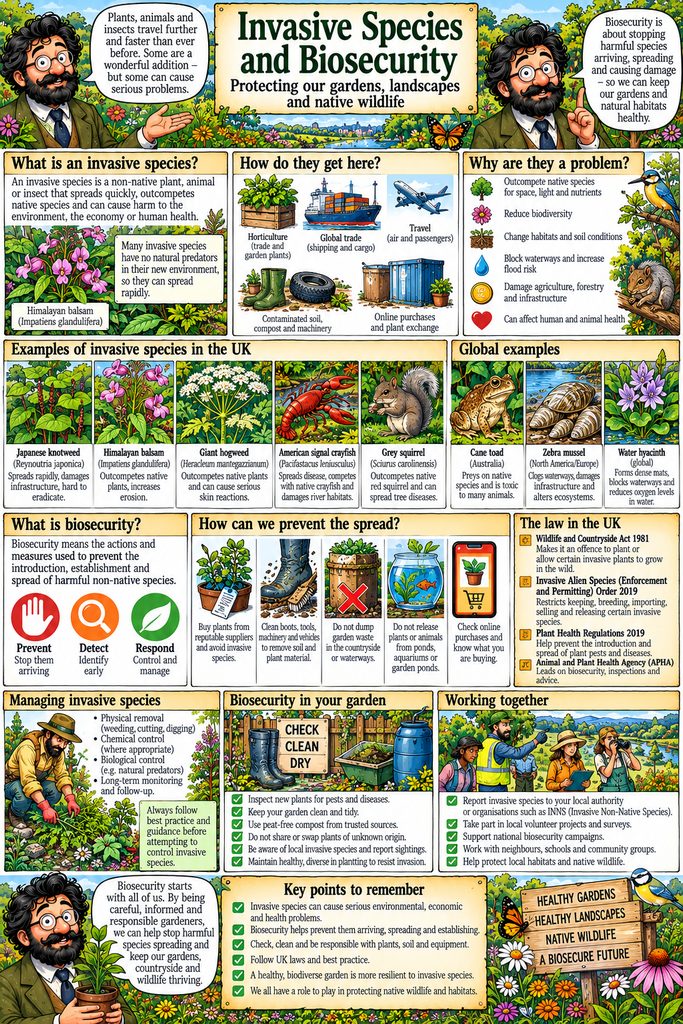
An invasive non-native species is a non-native organism that causes, or is likely to cause, ecological, economic or other harm.
Gardeners should avoid deliberately spreading invasive species and should dispose of potentially invasive plant material responsibly.
Examples of plants requiring particular care in the UK include:
- Japanese knotweed;
- Himalayan balsam;
- giant hogweed;
- and certain invasive aquatic plants.
Professional horticulturists should be able to identify problematic species and follow appropriate guidance.
17. Conservation of cultivated plants
Conservation is not limited to wild species.
Gardens can also conserve:
- heritage fruit varieties;
- traditional vegetables;
- historic cultivars;
- locally important plants;
- and horticultural genetic diversity.
Old varieties may contain useful characteristics such as:
- disease resistance;
- hardiness;
- unusual flavour;
- drought tolerance;
- or adaptation to particular conditions.
Maintaining plant diversity can therefore be valuable for both cultural and future horticultural reasons.
18. Historic gardens
Gardens can also be historic sites.
A garden may preserve evidence of:
- former planting styles;
- social history;
- land ownership;
- horticultural fashions;
- plant introductions;
- architecture;
- and changing attitudes towards nature.
Conservation work in a historic garden may therefore involve maintaining a particular design rather than simply increasing wildlife value.
This creates an important professional question:
What are we trying to conserve?
It might be:
- biodiversity;
- a historic design;
- a particular plant collection;
- a landscape feature;
- or several of these simultaneously.
19. Conservation does not mean no maintenance
One of the most important principles for a horticulturist is that conservation often requires active management.
Examples include:
- cutting a meadow;
- managing a hedge;
- removing invasive plants;
- maintaining a pond;
- controlling damaging pests;
- pruning trees;
- removing diseased material;
- managing scrub;
- and maintaining paths.
If a meadow is never cut, scrub and eventually woodland may develop.
If a pond is never managed, it may gradually fill with vegetation and sediment.
Conservation therefore involves understanding ecological succession and deciding which stage or feature should be maintained.
20. Practical conservation assessment
Students can assess a garden using the following questions.
Plants
- How many different plant species are present?
- Are there flowers available throughout the year?
- Are there fruiting or seed-producing plants?
Habitats
- Is there a hedge?
- Are there trees?
- Is there a pond?
- Are there areas of long vegetation?
- Is there dead wood?
Soil
- Is soil covered?
- Is it compacted?
- Is organic matter being returned?
Water
- Is rainwater collected?
- Is irrigation efficient?
- Is water being wasted?
Chemicals
- Are pesticides being used unnecessarily?
- Is fertiliser being applied according to plant requirements?
Connectivity
- Can wildlife move between the garden and surrounding green spaces?
Students can then identify three improvements that would provide the greatest conservation benefit.
21. Common mistakes
Thinking conservation means doing nothing
Habitats often require active management.
Making every area of the garden tidy
Excessive tidiness can remove valuable habitat.
Planting only one type of plant
Low diversity can reduce ecological resilience.
Removing all dead wood
Dead wood can be an important habitat.
Using pesticides automatically
The presence of a pest does not necessarily mean treatment is required.
Ignoring soil
Conservation begins below ground as well as above it.
Treating the garden as an isolated space
Gardens form part of wider ecological networks.
Knowledge Check
- What is conservation?
- What is biodiversity?
- Why can gardens be important for wildlife?
- What is a wildlife corridor?
- Give three ways a garden can conserve water.
- Why is healthy soil important for conservation?
- What is Integrated Pest Management?
- Why can dead wood be valuable?
- What is an invasive non-native species?
- Why can conservation require active management?
- How can gardens contribute to climate resilience?
- What is green infrastructure?
Key Level 2 Knowledge
A Level 2 horticulture student should understand:
- the meaning of conservation and biodiversity;
- the ecological value of gardens;
- the importance of soil, water and plants;
- the role of hedges and trees;
- how gardens can provide wildlife habitat;
- the importance of pollinators;
- basic principles of Integrated Pest Management;
- responsible use of fertilisers and pesticides;
- water conservation;
- composting and recycling organic matter;
- the importance of plant diversity;
- the problems associated with invasive non-native species;
- the relationship between gardens and wider green infrastructure;
- and how horticultural management can contribute to climate resilience.
Conclusion
Conservation is not separate from horticulture. Every decision made by a gardener can either increase or reduce the ecological value of a site.
Plant choice, pruning, mowing, irrigation, soil management, composting, pest control and hedge management all influence biodiversity and resource use.
The modern horticulturist therefore needs to think beyond individual plants and consider the garden as part of a much larger system.
A garden can be beautiful, productive and well maintained while also providing valuable habitat. The aim is not to stop gardening, but to garden in a way that works with ecological processes rather than constantly working against them.
References
City & Guilds (n.d.) Level 2 Award/Certificate/Diploma in Practical Horticulture Skills (7573-02). London: City & Guilds.
Royal Horticultural Society (RHS) (n.d.) Sustainable gardening. RHS Gardening Advice.
Royal Horticultural Society (RHS) (n.d.) Wildlife gardening. RHS Gardening Advice.
Royal Horticultural Society (RHS) (n.d.) Integrated pest management. RHS Gardening Advice.
Royal Horticultural Society (RHS) (n.d.) Composting. RHS Gardening Advice.
Natural England (n.d.) Green infrastructure framework. GOV.UK.
HM Government (1981) Wildlife and Countryside Act 1981. London: The Stationery Office.
HM Government (2021) Environment Act 2021. London: The Stationery Office.