Seasonal Pruning
What is pruning?
Pruning is the selective removal of parts of a plant, usually stems, branches, shoots, buds or roots. It is carried out for many different reasons, including maintaining plant health, controlling size and shape, improving flowering or fruiting, removing damaged material and managing the relationship between a plant and its surroundings.
Good pruning is not simply cutting branches off. The gardener needs to understand how the plant grows, when it grows and how it responds to being cut.
The old saying that you can always cut something off, but you cannot put it back is worth remembering.

Why do we prune?
Pruning may be carried out to:
- remove dead, diseased or damaged wood
- improve the health and appearance of a plant
- maintain the desired size and shape
- encourage new growth
- encourage flowering or fruit production
- improve light and air movement through the canopy
- remove crossing, rubbing or badly positioned branches
- maintain paths, buildings, roads and other structures
- reduce the risk of branches becoming hazardous
- rejuvenate older shrubs
- establish the framework of young trees and shrubs.
Pruning should always have a purpose. If you cannot explain why you are making the cut, it may be better not to make it.
Seasonal Pruning
Different plants respond differently to pruning, so there is no single pruning season that applies to everything.
Many deciduous trees are pruned during winter when they are dormant. The absence of leaves also makes the structure easier to see. However, this is not a universal rule: different species have different requirements.
Flowering time is particularly important.
A plant that flowers on last year’s growth can lose its flowers if it is pruned at the wrong time. Many spring-flowering shrubs should therefore be pruned after flowering, giving them time to produce the growth that will carry next year’s flowers.
Plants that flower on current-season growth are often pruned in late winter or spring. This encourages strong new shoots which will carry flowers later in the year.
This gives us one of the most useful rules in pruning:
Don’t ask when to prune until you know what you are pruning.
| Season | Typical pruning work | Examples / purpose |
| Winter | Structural pruning, removal of dead/damaged wood, renovation of suitable deciduous plants | Many deciduous trees and shrubs |
| Early spring | Cut back plants that flower on new growth; remove winter damage | Buddleja, some summer-flowering shrubs |
| Late spring | Prune many established evergreen shrubs; shape and maintain growth | Many evergreen shrubs |
| After flowering | Prune plants that flower on previous year’s growth | Forsythia, flowering currants and other early-flowering shrubs |
| Summer | Light trimming, control of vigorous growth and some formative pruning | Hedges, some fruit trees and selected shrubs |
| Autumn | Limited pruning; remove damaged or diseased material where appropriate | Avoid unnecessary heavy pruning of many plants |
| Any season | Remove dead, diseased or damaged material when appropriate | Health and safety of the plant |
The table is a guide rather than a calendar. Always identify the plant and check its individual pruning requirements (for example, Yew (Taxus baccata) should always be pruned in late August) before beginning work. The RHS divides woody plants into pruning groups to help gardeners understand these differences.
Winter pruning
Many deciduous trees and shrubs can be pruned during the dormant season.
Advantages can include:
- the branch structure is easier to see without leaves
- there is less foliage to work around
- some plants respond strongly to winter pruning
- fruit trees can be trained and managed effectively
- dead, damaged and crossing branches are easier to identify.
However, winter is not automatically the correct time for every plant.
Some trees, including Prunus species, can be more susceptible to certain diseases when pruned during wet winter conditions. Some shrubs also flower on old wood, so heavy winter pruning can remove the following season’s flowers.
One of the simplest starting points for a student learning to prune is:
Dead
Remove dead wood because it has no useful function and can become a source of decay or disease.
Damaged
Remove broken, split or badly damaged branches to prevent further problems.
Diseased
Remove diseased material where appropriate to reduce the possibility of disease spreading.
After this, consider:
Crossing → Rubbing → Congestion → Shape → Size
The objective is not to remove as much as possible. The objective is to remove the right material.
Summer Pruning
Summer pruning is often used where the aim is to control vigorous growth rather than encourage it.
It can be useful for:
- managing fruit trees
- reducing excessive vegetative growth
- maintaining restricted forms
- controlling size
- improving light penetration
- removing unwanted or badly positioned shoots.
Summer pruning can also be useful for trees where excessive winter pruning would produce a strong flush of vigorous regrowth.
Timing remains important. The gardener should understand whether the plant flowers or fruits on new wood or old wood before pruning.
Spring Pruning
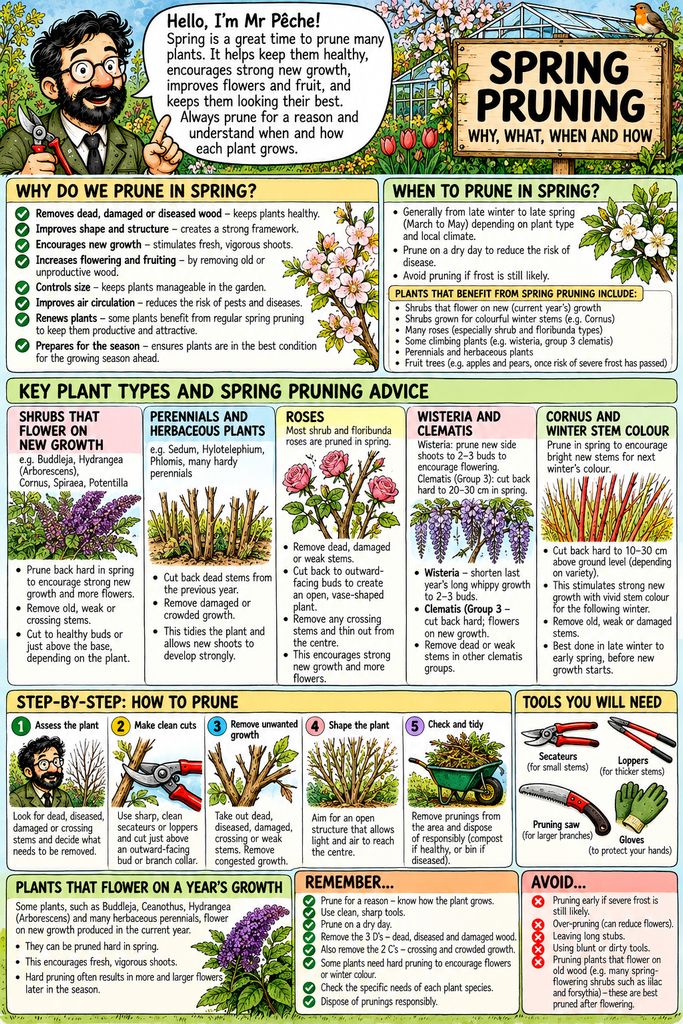
Spring pruning is often used for plants that are sensitive to severe winter conditions or for shrubs that flower later in the season.
Many shrubs that flower on new growth can be pruned in late winter or early spring, before their new growth develops.
However, spring is also the beginning of active growth. Birds may be nesting, plants are beginning to use stored reserves, and sap movement can be increasing.
The gardener therefore needs to consider the plant, weather, wildlife and purpose of the work.
Autumn Pruning

Autumn can be a useful time for removing dead, damaged or diseased material, but it is not necessarily the best time for heavy pruning.
Freshly cut growth may be more exposed to cold weather, while some plants can respond to pruning by producing new shoots that are vulnerable to winter damage.
Autumn is also an important season for wildlife. Before cutting hedges, shrubs or trees, check carefully for nesting birds and follow current wildlife protection requirements.
What is Wind Rock?
Wind rock occurs when strong winds cause a tree or plant to move excessively in the soil.
This is particularly noticeable with:
- newly planted trees
- trees with poorly developed root systems
- trees planted in exposed positions
- plants growing in wet or loose soil
- trees with large crowns exposed to strong winds.
Think of the tree as a lever.
The crown catches the wind, and the movement of the upper part of the tree is transferred down through the stem and into the root system.
Repeated movement can cause the root ball to rock backwards and forwards.
This can:
- break newly developing roots
- create gaps between the roots and surrounding soil
- reduce water uptake
- destabilise the tree
- cause the tree to lean
- slow establishment.
In severe cases, continued movement can eventually cause the tree to fail.
How can wind rock be reduced?
The gardener should first investigate why the plant is moving rather than simply cutting branches off.
Possible measures include:
- checking that the tree has been planted correctly
- firming the soil where appropriate
- providing suitable support for newly planted trees
- checking stakes and ties
- ensuring the root ball has adequate contact with the surrounding soil
- reducing excessive exposure where practical
- monitoring the tree after periods of strong wind.
Pruning may sometimes reduce the wind load on a tree, but unnecessary pruning should not be used as a substitute for correct planting and establishment.
Pruning and Wind
A common mistake is to assume that removing large numbers of branches will automatically make a tree safer in windy conditions.
Trees are dynamic structures. Their branches, stems and roots work together, and the tree responds to movement by developing its structure over time.
Heavy or inappropriate pruning can create its own problems, including:
- large wounds
- weak regrowth
- excessive epicormic growth
- reduced energy reserves
- altered crown structure
- decay.
The aim should therefore be targeted pruning rather than simply removing as much growth as possible.

Basic Pruning Cuts
When removing a branch, the cut should normally be made with an understanding of the branch collar and branch attachment.
Avoid leaving large stubs, but also avoid cutting unnecessarily into the trunk or main stem.
For smaller branches, use a sharp, clean tool that is appropriate for the size of the material.
For larger branches, appropriate cutting techniques are essential to control the weight of the branch and prevent tearing.
PPE and Safe Working
| Task | Possible hazards | Typical PPE / controls |
| Hand pruning | Cuts, thorns, awkward posture | Gloves where appropriate; safety footwear; suitable sharp tools |
| Large shrub pruning | Falling branches, cuts, eye injuries | Gloves; eye protection; safety footwear |
| Tree pruning from ground level | Falling material, tools, unstable branches | Safety helmet where required; eye protection; safety footwear; exclusion zone |
| Hedge cutting | Sharp blades, flying debris, noise | Eye/face protection; hearing protection; safety footwear; gloves where appropriate |
| Working at height | Falls, falling objects | Appropriate access equipment; work-at-height controls; exclusion zone |
| Chainsaw pruning | Severe cuts, kickback, falling timber, noise | Chainsaw helmet; eye/face protection; hearing protection; chainsaw gloves; chainsaw trousers/leg protection; chainsaw boots |
| Working in windy conditions | Falling branches, unstable trees, loss of control | Assess conditions before starting; postpone work where conditions make the task unsafe |
Never assume that because a task is part of routine gardening it is automatically safe.
Before You Prune: The Five Questions
1. What am I trying to achieve?
Size control? Health? Shape? Fruit? Flowers? Clearance?
2. What type of growth does the plant produce?
Does it flower or fruit on old wood or new wood?
3. When should it be pruned?
Consider the species, season, weather and local conditions.
4. What could go wrong?
Consider falling branches, tools, machinery, access, wildlife, electricity, people and structures.
5. How much should I remove?
As little as necessary to achieve the objective.
The Professional Gardener’s Rule
Pruning is an intervention, not a routine haircut.
A skilled gardener looks at the whole plant before making the first cut. They consider its age, species, structure, health, surroundings and intended purpose.
The best pruning job is often the one where the cuts are difficult to notice.
Cut with a reason. Prune with a purpose. Leave the plant better than you found it.
Key legislation and guidance
Pruning work can involve several areas of UK health and safety law, including:
- Health and Safety at Work etc. Act 1974
- Management of Health and Safety at Work Regulations 1999
- Personal Protective Equipment at Work Regulations 1992, as amended
- Work at Height Regulations 2005
- Provision and Use of Work Equipment Regulations 1998 (PUWER)
- Lifting Operations and Lifting Equipment Regulations 1998 (LOLER) where lifting equipment is used.
Work involving trees may also require specialist training, equipment and competence. Chainsaw use and work at height should only be undertaken by people who have received appropriate training and are competent for the specific task.
Environmental consideration
Before pruning or cutting vegetation, check for nesting birds and other wildlife. Under the Wildlife and Countryside Act 1981, wild birds, their nests and eggs receive legal protection, with additional provisions applying to certain species and circumstances.
Key message
Seasonal pruning is about working with the biology of the plant rather than simply working against it.
Understand the plant, understand the season, understand the risk—and then make the cut.
The Three D’s

Pruning and Plant Biology
Pruning changes the balance between the roots and shoots of a plant.
Removing branches reduces the amount of foliage available for photosynthesis. This can influence the plant’s energy balance and stimulate new growth.
This is why severe pruning can sometimes produce a vigorous flush of shoots. The gardener needs to understand that pruning is not simply cosmetic—it is an intervention in the plant’s biology.
A useful way of thinking about pruning is:
Cut less → Observe more → Understand the plant → Make the next cut
Good pruning is often surprisingly conservative.
PPE and Safe Working
Pruning involves sharp tools, woody material, falling branches and sometimes work at height.
Basic PPE
| Pruning activity | Typical PPE | Main reason |
| Hand secateurs | Safety footwear; gloves where appropriate | Protect hands and feet |
| Loppers | Gloves; safety footwear; eye protection where appropriate | Sharp blades and falling material |
| Pruning saw | Gloves; safety footwear; eye protection | Saw blade and falling material |
| Thorny shrubs | Suitable gloves; long sleeves; eye protection where appropriate | Protect skin and eyes |
| Hedge trimming | Eye/face protection; hearing protection where required; safety footwear | Flying debris and noise |
| Pole pruner | Eye/face protection; helmet where required by risk assessment; gloves; safety footwear | Falling branches and debris |
| Chainsaw pruning | Chainsaw helmet, eye/face protection, hearing protection, chainsaw gloves, chainsaw trousers/leg protection and chainsaw boots | Protection against severe injury |
Chainsaw work requires appropriate training and competence, as well as specific protective clothing. HSE states that anyone using a chainsaw at work must have adequate training relevant to the work undertaken.
Working at Height
Some pruning requires access above ground level. This introduces an additional hazard.
A ladder should not automatically be the first choice simply because it is available. The work should be assessed to determine whether a ladder is appropriate or whether safer equipment is required.
Where ladders are used, they should be suitable, stable and in good condition. HSE recommends pre-use checks and stresses that workers must be competent, or appropriately supervised while training.
Never use a chainsaw from a ladder. Chainsaw work from a tree or from height requires specialist training and equipment.
Wildlife and Seasonal Pruning
Seasonal pruning is not just about the plant.
Before cutting shrubs, hedges or trees, consider whether wildlife is using the plant. In particular, active bird nests must not be damaged or destroyed. The Wildlife and Countryside Act 1981 provides legal protection for wild birds and their nests.
This is another example of professional horticulture requiring the gardener to look before cutting.
Practical Pruning Checklist
Before starting:
☐ Have I correctly identified the plant?
☐ Do I know its natural growth habit?
☐ Does it flower on old or new wood?
☐ Is this the correct season?
☐ What am I trying to achieve?
☐ Have I identified dead, damaged and diseased material?
☐ Are there crossing or rubbing branches?
☐ Have I checked for wildlife and nesting birds?
☐ Are my tools clean, sharp and suitable?
☐ Am I wearing the correct PPE?
☐ Do I need to work at height?
☐ Have I completed the appropriate risk assessment?
☐ Do I know how the waste material will be dealt with?
Student Activity
Choose three plants from the garden.
For each plant, record:
Plant: __________________________
Evergreen / deciduous: __________________________
Flowering period: __________________________
Flowers on old or new wood: __________________________
Best pruning period: __________________________
Pruning objective: __________________________
Tools required: __________________________
PPE required: __________________________
Potential hazards: __________________________
What would happen if it was pruned at the wrong time?
Remember
Good pruning is not about cutting more. It is about understanding what to remove, when to remove it and why.
The professional gardener does not approach every plant with the same pair of secateurs and the same calendar date.
They look at the plant first.
Then they think.
Then they cut.
Key references
- Royal Horticultural Society (RHS), RHS Pruning Groups.
- Royal Horticultural Society (RHS), How to Prune a Tree.
- Royal Horticultural Society (RHS), Pruning Shrubs.
- Royal Horticultural Society (RHS), Pruning Early-Flowering Shrubs.
- Royal Horticultural Society (RHS), Pruning Summer- or Autumn-Flowering Shrubs.
- Health and Safety Executive (HSE), Working with Chainsaws.
- Health and Safety Executive (HSE), Chainsaw Personal Protective Equipment.
- Health and Safety Executive (HSE), Safe Use of Ladders and Stepladders.
Pruning for Winter, Spring and Summer Colour
Why do we prune for colour?
Pruning is often described as a way of controlling the size and shape of a plant. That is true, but for many ornamental plants the more important question is:
Where will next year’s flowers come from?
A gardener who removes the wrong stems at the wrong time may produce a beautifully shaped plant with very few flowers.
Understanding the relationship between growth, flowering and pruning allows the gardener to work with the plant rather than against it.
Plants generally flower either on:
- old wood – growth produced in previous seasons
- new wood – growth produced during the current growing season
There are also plants that flower on a mixture of old and new growth.
This distinction is one of the most useful principles in ornamental pruning.
Winter Colour
Winter pruning is often associated with deciduous plants, particularly when the structure of the plant can easily be seen without its leaves.
However, the purpose of winter pruning should not simply be to make the plant look tidy.
Winter can be a useful time to:
- remove dead wood
- remove damaged branches
- remove crossing or rubbing growth
- improve the structure of a young tree or shrub
- control excessive growth
- rejuvenate suitable plants
- encourage attractive young stems
Some plants are grown specifically for the colour of their young stems in winter.
Examples include:
- Cornus
- Salix
- Rubus
- some forms of dogwood and willow
With coloured-stem Cornus, for example, hard pruning can encourage vigorous young shoots which often provide the strongest winter colour.
This creates an interesting relationship between summer pruning and winter display.
The gardener is effectively pruning in one season to create a visual effect in another.
Winter Pruning: The Advantages
Better visibility
Without leaves, the framework of many deciduous plants is easier to see.
Reduced water loss
Dormant plants are generally under less water stress than actively growing plants.
Structural assessment
The gardener can see:
- crossing branches
- weak unions
- damaged wood
- congested growth
- the overall framework
Reduced risk of removing flowers
This depends entirely on the plant.
A winter-pruned plant that flowers on old wood may lose many of its potential flowers.
Therefore:
Winter is not automatically the correct time to prune.
Spring Colour
Spring flowering plants often produce their flowers from buds that developed during the previous growing season.
This means that heavy pruning during winter can remove the very wood carrying the spring display.
Examples include:
- Forsythia
- flowering currant
- Weigela
- Philadelphus
- Deutzia
- many early-flowering shrubs
For many of these plants, the better approach is to prune shortly after flowering.
The sequence becomes:
Flower → prune → new growth → flower buds develop → next year’s display
This is a particularly useful principle for students to understand.
Pruning After Spring Flowering
Once flowering has finished:
- Remove dead and damaged wood.
- Remove some of the oldest stems where appropriate.
- Remove weak or badly positioned growth.
- Thin congested areas.
- Encourage new shoots.
- Allow sufficient time for new growth to mature before winter.
The plant is then given the growing season to produce the stems that will carry next year’s flowers.
This is why pruning immediately after flowering can be more important than simply remembering a particular month.
Summer Colour
Many plants that flower during summer produce flowers on new growth made during the current season.
Examples include:
- Buddleja
- some Hydrangea species and cultivars
- many herbaceous plants
- some repeat-flowering shrubs
Pruning these plants in late winter or early spring can encourage vigorous new shoots which later produce flowers.
The gardener is therefore using pruning to influence the relationship between:
new growth → flower production → summer display
Summer Pruning
Summer pruning has several possible purposes.
It can:
- control vigorous growth
- maintain shape
- remove unwanted shoots
- improve light penetration
- improve air circulation
- control some fruit trees
- encourage a second flush of growth or flowering in suitable plants
- maintain hedges and topiary
However, summer pruning should not automatically mean cutting everything back.
The plant’s natural growth habit and flowering method must be considered first.
| Season / objective | What the gardener may do | Main consideration |
| Winter colour | Prune suitable plants to encourage colourful young stems | Strong young growth may provide the best display |
| Spring colour | Usually prune early-flowering shrubs after flowering | Flowers may be carried on old wood |
| Summer colour | Prune suitable plants in late winter/early spring to encourage new flowering growth | Flowers may be produced on current-season growth |
| Summer maintenance | Light trimming and selective pruning | Avoid removing developing flower buds unnecessarily |
| Autumn | Usually limit heavy pruning unless there is a specific reason | Plants may be entering dormancy; wildlife and weather also need consideration |
These are broad principles rather than fixed rules.
Always identify the plant before deciding when to prune.
Old Wood or New Wood?
This is one of the most important questions a horticulturist can ask.
Flowers on old wood
The flower buds are formed on growth produced during a previous season.
Prune at the wrong time → remove flower buds → fewer flowers.
Flowers on new wood
The plant produces new growth and then develops flowers on that growth.
Prune appropriately → encourage new growth → potentially more flowers.
This can be remembered as:
OLD WOOD
Don’t remove next year’s flowers before they open.
NEW WOOD
Encourage new growth before the flowering season.
Pruning for Winter Stem Colour
Some shrubs are grown not for their flowers but for the colour of their young stems.
Examples include coloured-stem Cornus.
The older stems gradually lose their strongest colour.
Removing some or all of the older stems encourages new shoots from the base.
These younger stems often provide the strongest winter display.
The gardener therefore needs to think several months ahead:
Prune now → new shoots develop → shoots mature → winter colour appears.
This is a useful example of why pruning is about planning rather than simply cutting.
Tools and Equipment
| Tool | Typical use |
| Secateurs | Small stems and fine pruning |
| Loppers | Larger branches |
| Pruning saw | Larger woody stems |
| Hedge shears | Formal hedges and some shrubs |
| Pole pruner | Higher branches where appropriate |
| Gloves | Protection from thorns and rough material |
| Disinfectant / cleaning equipment | Tool hygiene |
| Labels | Identifying plants and pruning trials |
Tools should be clean, sharp and suitable for the task.
A blunt tool crushes tissue rather than making a clean cut.
PPE and Safety
Pruning is a relatively common horticultural task, but it still contains hazards.
| Hazard | Possible risk | Control / PPE |
| Sharp tools | Cuts | Correct technique; suitable gloves; keep tools maintained |
| Falling branches | Head or body injury | Assess the area; establish exclusion zones; head protection where required |
| Thorns | Punctures and scratches | Suitable gloves and protective clothing |
| Eye injuries | Flying particles | Eye protection where appropriate |
| Hedge machinery | Noise and flying debris | Eye/face protection, hearing protection and suitable footwear |
| Working at height | Falls | Appropriate equipment and work-at-height controls |
| Chainsaw use | Severe injury | Specialist training and chainsaw-specific PPE |
PPE is only one part of safe working. The task should be risk assessed and appropriate methods of work used.

Wildlife and Pruning
Before pruning hedges, shrubs and trees, check for wildlife.
Birds may use dense vegetation for nesting, particularly during the breeding season.
The Wildlife and Countryside Act 1981 provides legal protection for wild birds, their nests and eggs.
A professional gardener therefore does not simply look at the plant.
They look at what is living in and around the plant.
Common Pruning Mistakes

Pruning by calendar alone
“It’s February, so everything can be pruned.”
Not true.
Removing all old wood
Some plants need older wood because it carries their flower buds.
Cutting everything to the same height
Plants have different natural forms.
Removing too much
Heavy pruning can create vigorous regrowth and stress the plant.
Ignoring the purpose of the plant
A shrub grown for flowers should be pruned differently from one grown for coloured stems.
Forgetting next year’s display
The gardener should always ask:
“What will this plant do after I cut it?”
Practical Activity
Choose three plants with different flowering periods.
Plant 1
Plant: ______________________________
Flowering season: ____________________
Old wood / new wood: _________________
Best pruning period: __________________
Purpose of pruning: ___________________
Plant 2
Plant: ______________________________
Flowering season: ____________________
Old wood / new wood: _________________
Best pruning period: __________________
Purpose of pruning: ___________________
Plant 3
Plant: ______________________________
Flowering season: ____________________
Old wood / new wood: _________________
Best pruning period: __________________
Purpose of pruning: ___________________
Student Challenge
Choose a plant that flowers in spring and one that flowers in summer.
Explain why pruning them at exactly the same time might produce different results.
Now answer:
If a shrub flowers on old wood, what might happen if you prune it heavily in winter?
If a shrub flowers on new wood, why might late-winter pruning be useful?
Why might a gardener hard-prune a coloured-stem Cornus?
The Pruning Calendar
Instead of memorising hundreds of dates, learn this sequence:
Identify the plant
↓
Understand its natural growth habit
↓
Find out when it flowers
↓
Work out whether flowers are produced on old or new wood
↓
Decide what you want pruning to achieve
↓
Choose the appropriate time
↓
Make the minimum cuts necessary
This is the difference between cutting plants and pruning professionally.
Remember
A gardener should always be thinking one season ahead.
The flowers you see today may have been prepared by the plant months earlier.
The stems you prune today may determine the display you see next spring.
The young shoots encouraged in spring may provide the colour of winter.
Good pruning is therefore a conversation with the future of the plant.
You are not simply deciding what to remove.
You are deciding what the plant will become.
Key references
- Royal Horticultural Society (RHS), RHS Pruning Groups.
- Royal Horticultural Society (RHS), Pruning Trees and Shrubs.
- Royal Horticultural Society (RHS), guidance on pruning early-flowering and summer-flowering shrubs.
- Brickell, C. and Joyce, D., Pruning & Training, DK/RHS.
- Hartmann, H.T. et al., Plant Propagation: Principles and Practices.
- Health and Safety Executive (HSE), guidance on safe use of hand tools, machinery and work at height.
- Wildlife and Countryside Act 1981, as amended.