Gardening East Anglia: North Winds, Heavy Clays and Fenlands
The gardens of East Anglia reflect a distinctive combination of maritime exposure, relatively low rainfall, fertile agricultural soils and extensive low-lying fenlands. Although counties such as Lincolnshire and Norfolk are often associated with open skies and flat landscapes, its gardening conditions vary considerably. Exposed coastal gardens must withstand cold winds and salt spray, while gardens on heavy clay can suffer from waterlogging in winter and cracking soils during summer drought. In the Fens, drainage, water management and the protection of peat soils are particularly important.
Therefore, successful gardening in counties like Norfolk depends on understanding local geology, soil structure, wind exposure and water availability.

North Winds and Coastal Exposure
Norfolk’s open landscape offers limited natural shelter in many locations. Cold northerly and north-easterly winds can damage foliage, increase moisture loss and restrict plant growth, particularly during spring. Coastal gardens may also experience salt spray, which can scorch leaves and damage sensitive plants.
Windbreaks can reduce exposure, but completely solid barriers may create turbulence. Porous hedges, mixed native shrubs and carefully positioned fences can provide more effective shelter. Suitable plants depend on the degree of exposure, but options for many exposed sites include hawthorn (Crataegus monogyna), field maple (Acer campestre) and sea buckthorn (Hippophae rhamnoides) in appropriate coastal locations. Sea buckthorn should be avoided where its spread could threaten sensitive dune habitats.
Planting shelter belts in stages can create a more favourable microclimate for less wind-tolerant plants.
Heavy Clay Soils
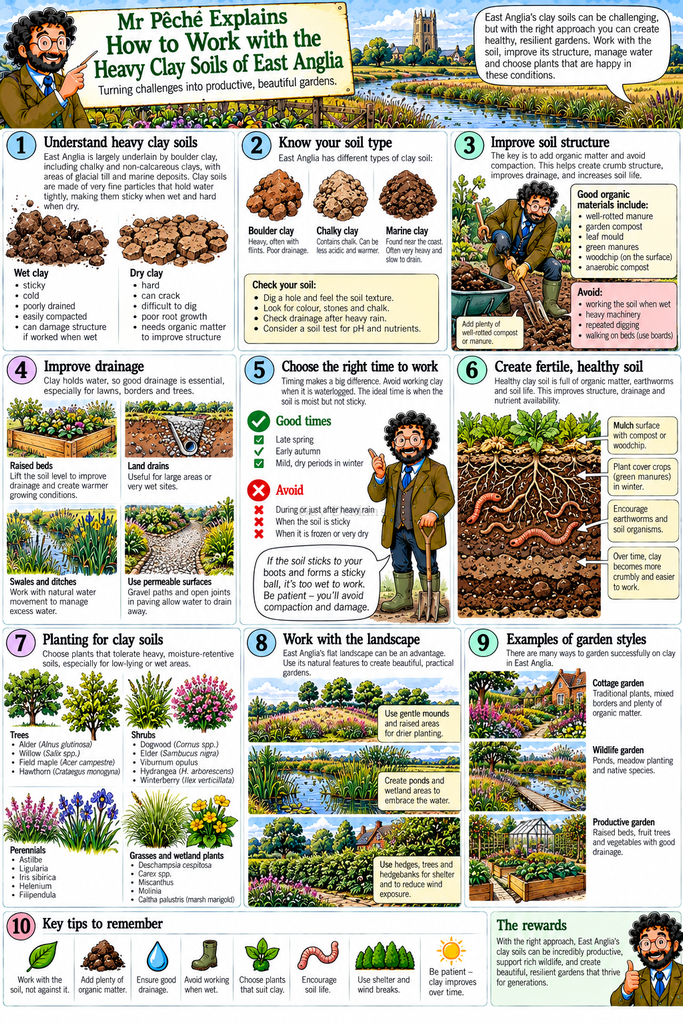
Much of Norfolk contains clay-rich soils, although sandy, chalky and loamy soils also occur. Heavy clay holds nutrients and can retain moisture, but it may drain slowly, become waterlogged in winter and form hard clods when dry. Working clay while it is wet can cause compaction and damage its structure.
Good clay-soil management involves:
- Avoiding digging or trafficking when the soil is saturated.
- Incorporating suitable organic matter into cultivated beds where appropriate.
- Maintaining permanent plant cover to protect the soil surface.
- Using raised beds where drainage problems cannot otherwise be resolved.
- Selecting plants tolerant of the site’s moisture conditions.
Clay soils can support productive gardens when their structure is maintained. However, adding sand alone is rarely an effective remedy for heavy clay and may make the soil more difficult to manage.
The Norfolk Fenlands
The Norfolk Broads and surrounding fenland landscapes are shaped by water, drainage and distinctive wetland ecology. Historically, many fenlands contained deep peat formed from accumulated plant material under waterlogged conditions. Drainage for agriculture has lowered water tables in many areas, exposing peat to oxidation, subsidence and carbon loss.
Gardening in these landscapes requires particular care. Some sites have fertile alluvial soils, while others contain peat or soils affected by changing water levels. Before installing drainage or raising ground levels, gardeners should understand local conditions and any environmental restrictions.
Where appropriate, moisture-tolerant plants such as yellow flag iris (Iris pseudacorus), purple loosestrife (Lythrum salicaria) and marsh marigold (Caltha palustris) can create wildlife-friendly damp areas. These plants should be selected according to the garden’s water conditions, and invasive species must be avoided.
Rainwater collection, permeable surfaces and carefully designed wetland features can help manage water sustainably. Existing peat soils should be protected from unnecessary disturbance.
Designing for Norfolk’s Climate

Norfolk’s relatively dry climate can create summer drought even where clay soils remain wet during winter. Gardens should therefore be designed for both extremes. Mulching, rainwater harvesting and drought-tolerant planting can reduce summer water demand, while good soil structure and suitable drainage help manage winter rainfall.
Trees, hedges and mixed planting can provide shelter and wildlife habitat, but planting should respect underground services, property boundaries and the mature dimensions of trees. In coastal and fenland locations, local ecology should guide the choice of species and materials.
Conclusion
Gardening in Norfolk requires adaptation to contrasting conditions: exposed winds, heavy clay, seasonal drought and water-sensitive fenland soils. By establishing effective shelter, protecting soil structure and managing water carefully, gardeners can create productive and resilient spaces that reflect the county’s varied landscapes.
Key learning points
- Northerly winds and coastal salt spray can restrict plant growth.
- Porous windbreaks can create shelter while reducing damaging turbulence.
- Heavy clay benefits from careful management and should not be worked when saturated.
- Fenland soils may include vulnerable peat that requires protection.
- Norfolk gardens must often cope with winter wetness and summer drought.
References
British Geological Survey (n.d.) Geology of Britain. Available at: https://www.bgs.ac.uk/
Broads Authority (n.d.) Landscape and biodiversity. Available at: https://www.broads-authority.gov.uk/
Royal Horticultural Society (n.d.) Soil types and soil improvement. Available at: https://www.rhs.org.uk/soil-composts-mulches
UK Centre for Ecology & Hydrology (n.d.) Peatlands and wetland science. Available at: https://www.ceh.ac.uk/