Irrigation, Drought, Waterlogging and Soil Water
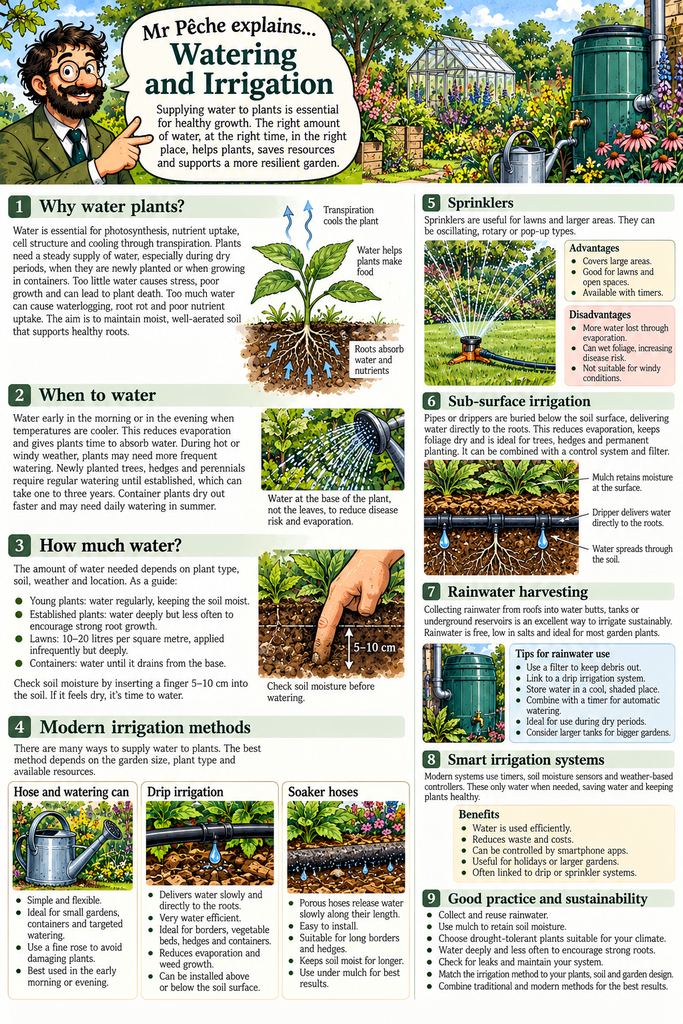
Water is essential for plant growth. It is involved in photosynthesis, nutrient transport, cell expansion and maintaining plant structure. However, plants need a balance of water and air around their roots.
Too little water can cause drought stress, while too much water can fill the air spaces in soil and restrict the oxygen available to roots.
Good horticultural irrigation is therefore about managing soil moisture, rather than simply adding water.
This chapter introduces the principles of irrigation, drought, waterlogging, field capacity, anaerobic soil and leaching. These are important areas of practical horticultural knowledge within City & Guilds Level 2 horticulture and support the RHS approach to responsible water management and plant care.
1. Why plants need water
Plants require water for several essential processes.
Water:
- is a raw material for photosynthesis;
- transports dissolved mineral nutrients;
- maintains cell turgidity;
- supports new growth;
- helps regulate plant temperature through transpiration;
- and allows roots to absorb nutrients from the soil solution.
Most water enters a plant through the roots and travels upwards through the xylem.
However, a plant cannot simply absorb all the water surrounding its roots. Water must be held within the soil in a form that roots can access.
2. Soil contains both water and air
A healthy soil contains:
- mineral particles;
- organic matter;
- water;
- air;
- and living organisms.
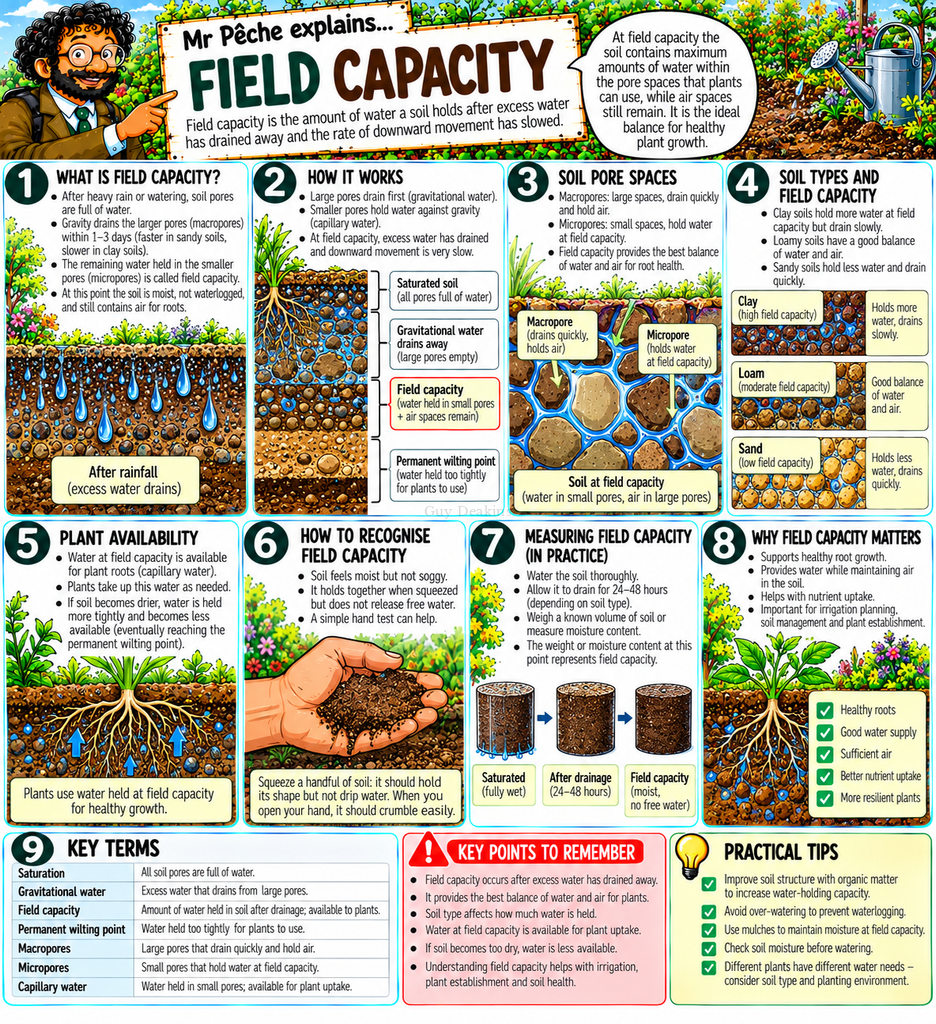
The spaces between soil particles are called pores.
Large pores generally drain rapidly and contain air after drainage.
Smaller pores hold water more strongly.
A productive soil therefore needs a balance between water-holding capacity and drainage.
This is why soil structure is so important.
A compacted soil may contain very little useful air space even when it appears to contain plenty of water.
3. Field capacity
Field capacity describes the amount of water remaining in soil after excess gravitational water has drained away.
Immediately after heavy rainfall or irrigation, many of the larger pores may be filled with water.
As drainage occurs, water leaves the largest pores and air returns to them.
The water remaining is approximately the soil’s field capacity.
Field capacity is important because it represents a useful balance between:
water available to plants + air available to roots.
Different soils have different field capacities.
| Soil | General water behaviour |
| Sandy soil | Drains rapidly and holds less water |
| Loamy soil | Generally provides a good balance |
| Clay soil | Holds considerable water but may drain slowly |
Organic matter can also influence the ability of soil to hold and release water.
4. Available water
Not all water held in soil is available to plants.
Some water drains away rapidly.
Some is held so tightly around soil particles that roots cannot extract it.
The water between these extremes is often described as plant-available water.
This helps explain why a soil can contain moisture but a plant can still show drought symptoms.
A very dry clay soil, for example, may contain water that is held too tightly for roots to access easily.
5. Irrigation
Irrigation is the artificial application of water.
Common methods include:
- watering cans;
- hoses;
- sprinklers;
- micro-irrigation;
- drip irrigation;
- porous or seep hoses;
- automated irrigation systems.
The appropriate method depends on:
- the crop or plant;
- soil type;
- weather;
- planting density;
- site conditions;
- water availability;
- and the purpose of the planting.
The RHS promotes efficient water use, including watering plants thoroughly when required rather than relying on frequent, superficial applications.

6. Watering efficiently
Good irrigation should place water where plants can use it.
Avoid unnecessary watering of:
- paths;
- hard surfaces;
- bare areas;
- and areas outside the root zone.
Watering early in the morning or later in the day can reduce losses through evaporation, although the priority is to water according to plant need and conditions.
Newly planted plants generally require more attention than established plants because their root systems have not yet explored the surrounding soil.
A common mistake is to give a plant a small amount of water every day when a deeper, less frequent watering would encourage better use of the available soil moisture.

7. Drought
Drought stress occurs when a plant cannot obtain enough water to meet its requirements.
Symptoms can include:
- wilting;
- curling leaves;
- premature leaf drop;
- reduced growth;
- flower or fruit loss;
- and, in severe cases, death.
Drought stress can occur even when rainfall has not completely stopped.
For example, a shallow-rooted plant in a sandy soil may experience water stress after several dry days.
8. Reducing drought stress
Horticulturists can reduce water demand through good design and maintenance.
Methods include:
- selecting plants suited to the site;
- improving soil structure;
- adding suitable organic matter;
- applying mulch;
- reducing unnecessary bare soil;
- protecting newly planted specimens;
- harvesting rainwater;
- and using efficient irrigation.
Mulching is particularly useful because it can reduce evaporation from the soil surface.
However, mulch should not be piled directly against plant stems or trunks.
9. Drought and climate change
Climate change is increasing the importance of water management in horticulture.
UK gardens may experience combinations of:
- hotter summers;
- longer dry periods;
- intense rainfall events;
- water restrictions;
- and periods of drought followed by heavy rain.
Planting design therefore needs to consider both water availability and drainage.
A climate-resilient garden should not simply be designed to survive drought. It should also be capable of dealing with excessive rainfall.
10. Waterlogging
Waterlogging occurs when soil remains saturated with water for an extended period.
When the soil pores become filled with water, air is displaced.
This creates a serious problem for roots because they require oxygen for respiration.
Waterlogging can result from:
- heavy clay soil;
- compaction;
- poor drainage;
- excessive irrigation;
- high groundwater;
- impermeable layers;
- or prolonged rainfall.
11. Anaerobic soil
The term anaerobic means occurring without oxygen.
Waterlogged soil can become anaerobic because water fills the pore spaces that would normally contain air.
Roots may then struggle to respire.
Anaerobic conditions can lead to:
- poor root growth;
- root death;
- yellowing foliage;
- reduced nutrient uptake;
- unpleasant-smelling soil;
- and increased susceptibility to root diseases.
Soil microorganisms also behave differently under anaerobic conditions.
Some microorganisms can use substances other than oxygen during respiration, changing the chemistry of the soil.

12. Waterlogging and plant roots
Healthy roots require access to both water and oxygen.
This creates an important horticultural principle:
A plant can suffer from lack of oxygen even when there is plenty of water.
This is why simply adding more water to a wilting plant can sometimes make the problem worse.
A plant showing poor growth should therefore be investigated rather than automatically watered.
Check:
- soil moisture;
- drainage;
- soil structure;
- root condition;
- recent rainfall;
- irrigation frequency;
- and the plant’s requirements.
13. Leaching
Leaching occurs when water moves through soil and carries dissolved substances with it.
Nutrients can be lost through leaching, particularly in freely draining soils.
Nutrients particularly susceptible to movement include forms of:
- nitrogen;
- potassium;
- and other soluble minerals.
Heavy rainfall or excessive irrigation can therefore move nutrients below the main root zone.
This can reduce fertility and potentially contribute to nutrient pollution of groundwater and watercourses.
14. Irrigation and nutrient loss
Overwatering can therefore create two problems at the same time:
Water waste + nutrient loss
For example:
- Fertiliser is applied.
- Excessive irrigation follows.
- Water moves through the soil.
- Soluble nutrients are carried downwards.
- Some nutrients move beyond the plant’s effective root zone.
This is one reason why fertiliser and irrigation should be managed together.
The aim should be to provide plants with what they need rather than applying large quantities and attempting to correct problems afterwards.
15. Soil structure and water management
Good soil structure helps manage both drought and excessive rainfall.
A well-structured soil can contain:
- large pores for drainage and aeration;
- smaller pores for water storage;
- organic matter;
- stable aggregates;
- and biological activity.
Compaction reduces pore space and can create poor drainage.
Practical methods of protecting soil structure include:
- avoiding unnecessary cultivation;
- avoiding working wet soils;
- reducing compaction;
- incorporating suitable organic matter where appropriate;
- maintaining vegetation;
- and using mulches.
This links water management directly to soil management.
16. Irrigation methods
| Method | Advantages | Limitations |
| Watering can | Cheap and precise | Labour intensive |
| Hose | Flexible | Can waste water |
| Sprinkler | Covers large areas | Evaporation and overspray |
| Drip irrigation | Targets root zone | Requires installation and maintenance |
| Micro-irrigation | Efficient for planted areas | Can block or require maintenance |
| Porous hose | Delivers water along planting areas | Performance depends on pressure and installation |
The best system depends on the site.
There is no single irrigation method suitable for every garden.
17. Practical water-management check
Before irrigating, students should ask:
Does the plant actually need water?
Then check:
- Is the soil dry?
- What type of soil is present?
- Has it rained recently?
- Is the plant newly planted?
- Is the plant showing genuine drought stress?
- Is the soil actually waterlogged?
- Is the irrigation reaching the root zone?
- Could mulch reduce evaporation?
- Could water be collected or reused appropriately?
This simple assessment prevents irrigation becoming an automatic routine.
18. Practical investigation: Field capacity
A simple classroom or practical investigation can demonstrate field capacity.
Equipment
- soil sample;
- plant pot with drainage holes;
- container;
- water;
- measuring jug;
- scales if available.
Method
- Place a known quantity of soil into a pot.
- Slowly add water until the soil is thoroughly wet.
- Allow excess water to drain freely.
- Observe the soil after drainage has largely stopped.
- Examine its moisture and structure.
The soil remaining after free drainage has occurred provides a practical demonstration of the concept of field capacity.
Students can compare:
- sand;
- loam;
- clay;
- and soil containing organic matter.
The investigation can demonstrate why different soils require different irrigation strategies.
19. Practical investigation: Waterlogging
Take equal quantities of different soils.
Place some in containers with drainage holes and others in sealed or restricted-drainage containers.
Add similar quantities of water.
Observe:
- drainage rate;
- water retention;
- soil smell;
- soil structure;
- and changes over several days.
Discuss which conditions might become anaerobic and why.
This demonstrates the relationship between soil pores, water and oxygen.
20. Common mistakes
Watering automatically
Watering should respond to plant and soil conditions.
Light surface watering
Small amounts may wet only the surface and encourage shallow rooting.
Ignoring soil type
Sandy and clay soils behave very differently.
Watering waterlogged plants
More water does not solve a drainage problem.
Applying excessive fertiliser
Nutrients can be wasted through leaching.
Compacting soil
Compaction reduces pore space and can restrict both drainage and root aeration.
Ignoring mulch
A suitable mulch can reduce evaporation and improve water conservation.
Knowledge Check
- What is irrigation?
- What is field capacity?
- Why do roots require oxygen?
- What is waterlogging?
- What does anaerobic mean?
- Why can waterlogged soil damage roots?
- What is leaching?
- Which soil generally drains most rapidly: sand or clay?
- Why can excessive irrigation cause nutrient loss?
- Give three ways of reducing drought stress.
- Why is soil structure important for water management?
- Why should a horticulturist check soil conditions before watering?
Key Level 2 Knowledge
A Level 2 horticulture student should understand that:
- plants require water but also oxygen around their roots;
- irrigation should be based on plant and soil requirements;
- field capacity describes the water remaining after excess water has drained;
- soil type affects water retention and drainage;
- drought causes water stress;
- waterlogging can restrict oxygen and damage roots;
- anaerobic conditions occur when oxygen becomes severely limited;
- excessive irrigation can cause leaching;
- nutrients can be transported beyond the root zone;
- good soil structure improves water and air movement;
- mulches can help conserve soil moisture;
- and efficient irrigation reduces unnecessary water use and nutrient loss.
Conclusion
Effective water management is about achieving a balance. Plants need enough water to grow, but their roots also need oxygen. Field capacity represents an important balance between water storage and air-filled pore space, while waterlogging can push soil towards anaerobic conditions. At the other extreme, drought reduces the water available to plants.
Good horticultural practice therefore combines appropriate irrigation, soil management, drainage, mulching and plant selection. By understanding how water behaves within soil, horticulturists can irrigate more efficiently, reduce drought stress, prevent waterlogging and minimise nutrient losses through leaching.
References
City & Guilds (n.d.) Level 2 Award/Certificate/Diploma in Practical Horticulture Skills (7573-02). London: City & Guilds.
Royal Horticultural Society (RHS) (n.d.) Watering. RHS Gardening Advice. Available at: https://www.rhs.org.uk/garden-management/watering
Royal Horticultural Society (RHS) (n.d.) Soil, compost and mulch. RHS Gardening Advice. Available at: https://www.rhs.org.uk/soil-composts-mulches
Royal Horticultural Society (RHS) (n.d.) Water-saving gardening. RHS Gardening Advice. Available at: https://www.rhs.org.uk/garden-design/water-saving-gardening