Customer Service, Simple Business Practice and How Tax Works
Introduction

Horticulture is not only about plants, soil, tools and practical skills. Many horticultural jobs involve working with people, understanding what a customer wants, organising work, calculating costs and keeping accurate records.
A gardener, landscaper, garden centre employee, nursery worker or self-employed horticulturist may need to:
- speak to customers
- understand their requirements
- arrange appointments
- provide quotations
- order materials
- organise work
- invoice customers
- receive payments
- keep business records
- deal with complaints
- understand basic taxation.
Good customer service and good business practice are therefore practical horticultural skills.
A technically excellent gardener can still lose customers if they are unreliable, fail to communicate, arrive late without explanation or leave work unfinished.
The basic principle is:
Do good work, communicate clearly, keep your promises and keep accurate records.
1. What is customer service?
Customer service is the way a business communicates with and supports its customers before, during and after providing a service.
In horticulture, customers might include:
- private householders
- landlords
- businesses
- schools
- care homes
- property managers
- housing associations
- local authorities
- community organisations.
Customer service begins before the work starts.
A customer should feel that the horticultural business:
- understands what they want
- communicates clearly
- behaves professionally
- provides a reliable service
- respects their property
- delivers what was agreed.
2. First impressions
The first contact with a customer can influence their expectations.
Professional behaviour includes:
- introducing yourself
- being polite
- listening carefully
- speaking clearly
- dressing appropriately for the work
- arriving on time
- keeping appointments
- using professional language.
This does not mean that a gardener needs to wear formal office clothing.
Practical workwear can be completely appropriate.
The important issue is whether the appearance is:
- clean
- suitable
- safe
- professional.
3. Listening to the customer
One of the most important customer-service skills is active listening.
Do not immediately assume that you know what the customer wants.
Ask questions such as:
- What would you like to achieve?
- Which parts of the garden are most important?
- Are there particular plants you want to keep?
- Are there plants you do not want?
- Is the garden intended for children or pets?
- How much maintenance are you prepared to do?
- Do you have a preferred budget?
- When would you like the work completed?
Listening carefully can prevent misunderstandings.

4. Understanding the customer’s requirements
Customers may describe a problem without knowing the horticultural terminology.
For example, a customer might say:
“My hedge has got out of control.”
The horticulturist needs to establish what this actually means.
They may need to determine:
- current hedge height
- desired height
- current width
- desired width
- hedge species
- access requirements
- whether wildlife is present
- whether waste needs to be removed.
The professional should translate the customer’s request into a practical specification.
5. Managing expectations
A customer may ask for something that is:
- unsuitable for the plant
- unsafe
- impractical
- outside the agreed service
- unrealistic within the available budget.
Good customer service does not mean agreeing to everything.
A professional should explain the situation clearly and suggest an appropriate alternative where possible.
For example:
“That hedge can be reduced, but removing that much growth in one operation may damage the plants. I recommend reducing it in stages.”
Clear explanation helps the customer understand why a particular approach is being recommended.

6. Written communication
Business communication may include:
- emails
- text messages
- letters
- quotations
- invoices
- contracts
- appointment confirmations.
Written communication should be:
- clear
- polite
- accurate
- concise
- professional.
Important information should not rely solely on a verbal conversation.
For larger jobs, written confirmation can help prevent disagreements about what was agreed.
7. Appointments
Reliability is an important part of customer service.
If a gardener agrees to arrive at 9:00 am, they should aim to arrive at the agreed time.
If circumstances prevent this, the customer should be informed as soon as reasonably possible.
For example:
“I am delayed by traffic and expect to arrive approximately 30 minutes later than planned.”
This is much better than simply failing to arrive.

8. Quoting for work
A quotation is a proposed price for work.
A quotation should make clear:
- what work will be carried out
- what materials are included
- what labour is included
- whether waste removal is included
- the price
- whether VAT is included, where applicable
- how long the quotation remains valid, if relevant
- any important assumptions or exclusions.
For example:
Hedge maintenance quotation
Work: Reduce and trim approximately 20 metres of established laurel hedge.
Includes:
- preparation
- hedge cutting
- removal of cut material
- site tidy
Price: £350
Excludes: Major access works or removal of material other than the stated hedge waste.
A clear quotation reduces the possibility of disagreement later.
9. Estimate versus quotation
An estimate is an approximate indication of likely cost.
A quotation is a stated price for specified work, subject to the terms and assumptions included.
The distinction matters.
If the scope of work changes, the price may need to change.
For example, a customer initially asks for a hedge to be trimmed but, once work begins, asks for the hedge to be reduced by another metre.
The additional work should be discussed and agreed before it is carried out.
10. Changes to the job
Customers sometimes change their minds.
For example:
“While you’re here, could you also remove that old shrub?”
Before undertaking additional work, clarify:
- what will be done
- how much it will cost
- whether additional materials are required
- whether waste disposal will change
- whether additional time is required.
Where possible, obtain agreement before beginning the extra work.
This protects both the customer and the business.
11. Pricing a horticultural job
A simple price calculation can include:
Labour + materials + equipment/overheads + waste disposal + other costs = business cost
The business then adds an appropriate margin.
For example:
| Cost | Amount |
| Labour | £180 |
| Materials | £75 |
| Waste disposal | £30 |
| Travel and other costs | £20 |
| Total cost | £305 |
The business must then determine the appropriate selling price.
The selling price should allow the business to cover its costs and generate a sustainable return.
12. Labour costs
Labour is not simply the time spent holding a tool.
A self-employed gardener may also spend time:
- travelling
- purchasing materials
- writing quotations
- answering messages
- completing paperwork
- maintaining equipment
- disposing of waste
- completing accounts.
These activities are part of running a business.
A business that charges only for time physically spent gardening may underestimate its true costs.
13. Materials
Materials may include:
- plants
- compost
- mulch
- fertiliser
- seeds
- timber
- paving materials
- irrigation components
- protective materials.
The business needs to know:
- purchase cost
- quantity
- delivery cost
- wastage
- storage requirements.
Materials supplied to customers should be included clearly in the quotation or invoice.
14. Overheads
Overheads are ongoing business costs that are not directly attributable to one individual job.
Examples can include:
- insurance
- vehicle costs
- fuel
- equipment
- tool maintenance
- telephone
- software
- accountancy
- advertising
- storage
- website costs.
A business must account for overheads when setting prices.
15. Invoices
An invoice is a request for payment for goods or services supplied.
A professional invoice normally includes:
- business name
- business contact details
- invoice number
- invoice date
- customer details
- description of work
- quantity where relevant
- price
- total amount due
- payment terms
- bank or payment details where appropriate.
If the business is VAT registered, the invoice must also contain the required VAT information.
16. Example invoice
GREEN LEAF GARDEN SERVICES
Invoice: 00027
Date: 28 September 2026
Customer:
Mr Smith
London
| Description | Amount |
| Hedge reduction and maintenance | £240 |
| Green-waste removal | £40 |
| Total | £280 |
Payment terms: Payment due within 14 days.
This simple structure makes it clear what the customer is being asked to pay for.
17. Keeping records
Good record keeping is essential.
A business may need to keep records of:
- sales
- invoices
- expenses
- receipts
- bank transactions
- mileage
- equipment purchases
- materials
- wages, if employees are involved
- tax information.
Records should be:
- accurate
- organised
- retained for the required period
- easy to retrieve.
Good records make it easier to understand whether the business is actually making money.
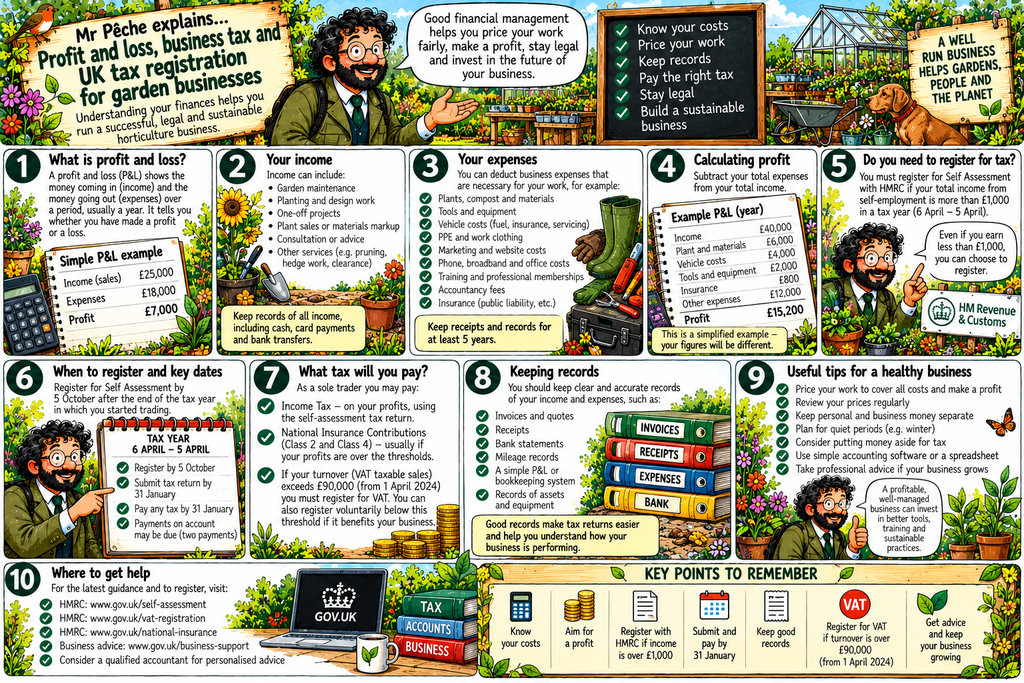
18. Profit and loss
A simple business calculation is:
Income − allowable business expenses = profit
For example:
| Amount | |
| Customer payments | £20,000 |
| Allowable business expenses | £7,000 |
| Profit | £13,000 |
The £13,000 is not necessarily the amount the business owner can simply treat as personal spending.
Tax and other obligations may need to be considered.
19. What is tax?
Tax is money collected by government under the tax system.
For a small horticultural business, relevant taxes may include:
- Income Tax
- National Insurance
- VAT
- Corporation Tax, depending on how the business is structured.
The taxes that apply depend on the type of business and its circumstances.
This chapter provides an introduction rather than tax advice.
Tax rules and thresholds can change, so current information should always be checked with HM Revenue & Customs (HMRC) or a qualified accountant.
20. Sole traders
A common structure for a small gardening business is sole trader.
A sole trader is self-employed and runs the business personally.
The business owner generally:
- keeps business records
- reports business income and expenses
- calculates taxable profit
- pays applicable Income Tax
- pays applicable National Insurance.
The important calculation is generally based on taxable profit, rather than simply the total amount of money received from customers.
HMRC provides guidance on setting up as a sole trader and completing Self Assessment.
21. Income Tax
Income Tax is charged on taxable income.
For a sole trader, business profit forms part of their taxable income.
A simplified example is:
Business income
minus
allowable business expenses
equals
taxable business profit
The applicable tax depends on the person’s overall circumstances and the tax rules for the relevant tax year.
The UK Income Tax system includes a tax-free Personal Allowance for people who qualify, followed by different tax rates at different income levels.
The actual amount of tax owed depends on the individual’s circumstances.
22. Allowable business expenses
Some costs incurred wholly and exclusively for business purposes can be allowable expenses.
Examples may include appropriate proportions of:
- tools
- equipment
- protective clothing
- business insurance
- advertising
- professional services
- materials
- business travel
- vehicle expenses under the relevant rules.
Not every expense is automatically allowable.
Personal expenditure should not simply be recorded as a business expense.
HMRC provides detailed guidance on allowable expenses.
23. National Insurance
Self-employed people may also have National Insurance obligations.
The rules for self-employed National Insurance have changed over time, so students should not rely on old examples or remembered thresholds.
The applicable National Insurance rules depend on:
- the tax year
- level of profits
- type of National Insurance contribution.
Current HMRC guidance should be checked when actually running a business.
24. VAT
VAT stands for Value Added Tax.
It is a tax applied to many goods and services.
A business does not automatically charge VAT simply because it exists.
VAT registration depends on factors including taxable turnover and the current VAT registration threshold.
If a business becomes VAT registered, it generally has responsibilities including:
- charging VAT where applicable
- keeping VAT records
- issuing appropriate VAT invoices
- calculating VAT owed or reclaimable
- submitting VAT returns
- paying HMRC amounts due.
The VAT registration threshold can change, so the current HMRC figure should always be checked rather than relying on an old textbook.
25. VAT in simple terms
Imagine a VAT-registered horticultural business charges a customer:
£1,000 + VAT
The customer pays the business the total amount shown on the invoice.
The business records the VAT separately because that VAT is not simply additional business profit.
The business may also have paid VAT on eligible business purchases.
The VAT system involves accounting for:
VAT charged to customers − eligible VAT on purchases
The resulting amount is generally what is accounted for to HMRC, subject to the applicable VAT rules.
VAT accounting can become complicated, which is why many businesses use accounting software or professional advice.
26. Limited companies
A horticultural business can also operate as a limited company.
A limited company is legally separate from its owners.
A company normally has its own:
- accounts
- records
- tax obligations
- bank account
- legal identity.
A company may be liable for Corporation Tax on its taxable profits.
The people running the company may also have personal tax obligations relating to money they receive from the company.
This means that:
A sole trader and a limited company do not operate under the same tax system.
The most appropriate structure depends on the circumstances of the business.
27. Sole trader versus limited company
A simplified comparison is:
| Sole trader | Limited company |
| Owner and business are closely linked legally | Company is a separate legal entity |
| Business profit is generally taxed through owner’s tax arrangements | Company generally pays Corporation Tax on taxable profits |
| Simpler administration in many cases | More formal administration |
| Owner has personal responsibility for business debts, subject to relevant law | Limited liability may apply, subject to circumstances |
| Self Assessment generally applies | Company reporting and tax obligations apply |
This is an introductory comparison rather than a recommendation about which structure a person should choose.
Professional advice should be obtained before establishing a business where the choice has significant financial or legal consequences.
28. Tax is not the same as profit
This is an important business concept.
Suppose a gardener receives:
£30,000
from customers.
That does not mean the gardener has made £30,000 profit.
If business expenses are:
£12,000
then the simplified calculation is:
£30,000 − £12,000 = £18,000 profit
Tax calculations then take account of the relevant tax rules and the person’s circumstances.
Therefore:
Turnover is not the same as profit.
29. Cash flow
A business can make a profit on paper and still have cash-flow problems.
For example, a customer may owe £2,000 but not pay for 30 days.
Meanwhile, the business may need to pay:
- suppliers
- fuel
- wages
- insurance
- equipment costs.
Cash flow means understanding when money comes into and out of the business.
A simple cash-flow record might look like:
| Month | Money in | Money out | Balance movement |
| September | £4,000 | £2,500 | +£1,500 |
| October | £2,000 | £3,000 | -£1,000 |
| November | £5,000 | £2,000 | +£3,000 |
Good businesses monitor both profitability and cash flow.
30. Getting paid
A business should establish clear payment terms.
These might state:
- when payment is due
- accepted payment methods
- whether a deposit is required
- whether staged payments apply
- what happens if payment is late.
Payment terms should be communicated before work begins.
For larger projects, deposits or staged payments may sometimes be appropriate, depending on the contract and circumstances.
31. Handling complaints
Complaints should be treated professionally.
A useful process is:
1. Listen
Allow the customer to explain the problem.
2. Clarify
Establish exactly what has happened.
3. Check the agreement
Review the quotation, specification and records.
4. Explain
Provide a clear response.
5. Resolve
Where appropriate, agree a reasonable solution.
6. Record
Keep a record of the complaint and the outcome.
Do not become defensive or argumentative.
A complaint can also reveal where a business needs to improve its communication or working practices.
32. Mistakes and correcting them
Mistakes can happen.
For example:
- the wrong plant may be supplied
- the wrong area may be cut
- a measurement may be incorrect
- a customer may have been given the wrong information.
Professional behaviour means acknowledging mistakes and taking appropriate action.
Trying to hide an error can turn a manageable problem into a serious loss of trust.
33. Customer privacy
Businesses may hold customer information such as:
- names
- addresses
- telephone numbers
- email addresses
- invoices
- payment information.
This information should be handled responsibly.
Businesses operating in the UK need to consider data-protection requirements, including the UK GDPR and Data Protection Act 2018.
Only appropriate information should be collected and it should be stored securely.
34. Insurance
A horticultural business may need appropriate insurance.
Depending on the work and business structure, this may include:
- public liability insurance
- employers’ liability insurance where applicable
- professional indemnity insurance where appropriate
- vehicle insurance suitable for business use
- equipment insurance.
Insurance requirements depend on the business.
For example, employers’ liability insurance is generally required where a business employs people, subject to specific legal exceptions.
Students should seek appropriate professional advice before starting a business.
35. Health and safety is part of customer service
Customers expect horticultural businesses to work safely.
This includes:
- controlling risks
- using equipment correctly
- protecting people nearby
- managing waste
- maintaining tools
- using appropriate PPE
- following relevant legislation and guidance.
A gardener working in someone’s home has a responsibility to consider the safety of the customer as well as their own safety.
36. Building repeat business
A horticultural business often depends on repeat customers.
Good customer service can encourage customers to return.
Important factors include:
- reliability
- quality
- communication
- honesty
- punctuality
- reasonable pricing
- cleanliness
- professional behaviour.
A customer who trusts a gardener may ask them to return for:
- seasonal maintenance
- hedge cutting
- lawn care
- planting
- pruning
- garden clearance
- ongoing maintenance.
The quality of the relationship can therefore be as important as the individual job.
37. A simple business workflow
A small horticultural business can use the following process:
Customer enquiry
↓
Site visit
↓
Understand requirements
↓
Prepare quotation
↓
Customer agrees
↓
Book work
↓
Carry out work
↓
Check completed work
↓
Invoice
↓
Receive payment
↓
Record income and expenses
↓
Follow up where appropriate
This simple system can help prevent important steps from being missed.
38. A simple record-keeping system
A small business could maintain separate records for:
Customers
- name
- contact details
- address
- work requested.
Jobs
- quotation
- agreed specification
- date
- labour
- materials
- completed work.
Money
- invoices
- payments
- expenses
- receipts
- bank transactions.
Tax
- taxable income
- allowable expenses
- VAT records if registered
- relevant tax documents.
Digital accounting systems can make these processes easier, but a spreadsheet can also be used for simple record keeping.
39. Example: a small gardening job
A gardener agrees to maintain a customer’s garden.
The quotation states:
Labour: £180
Materials: £50
Waste removal: £30
Total: £260
The customer agrees.
The gardener completes the work and issues an invoice for £260.
The gardener then records:
Income: £260
If the actual allowable business expenses associated with the job were £80, the simplified gross contribution from the job would be:
£260 − £80 = £180
The business then needs to account for its wider expenses and applicable taxes.
This illustrates why simply looking at the amount charged to the customer does not show the actual profit of the business.
40. Tax checklist for a new gardener
Someone starting a gardening business should investigate:
- What business structure will I use?
- Do I need to register with HMRC?
- Do I need to complete Self Assessment?
- What records must I keep?
- Which expenses are allowable?
- Do I need to register for VAT?
- Do I need insurance?
- Am I employing anyone?
- What health and safety requirements apply?
- Do I need to register or comply with any waste-related requirements?
- What contracts or terms should I use?
- Do I need professional accounting advice?
The answers depend on the individual’s circumstances.
Current information should be obtained directly from HMRC and other relevant official sources.
41. A simple way to remember tax
For a sole trader, a simplified model is:
Customer income
↓
Minus allowable business expenses
↓
Business profit
↓
Tax rules applied
↓
Income Tax and applicable National Insurance
For a VAT-registered business, VAT is accounted for separately.
For a limited company:
Company income
↓
Minus allowable company costs
↓
Taxable company profit
↓
Corporation Tax
The owner may then have separate personal tax considerations depending on how money is taken from the company.
These are simplified educational models. Actual tax calculations can be considerably more complicated.
42. Key business vocabulary
Customer
The person or organisation buying the service.
Service
Work provided for a customer.
Quotation
A stated price for specified work, subject to its terms and assumptions.
Estimate
An approximate indication of likely cost.
Invoice
A request for payment for goods or services supplied.
Revenue or turnover
Money received or invoiced from sales before deducting business expenses, according to the relevant accounting basis.
Expense
A cost incurred in running the business.
Profit
The amount remaining after relevant business costs are deducted from income.
Overhead
An ongoing business cost.
VAT
Value Added Tax.
Income Tax
A tax applied to taxable income.
National Insurance
Contributions made under the National Insurance system.
Corporation Tax
A tax generally charged on the taxable profits of companies.
For a UK garden/horticultural business, it is useful to separate the taxes into taxes on the business, taxes on the owner, and taxes connected with employees.
Mr Pêche explains… What taxes might a garden business pay?
Income Tax — sole trader
If you operate as a sole trader, you normally pay Income Tax on your taxable profit, not on your total turnover.
Turnover − allowable business expenses = taxable profit
For 2026/27 in England, Wales and Northern Ireland:
| Taxable income | Rate |
|---|---|
| Personal Allowance up to £12,570 | 0% |
| Basic rate | 20% |
| Higher rate | 40% |
| Additional rate | 45% |
The Personal Allowance reduces once adjusted net income exceeds £100,000 and can fall to zero. GOV.UK
For a sole trader, the business profit is effectively the owner’s income. There is no separate Corporation Tax simply because you are trading as a sole trader. GOV.UK
National Insurance
A sole trader may also have self-employed National Insurance liabilities, depending on profits.
If you employ people, you normally have to operate PAYE and deal with employee and employer National Insurance.
For 2026/27, the standard employer Class 1 NI rate is 15% above the relevant secondary threshold. GOV.UK
VAT
VAT is based on taxable turnover, rather than profit.
You must normally register when:
- your taxable turnover for the previous 12 months exceeds £90,000, or
- you expect taxable turnover to exceed £90,000 in the next 30 days. GOV.UK
Current principal VAT rates are:
- 20% standard rate
- 5% reduced rate
- 0% zero rate
The VAT registration threshold remains £90,000 for 2026/27. GOV.UK
Important for gardeners: VAT is not an additional profit tax. A VAT-registered business normally charges VAT to customers, accounts for it to HMRC and can generally reclaim eligible VAT on business purchases.
Corporation Tax — limited companies
If the garden business is a limited company, the company normally pays Corporation Tax on its taxable profits.
For 2026:
- profits up to £50,000 → 19% small profits rate
- profits above £250,000 → 25%
- profits between £50,000 and £250,000 → potentially marginal relief. GOV.UK
The owner then has to consider how money is taken from the company.
For example:
Company profit → Corporation Tax → remaining money → salary/bonus/dividend
Bonuses
This is particularly important if the business has employees.
A bonus paid to an employee is normally treated as earnings.
It therefore goes through payroll and can be subject to:
- PAYE Income Tax
- employee National Insurance
- employer National Insurance
For 2026/27, standard employee Class 1 NI is generally 8% between the primary threshold and upper earnings limit, then 2% above the upper earnings limit. Employer Class 1 NI is generally 15% above the secondary threshold. GOV.UK
For a sole trader: taking money out of your own business is not normally a “bonus”. It is an owner’s drawing and is not an allowable business expense.
Dividends
A limited-company owner may take some profits as dividends rather than salary.
Dividends are paid from profits after Corporation Tax.
The shareholder may then have personal dividend tax to pay.
For 2026/27 the dividend rates are:
- Basic rate: 10.75%
- Higher rate: 35.75%
- Additional rate: 39.35%
after the applicable dividend allowance. GOV.UK
So salary, bonus and dividend are not interchangeable from a tax perspective.
Business rates
If the business occupies premises such as:
- a garden centre
- shop
- nursery
- workshop
- commercial office
- horticultural yard with rateable premises
it may have to pay business rates.
Business rates are based principally on the property’s rateable value and the relevant multiplier.
In England, from 1 April 2026, a property with a rateable value of £12,000 or less can qualify for 100% Small Business Rate Relief where it is the only property used by the business. Relief gradually reduces between £12,001 and £15,000. GOV.UK
For 2026/27, the small-business multiplier is 43.2p and the standard multiplier is 48p for properties below the relevant £51,000 threshold. GOV.UK
A gardener working from customers’ gardens may therefore have very different business-rate liabilities from a garden centre operating from a large commercial property.
Tax when employing staff
Once a garden business employs people, the tax responsibilities become considerably greater.
The employer may need to deal with:
Employee
- PAYE Income Tax
- employee National Insurance
- student/postgraduate loan deductions where applicable
Employer
- employer National Insurance
- PAYE reporting
- workplace pension duties
- National Minimum Wage
- possible tax on benefits and expenses
Employer NI is currently 15% above the relevant secondary threshold for most standard employees. GOV.UK
Benefits and expenses
Things provided to employees can sometimes create additional tax and NI obligations.
Examples include:
- company cars
- private medical insurance
- certain gifts
- private use of business assets
- taxable expenses
Employers can have a Class 1A National Insurance liability on taxable benefits and expenses. The 2026/27 Class 1A rate is 15%. GOV.UK
Other taxes that may become relevant
Depending on how the horticultural business operates, there can also be:
| Tax | When it might matter |
|---|---|
| Capital Gains Tax | Selling business/personal assets or disposing of certain business interests |
| Corporation Tax | Limited company profits |
| Dividend Tax | Dividends received by shareholders |
| PAYE | Employees/directors receiving salary or bonuses |
| Employer NI | Employing staff |
| VAT | Taxable turnover above the registration threshold or voluntary registration |
| Business rates | Occupying rateable commercial premises |
| Vehicle taxes | Business vehicles, depending on type/use |
| Stamp Duty Land Tax | Purchasing certain land or property |
| Insurance Premium Tax | Included in the cost of many taxable insurance policies rather than normally being a separate business return |
| Apprenticeship Levy | Mainly relevant to larger employers |
The important distinction
For teaching horticulture students about starting a business, I would simplify it to this:
A garden business can encounter five major tax areas:
1. TAX ON PROFITS
→ Income Tax for a sole trader
→ Corporation Tax for a limited company
2. TAX ON SALES
→ VAT
3. TAX ON PEOPLE
→ PAYE + National Insurance + bonuses/benefits
4. TAX/CHARGES ON PREMISES
→ Business rates
5. TAX ON PARTICULAR TRANSACTIONS
→ Capital Gains Tax, SDLT, vehicle-related taxes etc.
The biggest mistake for a new gardener is to think “I made £50,000, so I pay tax on £50,000.” For Income Tax, the crucial figure is generally profit after allowable expenses, whereas the £90,000 VAT test is based on taxable turnover. GOV.UK

43. Practical activity: create a gardening business
Imagine that you are starting a small gardening business.
Create:
A business name
…………………………………………….
Services offered
- …………………………………………….
- …………………………………………….
- …………………………………………….
Target customers
…………………………………………….
Example quotation
Job: …………………………………………….
Labour: £………………..
Materials: £………………..
Waste: £………………..
Other costs: £………………..
Total: £………………..
Payment terms
…………………………………………….
Customer information to record
…………………………………………….
Business expenses to consider
…………………………………………….
Insurance to investigate
…………………………………………….
Tax questions to investigate
…………………………………………….
This activity demonstrates that running a horticultural business involves considerably more than practical gardening.
44. Knowledge check
Question 1
What is customer service?
Question 2
Why is listening important when dealing with a customer?
Question 3
What is the difference between an estimate and a quotation?
Question 4
What information should appear on a quotation?
Question 5
What is an invoice?
Question 6
What is the difference between turnover and profit?
Question 7
Give five examples of business expenses a gardener might have.
Question 8
What does VAT stand for?
Question 9
What is Income Tax?
Question 10
What is Corporation Tax?
Question 11
Why is accurate record keeping important?
Question 12
Why should a gardener communicate with a customer if they are going to be late?
Question 13
Why should additional work be agreed before it is carried out?
Question 14
What is cash flow?
Question 15
Why is professional behaviour important when dealing with customers?
45. Key knowledge
A horticulture student should understand:
- the importance of professional customer service
- how to communicate with customers
- how to establish customer requirements
- how to manage expectations
- the purpose of quotations
- the difference between quotations and estimates
- the purpose of invoices
- the importance of accurate records
- the difference between turnover, costs and profit
- basic labour and material costing
- the meaning of overheads
- the importance of payment terms
- how to handle complaints professionally
- the importance of customer privacy
- why insurance should be considered
- basic differences between sole traders and limited companies
- the basic purpose of Income Tax
- the basic purpose of National Insurance
- the basic purpose of VAT
- the basic purpose of Corporation Tax
- why current HMRC guidance should be checked
- the importance of seeking professional financial or tax advice where necessary.
Conclusion
Horticulture is a practical profession, but successful horticultural businesses depend on much more than practical skill.
A gardener may be excellent at pruning, planting, lawn care or hedge cutting, but a sustainable business also needs:
good communication + accurate pricing + reliable work + good records + sensible financial management.
Customer service begins with listening to what the customer actually wants. Business practice involves turning that requirement into a clear specification, quotation and completed job. Good record keeping then allows the business to understand its income, costs and profit.
Tax is another part of running a business, but it should not be feared. The basic principle is to understand what money comes into the business, what legitimate business costs go out, what profit remains and which tax rules apply.
The most important lesson is:
A successful horticultural business needs both practical skill and professional organisation.
A gardener who can grow and maintain plants is a horticulturist.
A gardener who can also communicate with customers, price work accurately, keep records and manage a business is developing the wider professional skills needed to work successfully in the horticultural industry.
References
HM Revenue & Customs (HMRC) (2026) Set up as a sole trader. London: HM Revenue & Customs.
HM Revenue & Customs (HMRC) (2026) Self Assessment. London: HM Revenue & Customs.
HM Revenue & Customs (HMRC) (2026) Business Income Manual. London: HM Revenue & Customs.
HM Revenue & Customs (HMRC) (2026) VAT: Registration. London: HM Revenue & Customs.
HM Revenue & Customs (HMRC) (2026) Allowable expenses. London: HM Revenue & Customs.
GOV.UK (2026) Running a limited company. London: UK Government.
GOV.UK (2026) Employers’ Liability Insurance. London: UK Government.
Information Commissioner’s Office (ICO) (2026) Data protection and the UK GDPR. Wilmslow: Information Commissioner’s Office.
City & Guilds (2018) Level 2 Award/Certificate/Diploma in Practical Horticulture Skills (7573-02): Qualification Handbook. London: City & Guilds.
Royal Horticultural Society (RHS) (2022) RHS Level 2 Certificate in the Principles and Practices of Horticulture: Qualification Specification. London: Royal Horticultural Society.