Horticulture: Laying Out Plants for Display
Introduction
Planting a garden is not simply a matter of putting plants into empty spaces.
Good planting design considers: Colour; shape; texture; height; habit; season; repetition; contrast; scale; proportion; maintenance; soil; light; drainage; biodiversity; sustainability
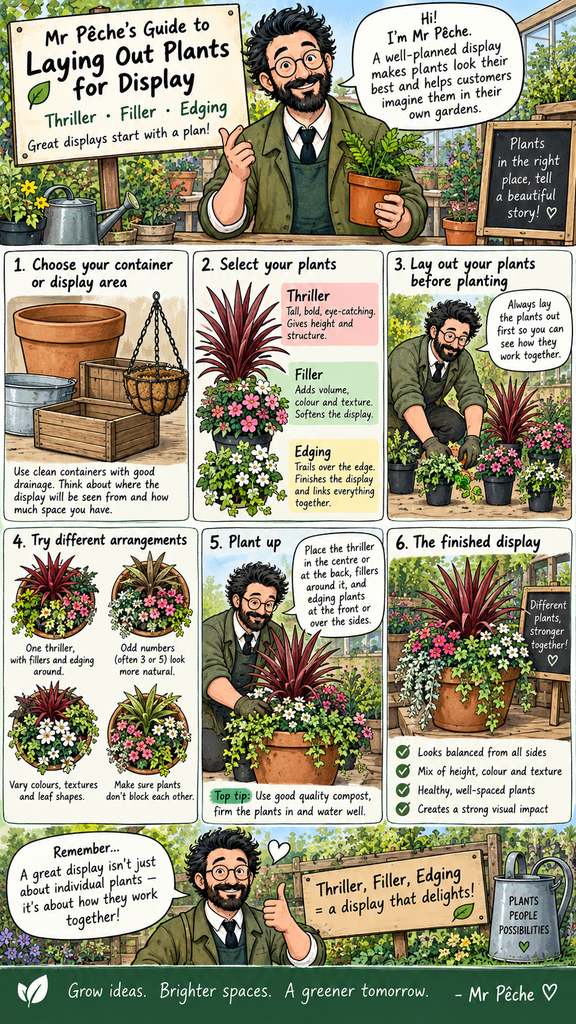
Before plants are planted, they should be laid out on the ground. This allows the horticulturist to see the proposed arrangement and make changes before the plants are permanently placed.
A good gardener should be able to look at a group of plants and ask:
Will these plants work together now, and will they still work together in five years?
Why Lay Plants Out Before Planting?
Laying plants out before planting allows you to:
| check spacing |
| check plant quantities |
| assess colour combinations |
| identify gaps |
| avoid overcrowding |
| create repetition |
| establish a good rhythm |
| check height relationships |
| adjust the composition |
| avoid unnecessary digging |
| reduce plant losses |
It is much easier to move a plant in a pot than to dig up an established plant.
Start with the Site
Before laying plants out, consider:
Soil
- sandy
- clay
- loam
- acidic
- alkaline
- fertile
- poor
- wet
- dry
Light
- full sun
- partial shade
- shade
Moisture
- dry
- moist
- waterlogged
Exposure
- sheltered
- windy
- coastal
- exposed
Existing vegetation
Consider:
- trees
- shrubs
- hedges
- established perennials
- existing bulbs
The principle is:
Right plant, right place.
Plant Labels and Plans
Before starting, check the plant labels.
Record:
- botanical name
- common name
- mature height
- mature spread
- preferred soil
- preferred light
- flowering period
- growth habit
Do not rely entirely on how large the plant looks in its pot.
A small plant may eventually become very large.

Plant Size vs Mature Size
One of the most common mistakes in planting is spacing plants according to their current size.
For example: A shrub may currently be 30 cm wide but eventually grow to 2 metres wide.
Planting it 30 cm from its neighbour may look attractive initially. Five years later it could be overcrowded.
Good planting design considers future size, not just today’s appearance.
The Basic Layout
A useful method is to divide the planting area into:
Back
Taller plants
Middle
Medium-height plants
Front
Lower-growing plants
However, this is only a starting point. Good planting can deliberately break this rule by allowing taller plants to move into lower areas and creating a more natural composition.

Planting in Groups
Plants often look stronger when planted in groups.
For example: 3 + 5 + 8
rather than: 1 + 1 + 1 + 1 + 1
Odd-numbered groups can produce a more natural visual effect. However, this is a design guideline rather than a law. Large plants may need fewer specimens. Small plants may need larger groups.
Repetition
Repeating a plant can create:
- rhythm
- continuity
- unity
For example: Lavender → grass → lavender → grass → lavender
The eye begins to recognise a pattern. Repetition can link different parts of a garden together.
Rhythm
Rhythm is created when visual elements are repeated or progress through a space.
It can be created through:
- colour
- height
- form
- texture
- plant species
Too little repetition can make a border appear disjointed.
Too much repetition can become monotonous.
Contrast
Contrast can make a planting display more interesting.
Contrast can occur between:
- tall and short
- dark and light
- fine and coarse foliage
- upright and spreading forms
- smooth and textured leaves
- warm and cool colours
For example:
fine grasses + large bold leaves
can create strong visual contrast.
Colour
Colour is often the first thing people notice.
Consider:
Warm colours
- red
- orange
- yellow
These can appear energetic and visually strong.
Cool colours
- blue
- violet
- some pinks
These can appear calmer and may visually recede.
Green
Green provides the framework for most planting schemes.
Different greens can be as important as flower colour.
Texture
Texture refers to the visual and physical character of foliage.
Examples include:
- fine
- coarse
- glossy
- hairy
- spiky
- fern-like
Combining different textures can make a border more interesting even when flowers are absent.
This is particularly important in perennial and shrub borders.

Annual Displays
An annual display is generally designed to provide strong seasonal impact over a relatively short period.
Examples include:
- summer bedding
- formal bedding schemes
- temporary displays
- seasonal containers
Annual displays are often changed regularly.
The design therefore focuses heavily on:
- immediate impact
- colour
- uniformity
- flowering period
- repetition
- seasonal theme
Laying Out an Annual Display
For an annual display, plants can often be arranged relatively close together to create a strong visual effect quickly.
The aim may be:
maximum impact in one season.
Typical approaches include:
- blocks of colour
- stripes
- geometric patterns
- repeated groups
- contrasting colours
- formal designs
Plants are generally chosen to perform over the same relatively short period.
Advantages of Annual Displays
They can provide:
- strong seasonal colour
- rapid visual impact
- flexibility
- opportunity to change the design each year
- opportunities for experimentation
They are useful where a garden needs:
- seasonal decoration
- event displays
- formal bedding
- temporary colour
Disadvantages of Annual Displays
Annual bedding can require:
- large quantities of plants
- frequent watering
- regular feeding
- deadheading
- replacement
- preparation each year
- disposal of spent plants
Some schemes also require significant:
- labour
- energy
- plastic pots
- compost
- transport
This raises sustainability questions.
Perennial and Shrub Borders
A perennial and shrub border is intended to provide a longer-term planting structure.
Unlike annual bedding, the plants are expected to remain in the garden for several years.
This changes the design process.
The gardener must consider:
What will this border look like next month?
but also; What will it look like in five years?

Laying Out a Perennial Border
When laying out a perennial and shrub border, consider:
- mature plant size
- spread
- seasonal interest
- flowering period
- foliage
- winter structure
- evergreen plants
- plant competition
- maintenance
- access
The border should not be designed only for its peak flowering period.
Four Seasons of Interest
A successful perennial and shrub border can provide interest throughout the year.
| Spring | bulbsearly perennialsfresh foliageblossom |
| Summer | flowersgrassesstrong foliage |
| Autumn | seedheadsberriesautumn colour |
| Winter | barkstemsevergreen foliageseedheadsstructural forms |
The best borders are not necessarily the ones with the most flowers.
They are the ones that remain interesting.
Annual vs Perennial and Shrub Border
| Annual display | Perennial/shrub border |
| Usually seasonal | Long-term |
| Designed for immediate impact | Designed for development |
| Often high colour intensity | Colour, form and structure |
| Plants may be replaced annually | Plants remain for several years |
| Close planting may be appropriate | Mature spacing is essential |
| Often highly formal | Can be formal or naturalistic |
| More frequent replacement | Lower replacement frequency |
| High seasonal maintenance | Ongoing maintenance |
| Future growth less important | Future growth essential |
Spacing Annuals
Annual plants are often planted relatively closely.
This can create:
- rapid coverage
- fewer visible gaps
- strong colour blocks
However, planting too closely can encourage:
- poor air circulation
- disease
- competition
- excessive watering requirements
Always follow the recommended spacing for the plant.
Spacing Perennials
Perennials should be spaced according to:
mature spread
rather than the size of the pot.
Allowing plants to grow into one another can produce a natural effect.
However, excessive overcrowding can lead to:
- competition
- reduced airflow
- disease
- weak growth
- difficult maintenance
Spacing Shrubs
Shrubs require particular care when calculating spacing.
Consider:
- mature height
- mature width
- growth rate
- pruning requirements
- root competition
A shrub border should not be planted as though every shrub will remain the size it is when purchased.
Planting in Drifts
A drift is a group or sweep of plants arranged to create a strong visual mass.
Drifts are particularly useful in:
- naturalistic planting
- prairie-style planting
- large borders
- public landscapes
Instead of scattering individual plants:
plant in groups and sweeps.
Planting in Blocks
Blocks create a more formal effect.
For example:
AAAAA
BBBBB
AAAAA
This can be effective for:
- bedding
- formal gardens
- geometric designs
It can also become visually repetitive if overused.

Naturalistic Planting
Naturalistic planting often uses repetition; drifts; grasses; seedheads; seasonal succession.
The arrangement may look informal but is often carefully designed. Naturalistic does not mean random.
The Importance of Focal Plants
A focal plant attracts attention.
It might be:
- a specimen tree
- a large shrub
- a strongly coloured plant
- an unusual architectural plant
Focal plants should be used carefully. If everything demands attention then nothing becomes the focal point.
Negative Space
Not every area needs to be filled with plants.
Space between plants can:
- emphasise individual specimens
- improve visual clarity
- provide access
- allow plants to develop
- make maintenance easier
The temptation to fill every gap can result in overcrowding.
Access and Maintenance
Before planting, ask:
Can I reach this plant later?
Can you:
- weed?
- prune?
- divide?
- deadhead?
- mulch?
- inspect for pests?
- repair irrigation?
A beautiful border that cannot be maintained is poorly designed.

A perennial border changes over time.
Year 1
Plants may appear:
- small
- widely spaced
- sparse
Year 2–3
Plants begin to fill the border.
Year 4–5+
Plants may reach mature dimensions.
This is why patience is important.
A border should not be designed solely to look perfect immediately after planting.

Sustainability in Planting Design
Sustainable planting aims to reduce unnecessary:
- resource use
- waste
- water use
- chemical inputs
- energy
- replacement planting
Possible approaches include:
- selecting plants suited to the site
- reducing irrigation
- reducing annual replacement
- using durable materials
- retaining healthy soil
- increasing biodiversity
- choosing long-lived plants
But sustainability involves trade-offs.
The Downsides of Sustainability
Sustainability should not be presented as a simple list of benefits.
Every approach can have disadvantages.
1. More expensive initially
High-quality:
- peat-free compost
- locally sourced plants
- durable materials
- water-saving systems
may cost more initially.
2. Slower establishment
Some sustainable approaches favour slower-growing, long-lived planting.
A client wanting immediate impact may prefer faster-growing plants.
3. More management knowledge required
Reducing chemical use means the gardener needs better skills in:
- observation
- identification
- prevention
- biological control
- physical control
4. Peat-free compost can behave differently
Peat-free growing media can have different:
- water-holding properties
- nutrient levels
- structure
They may require changes in watering and feeding.
5. Local is not automatically more sustainable
A locally produced plant grown in an energy-intensive heated greenhouse may have a different environmental impact from a plant produced elsewhere under lower-energy conditions.
“Local” is not automatically synonymous with “sustainable”.
6. Native is not automatically better
Native plants can provide valuable habitat.
However, the best planting choice depends on:
- site
- climate
- soil
- habitat requirements
- existing biodiversity
7. Biodiversity can conflict with design objectives
A formal historic garden may require:
- clipped hedges
- lawns
- bedding
- controlled planting
Removing all formal management in the name of biodiversity could destroy the garden’s historic character.
8. Sustainable materials still have impacts
Materials such as:
- timber
- stone
- compost
- ceramics
- metal
all require:
- extraction
- manufacture
- transport
Sustainability means reducing impacts, not achieving zero impact.
9. “Low maintenance” is not maintenance-free
A perennial border may require less replacement than annual bedding.
It still needs:
- weeding
- cutting back
- division
- pruning
- mulching
- monitoring
10. Some sustainable choices may reduce visual impact
A wildlife-friendly planting scheme may not provide the immediate, highly controlled appearance expected from traditional bedding.
The designer needs to understand the client’s priorities.
The Sustainability Question
Instead of asking:
“Is this sustainable?”
ask:
“More sustainable than what?”
This is a much better horticultural question. For example:
Replacing annual bedding with perennial planting may reduce:
- annual plant production
- transport
- compost use
- plastic pots
- replanting
But it may increase:
- initial establishment time
- weeding requirements
- plant division
- management complexity
Sustainability is therefore about trade-offs and whole-system thinking.
Example: Annual Bedding vs Perennial Border
Imagine a formal entrance requiring strong summer colour.
Option A – Annual bedding
Advantages:
- immediate impact
- strong colour
- predictable display
- easy to redesign
Disadvantages:
- annual replacement
- high plant numbers
- watering
- feeding
- waste
- labour
Option B – Perennial planting
Advantages:
- longer-lived
- seasonal succession
- potentially lower replacement
- habitat value
- structural interest
Disadvantages:
- slower initial impact
- more complex design
- plants may spread unpredictably
- seasonal gaps may occur
- maintenance is still required
There is no universally correct answer. The correct answer depends on purpose + place + people + resources + time.
Practical Layout Exercise
Choose a border.
Step 1 – Mark the boundaries
Use:
- string
- canes
- pegs
- tape
Step 2 – Place the tallest plants
Position the major structural plants.
Step 3 – Place medium plants
Create groups and repetition.
Step 4 – Place lower plants
Fill the foreground.
Step 5 – Stand back
View the display from:
- front
- side
- entrance
- main viewpoint
Step 6 – Adjust
Move plants before planting.
Step 7 – Check spacing
Consider mature size.
Plant Layout Record
Site: ______________________________
Date: ______________________________
Planting type:
☐ Annual display
☐ Perennial border
☐ Shrub border
☐ Mixed border
Main colour
Secondary colour
Tallest plant
Lowest plant
Focal plant
Repeated plants
Main texture
Flowering season
Winter interest
Design Assessment
Stand back from your proposed planting.
Ask:
Does it have balance?
☐ Yes ☐ No
Is there repetition?
☐ Yes ☐ No
Is there contrast?
☐ Yes ☐ No
Are there focal points?
☐ Yes ☐ No
Is there seasonal interest?
☐ Yes ☐ No
Are plants spaced for mature size?
☐ Yes ☐ No
Can the border be maintained?
☐ Yes ☐ No
Does it suit the site?
☐ Yes ☐ No
Does it meet the client’s requirements?
☐ Yes ☐ No
Student Questions
1. Why should plants be laid out before planting?
2. Why should mature plant size be considered?
3. What is the difference between an annual display and a perennial border?
4. Why might annuals be planted relatively closely?
5. Why should shrubs not be planted according to the size of the plant in its pot?
6. What is a drift?
7. What is repetition in planting design?
8. Give three examples of contrast that can be used in planting.
9. Why is winter interest important in a perennial and shrub border?
10. Give three possible benefits of reducing annual bedding.
11. Give three possible disadvantages of a sustainable planting approach.
12. Why is “local” not automatically the same as “sustainable”?
The Professional Planting Test
Before planting, ask:
Does it suit the site?
↓
Does it suit the soil?
↓
Does it suit the light?
↓
Will it fit when mature?
↓
Does it provide seasonal interest?
↓
Does the arrangement have rhythm and repetition?
↓
Is there enough contrast?
↓
Can it be maintained?
↓
Does it meet the purpose of the garden?
↓
Is the environmental cost justified?
Remember
An annual display is usually designed for immediate seasonal impact.
A perennial and shrub border is designed for development over time.
Annual planting can provide spectacular colour but may require considerable:
- water
- labour
- replacement
- compost
- transport
- energy
Perennial planting can be longer-lived and potentially more resource-efficient, but it still requires careful design and maintenance.
Sustainable planting does not mean:
“Use as many environmental ideas as possible.”
It means considering the whole system.
A sustainable planting scheme should consider:
the plant
the soil
the water
the wildlife
the materials
the labour
the energy
the maintenance
the lifespan
and the purpose of the garden.
The best planting design is not necessarily the one with the most plants, the most flowers or the lowest environmental impact on paper.
It is the planting scheme that is:
appropriate, beautiful, functional, maintainable and considered over its whole life.
Key references
- Royal Horticultural Society (RHS), guidance on planting design, plant selection, borders, seasonal displays and sustainable gardening.
- Royal Horticultural Society (RHS), guidance on garden design, soil management and biodiversity.
- Natural England, guidance on biodiversity and habitat creation.
- Department for Environment, Food & Rural Affairs (Defra), environmental improvement and biodiversity guidance.
- Dunnett, N. and Hitchmough, J., The Dynamic Landscape: Design, Ecology and Management of Naturalistic Urban Planting.
- Robinson, N., The Planting Design Handbook.