Heathland Gardens and Conservation
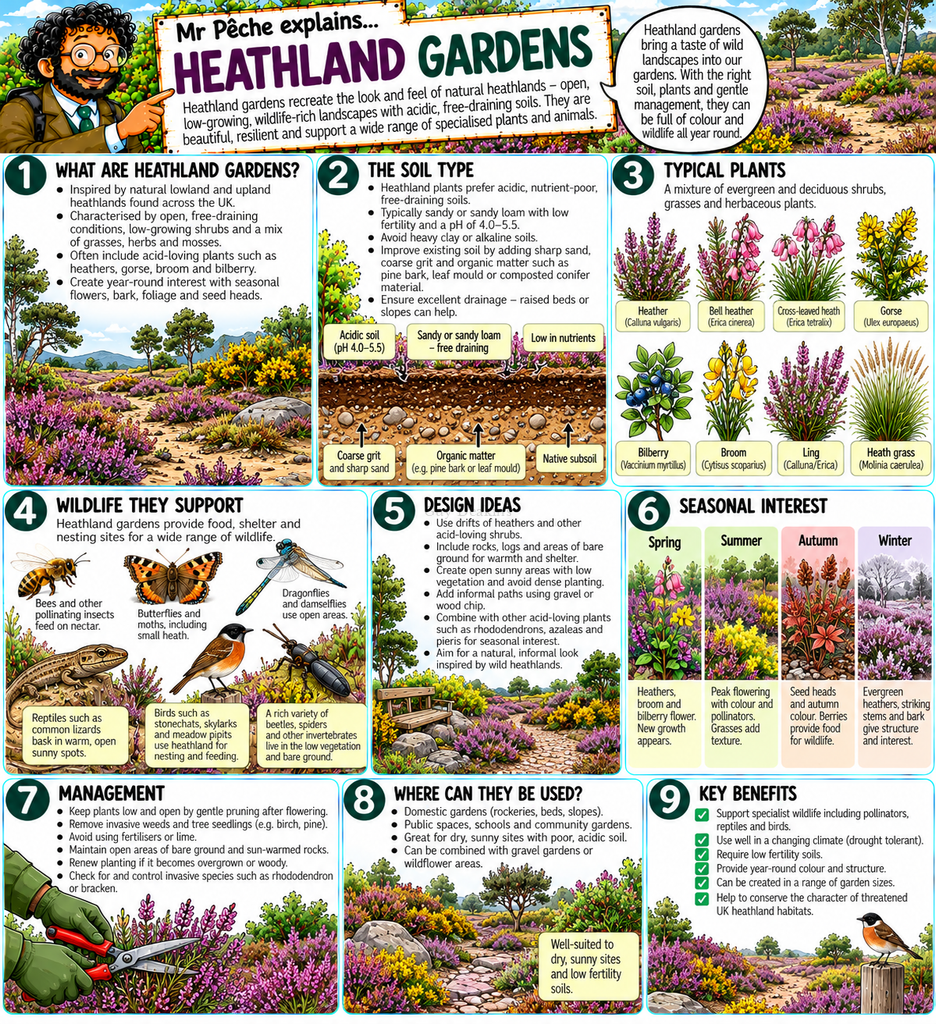
Heathlands are among Britain’s most distinctive and ecologically important habitats. Characterised by low-growing shrubs, heathers, gorse, grasses and areas of exposed soil, they support specialised communities of plants, birds, reptiles and invertebrates.
Although heathlands may appear natural and untouched, many lowland heathlands have developed through centuries of human activity, including grazing, cutting and woodland clearance. Their continued existence often depends upon appropriate conservation management.
Heathland gardens offer opportunities to incorporate the ecological characteristics of these landscapes into horticultural design. They can combine ornamental interest with habitat creation, using plants adapted to relatively infertile soils and open conditions.
The importance of heathland conservation has increased as Britain’s wildlife has declined. Habitat fragmentation, urban development, pollution, inappropriate land management and climate change have placed considerable pressure on species that depend upon these environments.
Recent research from the Royal Society for the Protection of Birds (RSPB) and The Wildlife Trusts demonstrates both the severity of biodiversity loss and the potential for successful conservation through habitat restoration.
1. What Is Heathland?
Heathland is a habitat generally associated with acidic, nutrient-poor soils and vegetation dominated by dwarf shrubs. Characteristic plants include common heather (Calluna vulgaris), bell heather (Erica cinerea) and cross-leaved heath (Erica tetralix).
There are important distinctions between dry heath, wet heath and upland heath. Dry heath generally develops on freely draining, sandy or gravelly soils, while wet heath occurs where drainage is restricted and soil moisture remains relatively high.
Heathlands developed through a combination of environmental conditions and human activity. Grazing, vegetation cutting and other forms of disturbance prevented woodland from becoming established and maintained the open conditions required by many heathland species (The Wildlife Trusts, n.d.).
Heathland is therefore commonly described as a semi-natural habitat. Although its vegetation consists of naturally occurring species, its continued existence often depends upon active management.
2. The Decline of British Heathland
The RSPB estimates that approximately 80% of Britain’s lowland heathland has been lost since the nineteenth century. The Wildlife Trusts provide a broadly comparable estimate of around 85% lost over approximately 150 years, reflecting differences in the periods and definitions used.
Much of this loss resulted from agricultural conversion, conifer plantations, urban development and changes in traditional land management (RSPB, 2026a; The Wildlife Trusts, n.d.).
Habitat loss is particularly damaging when remaining heathlands become isolated. Small populations may have difficulty dispersing between suitable sites, reducing opportunities for recolonisation after local extinction.
Conservation must therefore address not only the condition of individual heathlands but also their size, connectivity and surrounding landscapes.
3. Britain’s Wildlife Decline: The Evidence
The RSPB’s State of Nature 2023 report, produced in partnership with conservation and research organisations, provides a major assessment of the condition of Britain’s biodiversity. Subsequent conservation reporting continues to highlight the need for habitat restoration and stronger environmental protection.
Key findings from the State of Nature 2023 assessment include:
| Indicator | Reported finding |
|---|---|
| Species at risk | Approximately 16% of assessed species in Great Britain are threatened with extinction. |
| Flowering plants | 54% of assessed flowering plant species have declined in their distribution. |
| Invertebrates | Assessed species occur in 13% fewer places on average than in 1970. |
| Habitats | Only a small proportion of assessed UK wildlife habitats were considered to be in good condition. |
These indicators cover different species groups, geographical areas and periods. They should not be interpreted as interchangeable measures of biodiversity loss (RSPB, 2023).
The Wildlife Trusts’ 2026 report, Route Map to Recovery: Fixing Nature in the UK, highlights the gap between current environmental action and the UK’s international biodiversity commitments (The Wildlife Trusts, 2026a).
These findings demonstrate that protecting isolated nature reserves is insufficient on its own. Wildlife recovery requires habitat improvement across the wider countryside, including gardens, public parks, farmland, woodland edges and urban green spaces.

4. Plants for Heathland Gardens
Heathland planting should reflect the environmental conditions and ecological character of the habitat being represented.
Common heather (Calluna vulgaris)
An evergreen dwarf shrub providing late-summer flowers, nectar and structural cover. It is characteristic of many dry heathlands.
Bell heather (Erica cinerea)
Prefers acidic, freely draining conditions and provides summer colour and nectar for visiting insects.
Cross-leaved heath (Erica tetralix)
Associated with damp, acidic soils and suitable for wetter heathland planting where conditions are appropriate.
Common gorse (Ulex europaeus)
Provides flowers, shelter and nesting opportunities. Its size and vigorous growth require careful consideration in smaller gardens.
Other characteristic plants include bilberry (Vaccinium myrtillus), tormentil (Potentilla erecta), heath bedstraw (Galium saxatile) and certain native grasses.
Plant selection should be based on local soil conditions, provenance and ecological suitability. Native plants of local origin are particularly valuable in habitat restoration, although ornamental heathland-inspired gardens may have a broader design purpose.
5. Creating a Heathland Garden
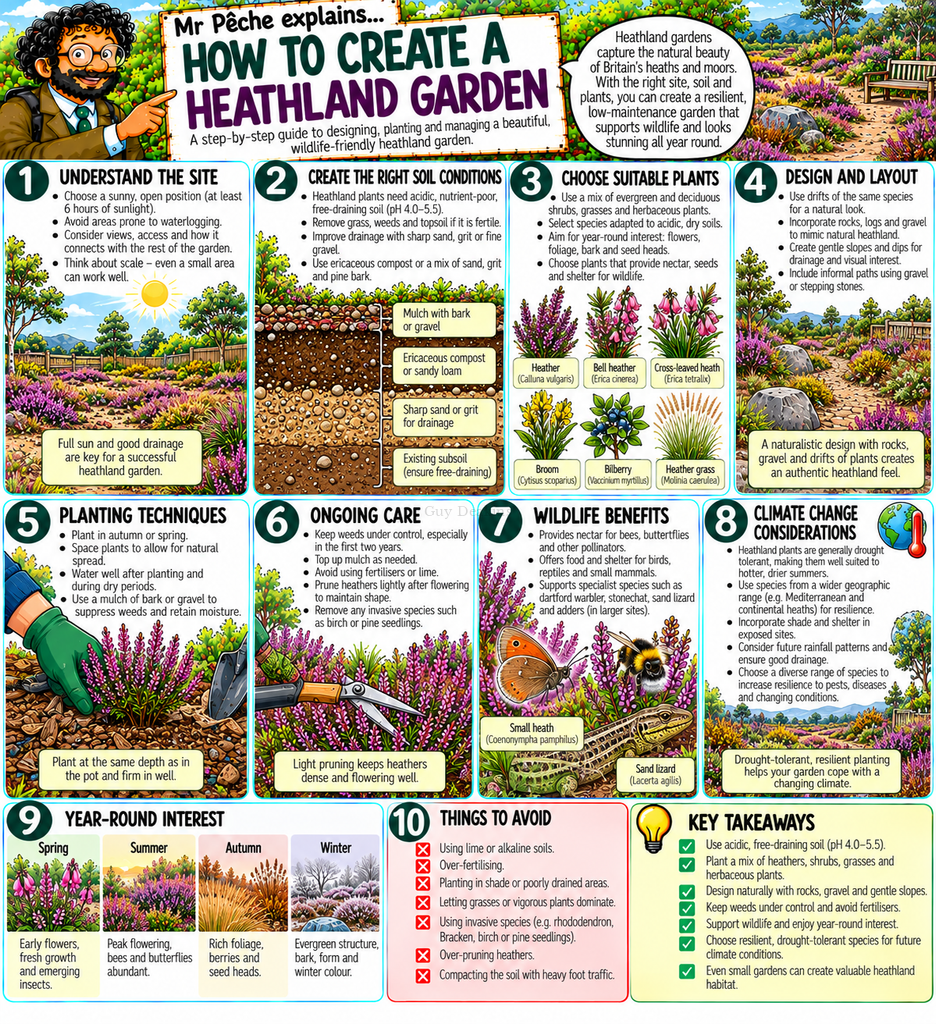
Successful heathland gardening depends primarily upon understanding soil conditions rather than attempting to recreate the appearance of heathland through planting alone.
Most characteristic heathland plants favour relatively low nutrient availability. Adding large quantities of compost, manure or fertiliser may encourage vigorous grasses and competing vegetation rather than the desired dwarf shrubs.
Important design considerations include:
- Soil: Test pH, texture and drainage before selecting plants. Many dry-heath species favour acidic, sandy soils.
- Light: Provide open, sunny conditions, with limited areas of partial shade where appropriate.
- Drainage: Match species to dry or damp conditions rather than imposing one drainage regime throughout.
- Planting: Use varied groups of heathers, gorse and associated native species to create structural diversity.
- Habitat: Retain small areas of bare mineral soil, stones and vegetation of different heights for invertebrates and reptiles where appropriate.
- Management: Avoid unnecessary fertiliser, excessive irrigation and frequent disturbance.
Where existing soil is alkaline or nutrient-rich, it may be more sustainable to develop a heathland-inspired garden using suitable plants than to undertake extensive soil replacement or chemical acidification.
A domestic heathland garden should not be confused with the restoration of an established priority habitat. Restoration requires ecological assessment, appropriate provenance and site-specific management.
6. Heathland Wildlife and Conservation
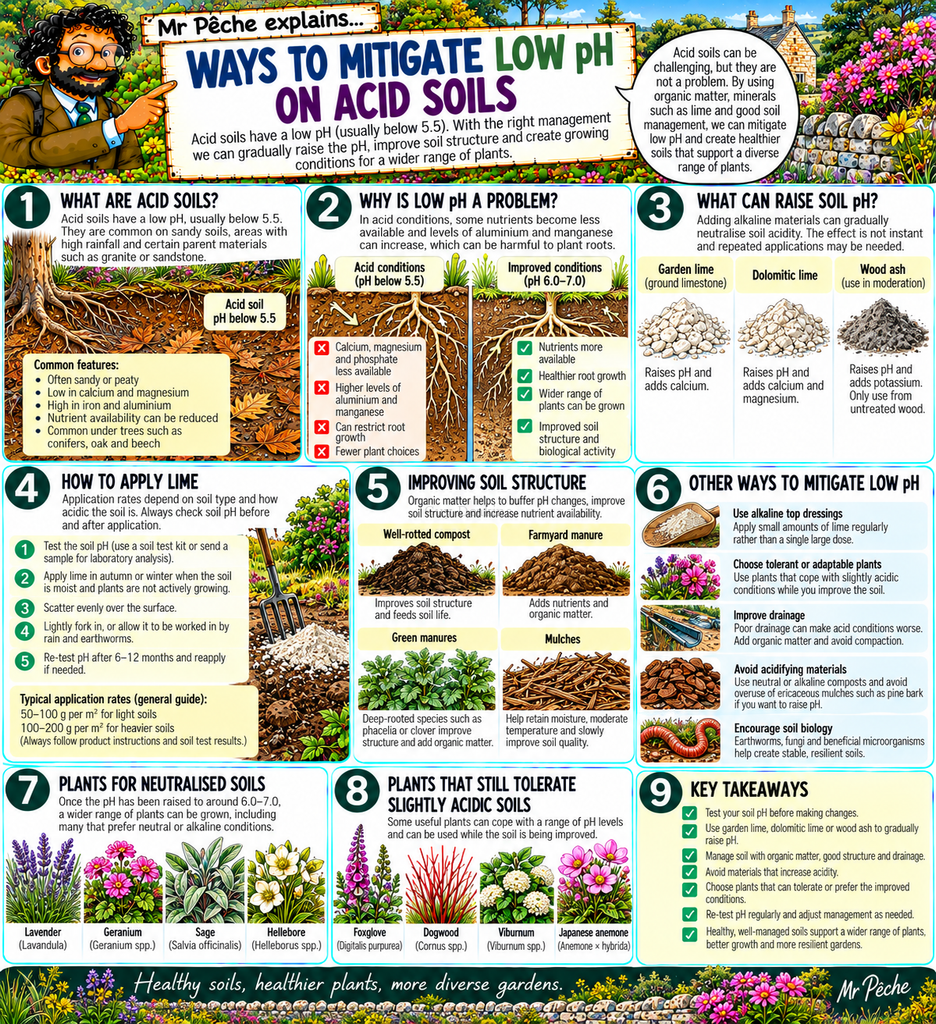
Heathland supports specialised wildlife, including species that depend upon open vegetation, bare ground, warm microclimates and varied shrub heights.
Important examples include:
- Nightjar (Caprimulgus europaeus): A summer migrant that nests on the ground in open heathland and woodland clearings.
- Dartford warbler (Curruca undata): Closely associated with gorse and heather, requiring suitable shrub cover and feeding habitat.
- Sand lizard (Lacerta agilis): A rare reptile that uses warm, open sandy areas for egg-laying and nearby vegetation for shelter.
- Silver-studded blue (Plebejus argus): A butterfly associated with particular heathland conditions, with larvae that interact with ants.
These species illustrate why conservation cannot focus solely on maintaining attractive flowering heather. A successful heathland must provide a mosaic of vegetation ages, heights and exposed ground.
Evidence that conservation can work
The RSPB’s 2026 reporting on the 2025 national heathland bird survey described increases in recorded territories for three important heathland birds:
| Species | Reported increase in territories |
|---|---|
| Dartford warbler | 27% |
| Woodlark | 29% |
| Nightjar | 20% |
The Dartford warbler and woodlark figures were compared with 2006, while the nightjar figure was compared with 2004. These are changes in estimated territories, not percentage increases in all UK wildlife (RSPB, 2026a).
The RSPB also reported 264 pairs of Dartford warblers on its reserves in 2025, the highest recorded total for those reserves. Restoration of former conifer plantations at Farnham Heath and Broadwater Warren has helped recreate habitat for heathland specialists (RSPB, 2026b).
These results demonstrate that targeted habitat management can support species recovery even while national biodiversity trends remain concerning.
7. Heathland Management and Ecological Succession
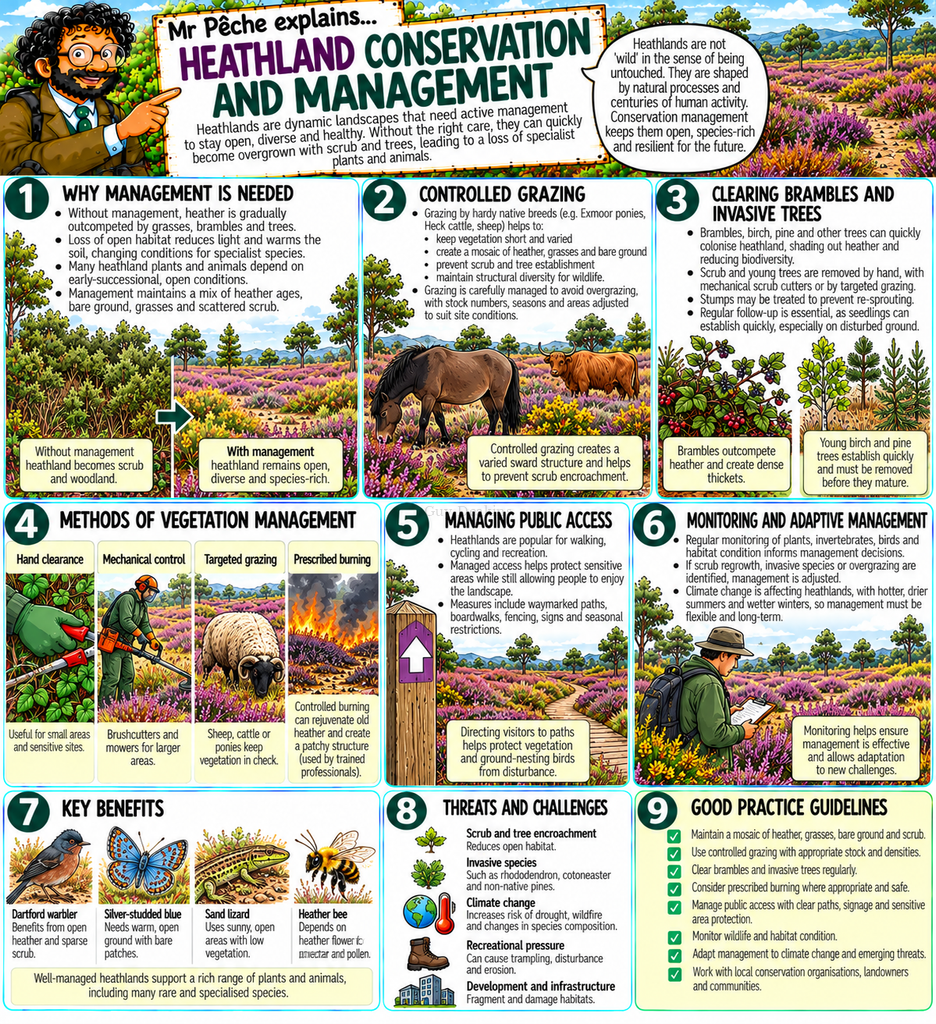
Without suitable management, many lowland heathlands gradually develop into scrub and woodland through ecological succession.
Although woodland is itself a valuable habitat, allowing every heathland to become woodland would result in the loss of species that depend upon open, nutrient-poor conditions.
Conservation management may involve:
- controlled grazing;
- selective scrub removal;
- rotational cutting;
- bracken control;
- the creation of small areas of exposed soil.
The aim is not to maintain every part of a site in an identical condition. Instead, managers seek a mosaic containing young and mature heather, gorse, bare ground, grasses and scattered scrub.
Controlled burning is sometimes used by trained conservation professionals under tightly regulated circumstances. It is not an appropriate routine management method for domestic gardens.
Management should also protect nesting birds, reptiles and other wildlife. Operations must be timed and undertaken in accordance with relevant wildlife legislation, site designations and ecological advice.
8. Climate Change and Heathland Conservation
Climate change presents additional challenges to heathland conservation.
Long periods of drought can dry out vegetation and soils, increasing wildfire risk. Extreme rainfall can affect drainage and erosion, while warmer temperatures may change the distribution of species.
The Wildlife Trusts’ 2025 reporting on climate impacts highlighted the vulnerability of habitats, including heathlands and peat bogs, to drought and heat extremes (The Wildlife Trusts, 2025).
However, climate change does not affect all species in the same way. The RSPB’s heathland reporting has noted that milder winters have helped Dartford warblers recover in Britain, even though climate change threatens significant parts of the species’ wider European range.
This demonstrates why conservation requires long-term monitoring rather than assuming that every species will respond identically to environmental change.
9. The Role of Gardens in Wildlife Recovery
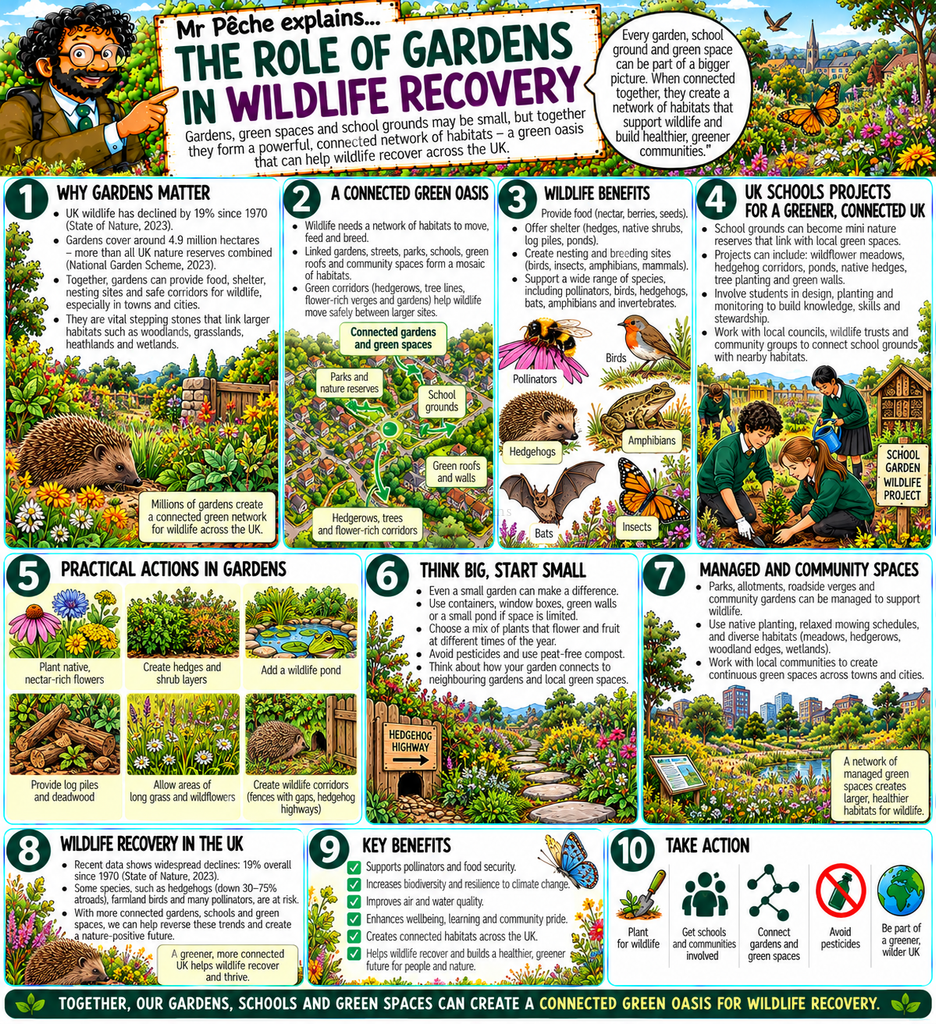
Domestic gardens cannot replace extensive, functioning heathland ecosystems. Nevertheless, gardens can contribute to wider ecological networks by providing flowering plants, shelter, undisturbed ground and opportunities for wildlife movement.
A heathland-inspired garden may be particularly valuable where it adjoins existing heathland or other suitable habitat. In such locations, careful planting and management can complement conservation efforts.
Gardeners can contribute by reducing pesticide use, protecting soil structure, retaining suitable native vegetation and providing varied flowering periods.
It is equally important to recognise the limits of small-scale gardening. Rare heathland species may require extensive territories, particular soil conditions or specialised ecological relationships that cannot be recreated in a domestic setting.
Conservation should therefore operate at several scales: individual gardens, public green spaces, nature reserves and connected landscapes.
Conclusion
Heathland gardens demonstrate the relationship between horticultural design and ecological conservation. Their distinctive planting, open structure and adaptation to nutrient-poor soils provide both ornamental possibilities and opportunities for habitat creation.
Britain’s substantial historical loss of heathland has contributed to the vulnerability of many specialist species. Recent RSPB and Wildlife Trust reporting shows that biodiversity remains under serious pressure, but also provides evidence that carefully planned restoration can reverse declines in particular wildlife populations.
The central principle of heathland conservation is that habitats must be managed for the ecological requirements of the species they support, rather than for appearance alone.
Protecting existing heathland, restoring degraded sites and improving connections between habitats remain essential to the long-term recovery of Britain’s wildlife.
Key Learning Points
- Heathland is generally associated with acidic, nutrient-poor soils and dwarf-shrub vegetation.
- Most British lowland heathland is semi-natural and requires ongoing management.
- Approximately 80–85% of historic lowland heathland has been lost, depending on the assessment.
- Wildlife decline affects plants, invertebrates, birds and other animal groups.
- Heathland conservation requires varied habitat structure, not simply extensive heather planting.
- Conservation surveys demonstrate encouraging recovery in some specialist heathland birds.
- Climate change, habitat fragmentation and inappropriate management remain major challenges.
- Gardens can contribute to habitat networks but cannot substitute for large, functioning heathland ecosystems.
References
Royal Society for the Protection of Birds (RSPB) (2023) State of Nature 2023. Available at: https://www.rspb.org.uk/whats-happening/news/state-of-nature-report (Accessed: 18 October 2026).
Royal Society for the Protection of Birds (RSPB) (2026a) Latest survey reveals good news for three heathland birds. Available through the RSPB website (Accessed: 18 October 2026).
Royal Society for the Protection of Birds (RSPB) (2026b) Wildlife on RSPB nature reserves in 2025: Successes and setbacks. RSPB.
The Wildlife Trusts (n.d.) Heathland and moorland. Available at: https://www.wildlifetrusts.org/habitats/heathland-and-moorland (Accessed: 18 October 2026).
The Wildlife Trusts (2025) New report shows UK nature bearing brunt of chaotic climate. Available through The Wildlife Trusts website (Accessed: 18 October 2026).
The Wildlife Trusts (2026a) Route Map to Recovery: Fixing Nature in the UK. Available through The Wildlife Trusts website (Accessed: 18 October 2026).
Further reading: RSPB and The Wildlife Trusts provide habitat guidance, conservation case studies and updates on British wildlife.